JBRA Assist. Reprod. 2016;20 (1):3-7
ORIGINAL ARTICLE
doi: 10.5935/1518-0557.20160002
Elective single embryo transfer: Is frozen better than fresh?
1NewLife Fertility Center, Mississauga, Ontario, Canada
CONFLICT OF INTERESTS
No conflict of interest have been declared.
ABSTRACT
Objective:
Single embryo transfer (SET) has been recommended to avoid multiple
births following assisted reproductive technology (ART) procedures.
Many studies have shown that frozen embryo transfer may yield better
pregnancy rates than fresh embryo transfer. This study looked into
pregnancy rates following fresh versus frozen single embryo transfer
procedures in age-matched patients.
Methods:
This retrospective case control study was carried out at a private
clinic [NewLife Fertility Clinic, ON, Canada]. Patient groups included
infertile women treated with IVF/ICSI and elective single embryo
transfer (eSET) given either fresh or frozen embryos. Cycle outcomes
were compared between patient groups matched by age. The primary
endpoints were positive testing for ß-hCG and viable ongoing pregnancy.
The secondary endpoints were live birth and miscarriage rates.
Results:
A total of 583 eSET cycles (212 fresh transfer cycles and 371 frozen
transfer cycles) were performed. Significantly higher pregnancy and
live birth rates were observed among patients aged ≤ 39 years given
frozen embryos.
Conclusion: Frozen single
embryo transfer was associated with higher pregnancy and live birth
rates when compared to fresh single embryo transfer.
Keywords: IVF, eSET, Fresh embryo transfer, Frozen embryo transfer, Pregnancy rate
INTRODUCTION
Infertility has been estimated to affect 10–15% of couples in developed nations (Evers, 2002).
Assisted reproductive technology (ART) has been increasingly used to
address this relevant societal issue. Over the past ten years, Canada
has seen a significant increase in the use of ART procedures (Gunby et al., 2011).
The most common side effect of ART is multiple births, an event
associated with higher levels of maternal morbidity, perinatal
morbidity, and mortality of twins (The ESHRE Capri Workshop Group, 2000).
Limiting the occurrence of multiple births while maintaining high
pregnancy rates in patients given IVF is a significant challenge. The
high rates of twin births after IVF stem from the current standard
practice of implanting more than one embryo in each patient. Elective
single embryo transfers have been shown to decrease the occurrence of
multiple births without affecting overall pregnancy rates (Tiitinen et al., 2003). In Canada, the mean rate of multiple births caused by IVF/ICSI of 33% in 2001 (Gunby et al., 2005)
dropped to 18.8% in 2012 (Canadian Fertility and Andrology Society
2013). In Quebec, the government has sponsored eSET and found that the
procedure decreased the number of births from IVF by approximately a
third (Gleicher, 2011). In addition to better
morbidity outcomes, a prospective study revealed that single embryo
transfers yield additional economic benefits. The transfer of a single
good quality embryo is equally effective and less expensive than a
double embryo transfer in women <38 years of age in their first
IVF/ICSI cycle when the cost of maternal and neonatal care given until
the newborn is three months old is considered (Gerris et al., 2004).
The use of cryopreservation programs may help maximize pregnancy rates
while minimizing multiple birth rates. Successful cryopreservation of
human blastocysts allows blastocyst transfers to be performed routinely
in IVF treatments, thus reducing the number of implanted embryos.
Additionally, frozen embryo transfers (FET) may increase both the cumulative pregnancy rates of IVF and ICSI procedures (Lurie et al., 2001) and take-home baby rates (Bergh et al., 1995). Embryos have been successfully cryopreserved in the blastocyst stage using various freezing protocols (Fehilly et al., 1985). Vitrification performed better than slow freezing in terms of post-thawing survival rates (Loutradi et al., 2008).
This study aimed to find the best way to decrease overall multiple
birth rates while maintaining live birth success rates. To this end,
the outcomes of elective single embryo transfers (eSET) using fresh and
frozen embryos of patients matched by age were compared.
MATERIALS AND METHODS
This
retrospective study looked into the outcomes of 583 eSET cycles
performed at the New Life Fertility Clinic from 2009 to 2013. Fresh
embryos were used in 145 and frozen embryos in 310 eSET procedures
performed in patients aged 35 years and under, whereas 67 fresh eSET
and 61 frozen eSET procedures were carried out in patients aged 36-39
years.
The data collected from patients at baseline included demographic
information, number of embryos, embryo quality, and pregnancy rates.
All eSET (fresh and frozen) cycles were performed using non-donor oocytes.
Enrollment criteria:
1. Female individuals under 35 years of age in their first IVF/ICSI cycle with at least two good quality embryos.
2. Female individuals of all ages with at least four good quality embryos (NICE guidelines).
Exclusion criteria:
1. Female individuals with more than one failed treatment cycle.
2. Abnormal uterine cavity findings on sonohysterogram or presence of hydrosalpinx.
The elected primary endpoints were clinical pregnancy and live birth rates.
The patients enrolled in the study gave informed consent to their
participation and to the collection of data concerning IVF/ ICSI,
cryopreservation, number of embryos transferred, and pregnancy
outcomes.
Ovarian Stimulation and Fresh Embryo Transfer
Ovarian stimulation was done using a recombinant or urinary FSH or HMG
combination with GnRH agonist or antagonist. Follicular development was
followed with ultrasound scanning and serial serum hormonal level of
FSH, LH, E2 and progesterone. When more than four follicles above 18 mm
in diameter were identified by transvaginal ultrasound, 10 000 IU of
urinary human chorionic gonadotrophin was given S.C to trigger
ovulation. Guided by transvaginal ultrasound, egg retrieval was done 34
to 36 hours after hCG injection. All mature eggs retrieved were
fertilized either by IVF or ICSI based on the semen quality and the
number of mature eggs retrieved. In fresh transfer cycles, for
luteal-phase support, 600 mg of progesterone was used vaginally started
on the day of oocyte retrieval. Fresh ET,was performed on day 5 or day
6 after oocyte retrieval.
Protocol for Vitrification and Warming
Blastocysts deemed suitable for vitrification on Day 5 were selected.
Artificial shrinkage of fluid volume in blastocysts was performed to
enhance survival rates. Expanded blastocysts with a cavity encompassing
> ½ of the embryo were mechanically collapsed prior to vitrification
using an ICSI needle. The collapsed blastocysts were vitrified using
Cryotop straws and commercially available vitrification solutions
(Kitazato BioPharma Co). Collapsed blastocysts were dipped in
equilibration solution (15% ethylene glycol – EG – plus dimethyl
sulfoxide – DMSO) for seven minutes; then they were placed in a
vitrification solution with 15% EG, 15% DMSO, and 0.5 mmol/L sucrose
for 30 seconds; Cryotop straws were then filled with 1 μl of
vitrification solution. Vitrified embryos were warmed in subsequent
cycles. The Cryotop straws holding the vitrified embryos were removed
from liquid nitrogen and dipped for one second in a thawing solution
containing 1 mol/L sucrose for one minute at 37°C. The embryos were
first equilibrated in Kitazato diluent solution for three minutes at
room temperature and then flushed with washing solution for five
minutes and kept at 37°C for one minute. Culture time for retrieval was
two hours before transfer.
Endometrial Preparation and Frozen Embryo Transfer
In frozen embryo transfer cycles, vitrified-warmed embryo was
transferred either during a natural cycle after confirmed ovulation or
after preparation of the endometrium; using estradiol valerate
[Estrace; Shire Canada Inc, Saint-Laurent, QC] which was administered
orally at a starting dose of 4 mg daily, beginning from day 3 of the
menstrual cycle. After ultrasonography confirmed an endometrial
thickness reaching 8 mm or more with triple line pattern , progesterone
600 mg is initiated. Transfer of day-5 vitrified-warmed top quality
embryo [2AA, 3AA or 4 AA] blastocysts. The quality was based on Gardner
classification system(Gardner and Schoolcraft 1999, Gardner et al. 2000).
In which the components of the blastocysts are graded, and the score
depends on expansion of the embryo’s cavity and goes from 2-6, inner
cell mass grade and trophoectoderm quality [ Table 1].
Assisted hatching is not a common practice at our clinic especially
first ones and If assisted hatching was done on the group of patients
that was included in our study, it would be on a very insignificant
number of patients which will not affect our data analysis. The
transfer was performed under ultrasound guidance using a cook catheter
(COOK IRELAND LTD, Ireland). Luteal-phase support was achieved with
vaginal progesterone 600 mg/day, which was continued daily until
positive serum βhCG concentrations were measured 7 days after transfer,
and the clinical pregnancy rates per embryo transfer procedure and
implantation rates per transferred blastocyst were based on the
detection of fetal heartbeats by ultrasound at 5 weeks after embryo
transfer.
Patients were considered to have had a miscarriage when they lost their fetuses before 20 weeks of gestation (Regan & Rai, 2000).
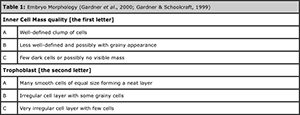
Table 1: Embryo Morphology (Gardner et al., 2000; Gardner & Schoolcraft, 1999)
Statistical Method
Individual data points were collected from the IVF database and entered
into Microsoft Excel 2007 (Microsoft Corporation). Data sets were
described in terms of their mean values and standard deviations.
Comparisons were carried out using the chi-square test. Statistical
significance was attributed to differences with P-values <0.05.
RESULTS
There was a total of 583 eSET cycles, 455 were patients ≤ 35 y. There
was no significant difference in age or the quality of blastocyst
transferred in both groups (2AA, 3AA or 4AA). In the group ≤ 35 y, our
results show a significantly higher pregnancy rate in the frozen group
(73.22%) versus the fresh group (59.31%) (P=
0.003). A higher but non-significant viable pregnancy rate was observed
in the frozen group (55.80%) versus the fresh group (48.96%) (P=0.2).
When live birth was compared between the frozen group and the fresh
cycle group a significant difference was observed (51.93% vs 42.06%) (P=0.05) (Table 2).
In the older age groups [36-39 years] (Table 3),
61 frozen eSET and 67 fresh eSET, there was a significant higher
positive β hCG in the frozen eSET cycles when compared to fresh eSET
(72.13%vs35.82%) (P<0.0001), the clinical pregnancy rate was (52.45%
versus 20.89%) (P= 0.0002). Also, there was a significant higher live birth rate in the frozen eSET cycles (52.45% versus 20.89%) (P=0.0002).

Table 2: Summary of the results found in patients aged 35 years and under [total = 455 cycles]
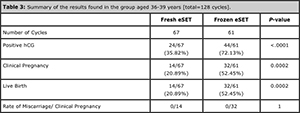
Table 3: Summary of the results found in the group aged 36-39 years [total=128 cycles]
DISCUSSION
This study aimed to assess the pregnancy rates derived from fresh and
frozen single embryo transfer cycles. Elective SET has been defined by
the Society for Assisted Reproductive Technology (SART) as the transfer
of one embryo despite the availability of multiple high quality embryos
(Practice
Committee of the Society for Assisted Reproductive Technology &
Practice Committee of the American Society for Reproductive Medicine,
2012; Regan & Rai, 2000; Gardner et al., 2000; Gardner & Schoolcraft, 1999). (Gerris et al., 1999)
carried out the first randomized trial in which elective single-embryo
transfer (SET) and double-embryo transfer procedures were compared.
Another study (Lundin & Bergh, 2007) compared
the cumulative pregnancy rates of eSET versus double embryo transfers
and reported similar results. Elective SET combined with subsequent
frozen-thawed embryo transfer was shown to produce high pregnancy rates
and a decrease in multiple births.
Pregnancies resulting from the
use of IVF eSET had reportedly decreased risk of low birth weight and
prematurity when compared to DET, but higher risk of prematurity,
placenta previa, gestational diabetes, and ectopic pregnancy than
spontaneous pregnancies (Grady et al., 2012).
Successful implantation, pregnancy, and embryo development require
synchronization between a receptive endometrium and the embryo (Perrier d’Hauterive et al., 2007; Dal Prato et al., 2002).
Despite the advancements seen in IVF, implantation failure remains an
unsolved problem in reproductive medicine and is considered a major
cause of recurrent IVF failure in otherwise healthy women. The mean IVF
cycle implantation rate is around 25% (de los Santos et al., 2003). Many authors have shown that endometrial receptivity can be adversely affected by controlled ovarian stimulation (Haouzi et al., 2009). Others have found that the endometrium is usually more receptive in natural non-stimulated cycles (Fatemi et al., 2010)
and that avoiding fresh embryo transfers and freezing all embryos
destined for transfer might improve the safety and effectiveness of IVF
and ICSI cycles (Maheshwari & Bhattacharya, 2013). The hypothesis, therefore, was that frozen embryo transfers could yield better success rates than fresh embryo transfers.
Based on these studies, starting in 2012 our patients were offered a
protocol comprised of cryopreservation of their good quality embryos
followed by single-embryo transfers through frozen-thawed embryo
transfer cycles.
This study compared the outcomes reported for the protocol based on
fresh embryo transfer cycles previously in effect at our clinic and the
outcomes of the new protocol in effect since 2012.
Top quality frozen embryos (2AA, 3AA or 4 AA) in terms of morphology at freezing (Hartshorne et al., 1990) and lack of damage after thawing (Salumets et al., 2006)
were used in this program. Embryo morphological traits were preserved
after thawing when high-quality characteristics existed before FET (Veleva et al., 2013).
Blastocyst transfer (BT) is effective at improving implantation and
clinical pregnancy rates and yields better clinical outcomes (Cruz et al., 1999).
In our study, the pregnancy rates of vitrified-warmed blastocysts were
significantly higher than the rates seen with fresh blastocyst transfer
(BT) cycles in both ≤ 35 year-old and 36-39 year-old patient groups
(73.22% vs. 59.31%, P=0.003; and 72.13% vs. 32.82%, P=<0.0001).
The ongoing pregnancy rate in the vitrified-warmed blastocysts
significantly higher only in the 36-39 year-old group (55.80 % vs.
48.96%; P= 0.2), in patients aged 35 years and under (52.45% vs. 20.89%; P= 0.0002), and in the 36-39 year-old group (Zhu et al., 2011; Veleva et al., 2006; Niinimaki et al., 2013).
SET using top quality embryos could serve as a predictor of early pregnancy outcome (De Neubourg et al., 2004).
In the present study, LBR in the group with top quality frozen embryos
was significantly higher when compared to the group given fresh embryo
transfers group in patients aged 35 years and under [51.93% vs. 42.06%;
P=0.05) and in the group aged 36-39 years [52.45% vs. 20.89%; P= 0.0002).
SET using good quality frozen blastocysts reduces the incidence of
ectopic pregnancies and twin births while maintaining comparable
pregnancy rates (Yanaihara et al., 2008).
No cases of ectopic pregnancy and only three twin births were observed in the population included in our study.
This descriptive study faces methodological limitations and calls for
the organization of randomized prospective trials to corroborate the
results reported herein.
In conclusion, the results of this study demonstrate the superiority of
the frozen eSET cycle over a fresh eSET and it can be performed with
good pregnancy outcome in all age groups, which will result in a
further decline in the twin pregnancy rate.
REFERENCES
Bergh
C, Josefsson B, Nilsson L, Hamberger L. The success rate in a Swedish
in-vitro fertilization unit: a cohort study. Acta Obstet Gynecol Scand.
1995;74:446-50.
Medline Crossref
Cruz
JR, Dubey AK, Patel J, Peak D, Hartog B, Gindoff PR. Is blastocyst
transfer useful as an alternative treatment for patients with multiple
in vitro fertilization failures? Fertil Steril. 1999; 72:218-20.
Medline Crossref
Dal
Prato L, Borini A, Cattoli M, Bonu MA, Sciajno R, Flamigni C.
Endometrial preparation for frozen-thawed embryo transfer with or
without pretreatment with gonadotropin-releasing hormone agonist.
Fertil Steril. 2002;77:956-60.
Medline Crossref
de
los Santos MJ, Mercader A, Galán A, Albert C, Romero JL, Pellicer A.
Implantation rates after two, three, or five days of embryo culture.
Placenta. 2003; 24:S13-9.
Medline Crossref
De
Neubourg D, Gerris J, Mangelschots K, Van Royen E, Vercruyssen M,
Elseviers M. Single top quality embryo transfer as a model for
prediction of early pregnancy outcome. Hum Reprod. 2004; 19: 1476-9.
Medline Crossref
Evers JL. Female subfertility. Lancet. 2002;360:151-9.
Medline Crossref
Fatemi
HM, Kyrou D, Bourgain C, Van den Abbeel E, Griesinger G, Devroey P.
Cryopreserved-thawed human embryo transfer: spontaneous natural cycle
is superior to human chorionic gonadotropin-induced natural cycle.
Fertil Steril. 2010;94:2054-8.
Medline Crossref
Fehilly
CB, Cohen J, Simons RF, Fishel SB, Edwards RG. Cryopreservation of
cleaving embryos and expanded blastocysts in the human: a comparative
study. Fertil Steril. 1985;44:638-44.
Medline
Gardner DK, Schoolcraft WB. Culture and transfer of human blastocysts. Curr Opin Obstet Gynecol. 1999;11:307-11.
Medline
Gardner
DK, Lane M, Stevens J, Schlenker T, Schoolcraft WB. Blastocyst score
affects implantation and pregnancy outcome: towards a single blastocyst
transfer. Fertil Steril. 2000;73:1155-8.
Medline Crossref
Gerris
J, De Neubourg D, Mangelschots K, Van Royen E, Van de Meerssche M,
Valkenburg M. Prevention of twin pregnancy after in-vitro fertilization
or intracytoplasmic sperm injection based on strict embryo criteria: a
prospective randomized clinical trial. Hum Reprod. 1999;14:2581-7.
Medline Crossref
Gerris
J, De Sutter P, De Neubourg D, Van Royen E, Vander Elst J, Mangelschots
K, Vercruyssen M, Kok P, Elseviers M, Annemans L, Pauwels P, Dhont M. A
real-life prospective health economic study of elective single embryo
transfer versus two-embryo transfer in first IVF/ICSI cycles. Hum
Reprod. 2004;19:917-23.
Medline Crossref
Gerris JM. Single embryo transfer and IVF/ICSI outcome: a balanced appraisal. Hum Reprod Update. 2005; 11:105-21.
Medline Crossref
Gleicher
N. Eliminating multiple pregnancies: an appropriate target for
government intervention? Reprod Biomed Online. 2011;23:403-6.
Medline Crossref
Grady
R, Alavi N, Vale R, Khandwala M, McDonald SD. Elective single embryo
transfer and perinatal outcomes: a systematic review and meta-analysis.
Fertil Steril. 2012; 97:324-31.
Medline Crossref
Gunby
J, Daya S, IVF Directors Group of the Canadian Fertility and Andrology
Society. Assisted reproductive technologies (ART) in Canada: 2001
results from the Canadian ART Register. Fertil Steril. 2005; 84:590-9.
Medline Crossref
Gunby
J, Bissonnette F, Librach C, Cowan L, IVF Directors Group of the
Canadian Fertility and Andrology Society. Assisted reproductive
technologies (ART) in Canada: 2007 results from the Canadian ART
Register. Fertil Steril. 2011;95:542-7.e1-10.
Medline Crossref
Haouzi
D, Assou S, Mahmoud K, Tondeur S, Rème T, Hedon B, et al. Gene
expression profile of human endometrial receptivity: comparison between
natural and stimulated cycles for the same patients. Hum Reprod.
2009;24:1436-45.
Medline Crossref
Hartshorne
GM, Wick K, Elder K, Dyson H. Effect of cell number at freezing upon
survival and viability of cleaving embryos generated from stimulated
IVF cycles. Hum Reprod. 1990;5(7):857-61.
Medline
Loutradi
KE, Kolibianakis EM, Venetis CA, Papanikolaou EG, Pados G, Bontis I,
Tarlatzis BC. Cryopreservation of human embryos by vitrification or
slow freezing: a systematic review and meta-analysis. Fertil Steril.
2008;90:186-93.
Medline Crossref
Lundin
K, Bergh C. Cumulative impact of adding frozen-thawed cycles to single
versus double fresh embryo transfers. Reprod Biomed Online.
2007;15:76-82.
Medline Crossref
Lurie
D, Check JH, Nazari A, Choe JK, Lee G. Cumulative pregnancy rates after
four embryo transfers of either fresh or frozen embryos. Clin Exp
Obstet Gynecol. 2001;28:148-52.
Medline
Maheshwari A, Bhattacharya S. Elective frozen replacement cycles for all: ready for prime time? Human Reproduction. 2013;28:6-9.
Medline Crossref
Niinimaki
M, Suikkari AM, Makinen S, Soderstrom-Anttila V, Martikainen H.
Elective single-embryo transfer in women aged 40-44 years. Hum Reprod.
2013;28:331-5.
Medline Crossref
Perrier
d’Hauterive S, Berndt S, Tsampalas M, Charlet-Renard C, Dubois M,
Bourgain C, Hazout A, Foidart JM, Geenen V. Dialogue between blastocyst
hCG and endometrial LH/hCG receptor: which role in implantation?
Gynecol Obstet Invest. 2007; 64:156-60.
Medline Crossref
Practice
Committee of Society for Assisted Reproductive Technology, Practice
Committee of American Society for Reproductive Medicine. Elective
single-embryo transfer. Fertil Steril. 2012; 97:835-42.
Medline Crossref
Regan
L, Rai R. Epidemiology and the medical causes of miscarriage.
Baillieres Best Pract Res Clin Obstet Gynaecol. 2000;14:839-54.
Medline Crossref
Salumets
A, Suikkari AM, Mäkinen S, Karro H, Roos A, Tuuri T. Frozen embryo
transfers: implications of clinical and embryological factors on the
pregnancy outcome. Hum Reprod. 2006; 21:2368-74.
Medline Crossref
The ESHRE Capri Workshop Group. Multiple gestation pregnancy. Hum Reprod. 2000;15:1856-64.
Medline Crossref
Tiitinen
A, Unkila-Kallio L, Halttunen M, Hyden-Granskog C. Impact of elective
single embryo transfer on the twin pregnancy rate. Hum Reprod.
2003;18:1449-53.
Medline Crossref
Veleva
Z, Orava M, Nuojua-Huttunen S, Tapanainen JS, Martikainen H. Factors
affecting the outcome of frozen-thawed embryo transfer. Hum Reprod.
2013;28:2425-31.
Medline Crossref
Veleva
Z, Vilska S, Hydén-Granskog C, Tiitinen A, Tapanainen JS, Martikainen
H. Elective single embryo transfer in women aged 36-39 years. Hum
Reprod. 2006;21:2098-102.
Medline Crossref
Yanaihara
A, Yorimitsu T, Motoyama H, Ohara M, Kawamura T. Clinical outcome of
frozen blastocyst transfer; single vs. double transfer. J Assist Reprod
Genet. 2008;25:531-4.
Medline Crossref
Zhu
D, Zhang J, Cao S, Heng BC, Huang M, Ling X, Duan T, Tong GQ.
Vitrified-warmed blastocyst transfer cycles yield higher pregnancy and
implantation rates compared with fresh blastocyst transfer cycles--time
for a new embryo transfer strategy? Fertil Steril. 2011;95:1691-5.
Medline Crossref