JBRA Assist. Reprod. 2016;20 (1):27-32
ORIGINAL ARTICLE
doi: 10.5935/1518-0557.20160007
The impact of age on blastocyst scoring after single and double embryo transfers
1Department of Morphological Sciences, ICBS, Federal University of Rio Grande do Sul, Porto Alegre, RS, Brazil.
2Nilo Frantz Human Fertility Center, Porto Alegre, RS, Brazil.
This study was presented in the 19o SBRA Meeting, August, 2015.
CONFLICT OF INTERESTS
No conflict of interest have been declared.
ABSTRACT
Objective:
The aim of the present study was to assess the putative relationship
between patient’s age and blastocyst scores, in single (SET) or double
(DET) transfer cycles, that resulted in single or twin pregnancy or
non-pregnancy. Second, we analyzed the effect of maternal age on
clinical gestation and implantation rates after single and double
blastocyst transfers.
Methods: Retrospective analysis of 164 assisted reproduction cycles with embryo transfers.
Results:
Data demonstrated that for both, young (<35 years of age) and older
(≥35 years of age) women, trophectoderm (TE) score is the most
important parameter to assess concerning embryo selection. However,
inner cell mass (ICM) also plays an important role on blastocyst
selection in the group of older patients. In addition, our data shows
that for young women the transfer of a single blastocyst results in
similar gestational rates as those for DET.
Conclusion:
We suggest that blastocyst grading for patients aged 35 years or above
shall be performed using a strict grading policy, possibly not of a
single parameter, but TE, ICM and expansion grades together, to choose
the “best combined-score blastocyst”. DETs should be considered,
particularly after previous cycles with pregnancy failures.
Keywords: Maternal age, blastocyst score, SET, DET.
INTRODUCTION
Despite the risks of multiple implantation and gestation, most IVF
clinics around the world do not perform SET for fear of dropping their
implantation and pregnancy rates. Successful SET cycles represent the
gold standard of an ART Institution. Success on a SET cycle depends
primarily on the choice of the best embryo to be transferred. Since the
advent of embryo culture to the blastocyst stage, “natural” in vitro
selection takes place in the laboratory. Considering that not all
cleavage stage embryos reach the blastocyst stage, they are naturally
eliminated from the cohort of putative candidates for transfer.
Although there is the possibility that a patient may have no embryo for
transfer, embryos that reach the blastocyst stage on days 5 or 6, have
higher likelihoods of implantation and pregnancy after transfer
(Gradner et al.,
1999). On the other hand, it is not uncommon for patients to have more
than one or two blastocysts on days 5 or 6 to transfer or to
cryopreserve. Again, a selection must take place to choose the embryo
with the highest likelihoods of implantation and gestation. Frequently,
embryo selection is based on morphological parameters. Possibly, the
most widely used blastocyst scoring system is the one proposed by Gardner & Schoolcraft (2000),
which takes into account three scores for each embryo: its ICM and TE
quality and, finally, the blastocyst expansion/hatching (EH) status.
Not surprisingly, better implantation and live birth rates were
obtained when transferred blastocysts presented top grading for all
three scores. Considering that the developing embryo, gastrula and
eventually fetus will develop from the ICM, it was reasonable to ponder
that the inner cell mass score was the major criterion to be taken into
account when choosing one embryo from a group of blastocysts with
similar grading for the three scores. However, a recent study on single
blastocyst transfer, showed that TE quality was the single most
important parameter for a successful pregnancy and live birth (Ahlström et al., 2011).
Subsequently, the same group of authors reported that similar
blastocyst quality criterion should be used in frozen embryo transfers (Ahlström et al., 2013).
In this case however, in addition to trophectoderm quality, the degree
of blastocoel re-expansion post-cryopreservation, also played an
important role in the prediction of live births.
One point that was
not taken into account in those studies was the age of the patients,
when blastocyst scores were evaluated (Ahlström et al., 2011; 2013). In a previous study on early embryo development (Bos-Mikich et al., 2001)
we observed that the occurrence of the early cleavage (EC) phenomenon
depended on maternal age. Early cleavage embryos with the highest
implantation and gestation rates occurred more frequently in younger
women. Other studies have already shown the effects of maternal age on
hormonal treatment to induce follicular growth, ovulation induction,
zygote and embryo quality, implantation and gestation rates (Van Kooij et al., 1996; Lass et al., 1998; Schoolcraft et al., 1999; Schoolcraft et al., 2000; Wittemer et al., 2000). The original study from Gardner et al. (1999)
did not find any statistical difference in age between the three groups
of patients that presented one, two or none top grade blastocysts.
However, the overall mean age of the patients was quite young, around
33 years old. The number of patients older than 35 years grows
continuously in Assisted Reproduction (AR) programs.
Thus, it is
important to assess the impact of maternal age on blastocyst quality in
this population of women, in order to best advise them on their
treatment and pregnancy probabilities with extended embryo culture.
The aim of the present study was to assess the impact of the three blastocyst scores (Gardner & Schoolcraft, 2000)
on gestation rates, after single and double embryo transfers of fresh
and vitrified blastocysts taking into account maternal age. The effect
of maternal age on chemical and clinical gestation and implantation
rates after single or double blastocyst transfers was also analyzed.
MATERIALS AND METHODS
In this
retrospective study, fresh and cryopreserved cycles of Assisted
Reproduction were analyzed, in which patients received a single or two
blastocyst(s), between 2012 and 2014. Only cycles in which blastocyst
grading scores were recorded clearly were included. Exclusion criteria
included patient incomplete records, no gestational information or
blastocyst images of poor quality. Clinical gestation and implantation
rates were analyzed for SET and DET, the patients were divided into
four age groups (<35, 35-37, 38-39, 40-42 years old; Morin et al., 2014).
To analyze the impact of ICM, TE and EH scores on clinical gestation
rates for SET or DET cycles that resulted in single (SETs) or twin
(DETs) pregnancies, or non-gestations, patients were divided into two
groups: < 35 and ≥35 years of age.
Stimulation protocol and embryo transfer
Pituitary suppression was achieved using GnRh antagonist and ovarian
stimulation was achieved using recombinant FSH or hMG. When at least
one follicle reached 18mm in diameter, patients received a single dose
of hCG. Oocyte collection was performed 36 hours after hCG
administration and insemination was performed by intracytoplasmic sperm
injection (ICSI). Embryo transfer was performed on days 5 or 6 if one
or two good quality blastocysts were available. One or two embryos with
the best score were transferred either on day 5 or day 6
post-insemination. The study outcomes were positive serum βhCG test and
clinical pregnancy, which was defined as the presence of intrauterine
gestational sac containing one embryo with a functioning heart.
Embryo culture and blastocyst scoring
Embryos were cultured from the pronuclear to the blastocyst stage in
Global®medium supplemented with 20% SSS. On the morning of day 5 or 6
of culture, the number of blastocysts was recorded. Blastocysts from
each patient were photographed prior to transfer. For the
vitrified/rewarmed embryos, pictures were taken on the day of rewarming
and transfer. For grading, blastocysts were classified using Gardner & Schoolcraft (2000)
scoring system. By using this scoring method, embryos received a score
from 1 to 6 according to their EH status, with grade “6” related to
hatching blastocysts. ICM and TE were given scores A, B or C, with
scores A and B corresponding to the best organized ICMs and
trophectoderm cells forming a continuous epithelium.
Grade C
related to very small or scattered ICM cells and few and large
trophectodermal cells. A single embryologist performed the blastocyst
scores. In order to make a correlation between maternal age, clinical
gestation and blastocyst scoring, only SETs and DETs, in which 2 or 0
gestational sacs detected by US were considered for analysis.
Cryopreservation
After transfer, surplus embryos that reached the blastocyst stage at days 5 or 6 were vitrified by cryoloop (Mukaida et al., 2001) using the Cryotech Vitrification Kit, and rewarmed according to the “Cryo top” technique.
Outcome measures and Statistical Analysis
Implantation (IR), Chemical (β-hCG) and clinical pregnancy (CPR) rates
were tabulated and compared for fresh and cryopreserved transfers for
patients in the SET and DET groups. Blastocyst scores were assessed on
SET and DET in pregnant and non-pregnant women, divided in 2 age
groups: <35 and ≥35 years old.
Differences between groups were assessed by two-tailed Fisher exact-test. A difference of P<0.05 was considered statistically significant.
RESULTS
A total of 35 fresh and 129 cryopreserved single and double blastocyst transfers were retrospectively analyzed.
For two cycles of cryopreserved embryo transfers, no gestational sac US
data was registered, so they were excluded from the implantation rate
and blastocyst score analysis.
Chemical and clinical gestation and implantation rates
Results showed that patients aged <35 years presented similar
chemical, clinical and implantation rates for fresh or cryopreserved,
single or double blastocyst transfers (Tables 1 and 2).
No fresh SET was performed for patients aged 35 years or older, because of clinic policy.
For patients aged 35-37 years, the transfer of a single cryopreserved
embryo resulted in significantly lower chemical, clinical and
implantation rates compared with the transfer of two cryopreserved
embryos (P<0.001).
For patients aged 38-39 and 40-42 years old, the cryopreserved SETs did not result in any gestation.
Double blastocyst transfers resulted in no significant differences in
chemical, clinical and implantation rates for fresh and cryopreserved
cycles, for patients aged <35 compared with patients aged 35-37,
38-39 and 40-42 years (Table 2).
For patients aged 38-39 and 40-42 years, cryopreserved DETs resulted in
chemical (73% and 50%, respectively) and clinical (50% and 40%,
respectively) gestations with fairly good implantation (35% and 20%,
respectively) rates.
Twin gestations
No twin gestation was detected for patients in fresh or cryopreserved SETs (Table 1).
Fresh and cryopreserved DETs resulted in high twin-pregnancy rates. No
significant differences were observed between groups regarding
twin-pregnancy rates (Table 2).
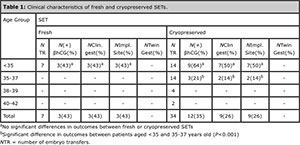
Table 1: Clinical characteristics of fresh and cryopreserved SETs.
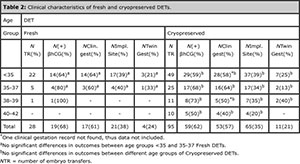
Table 2: Clinical characteristics of fresh and cryopreserved DETs.
Blastocyst scoring
For the analysis of the putative effect of maternal age on blastocyst
scores and pregnancy rates, blastocysts from pregnant and non-pregnant
patients that had SET or DET (with 2 or 0 gestational sacs) were
analyzed and grouped into two groups: <35 or ≥35 years of age
(Tables 3 and 4).
In fresh cycles, blastocyst grading did not show a significant
difference in distribution of EH, ICM and TE scores between pregnant
and non-pregnant women for both age groups (Table 3).
Interesting to notice, was the fact that embryos presenting the lower
expansion scores (1 or 2) showed a trend to higher frequencies in the
group of non-pregnant patients (Tables 3 and 4). Among patients aged
<35 years, the comparison between pregnant and non-pregnant women in
cryopreserved cycles showed a significant difference in the
distribution of expansion and trophectoderm scores, but not of ICM (Table 4).
In contrast, in the group of older patients (≥35yrs), significant
differences in the distribution of ICM and trophectoderm scores, but
not in expansion score between pregnant and non-pregnant women.
Trophectoderm scores were highly significant for both age groups. The
majority of blastocysts that resulted in pregnancy received TE scores
“A” or “B”, whereas the majority of the embryos transferred to patients
that did not achieve a gestation received a score “C” TE (Table 4).
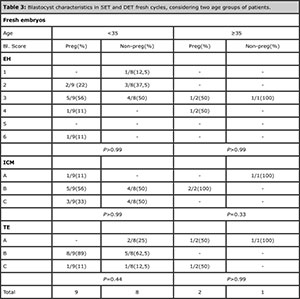
Table 3: Blastocyst characteristics in SET and DET fresh cycles, considering two age groups of patients.
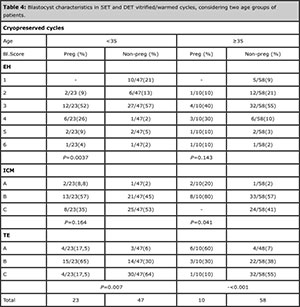
Table 4: Blastocyst characteristics in SET and DET vitrified/warmed cycles, considering two age groups of patients.
DISCUSSION
Our results show that for women aged <35 years the transfer of a
single fresh or cryopreserved blastocyst results in pregnancy and
implantation rates similar to the transfer of two. This is a very
reassuring result that should be taken into consideration, when
performing AR Technologies in this group of patients, to avoid multiple
gestations and their undesired consequences. Similar results have
already been published for this age group (Koryntová et al., 2005; Yang et al., 2012; Chai et al., 2014).
The present study divided patients into four age groups as recent
reports have been using this system when describing women´s fertility
status (Morin et al., 2014). In contrast to the data reported by Wen et al. (2013),
SET of cryopreserved blastocysts for patients aged 35-37 years old
resulted in a significantly lower chemical and clinical gestation and
implantation rates compared with the younger group of patients (<35
years of age). The reason for this discrepancy may be the fact that the
authors grouped young women (<35 years) together with patients aged
37-38 years old, enhancing average pregnancy and implantation rates, in
comparison with the group of patients aged >38years.
Ideally, AR
cycles should perform a genetic screening before SET, regardless
whether fresh or cryopreserved embryos are being transferred, for all
patients, to further increase their implantation and clinical gestation
chances (Capalbo et al., 2014).
However, genome amplification techniques are expensive and not
available on site for the majority of the IVF Institutions. Thus the
use of strong morphology parameters for embryo grading still has its
place on embryo selection prior to transfer.
The relevance of each
of the three blastocyst scores for embryo selection has been a matter
of discussion in the literature. A recent publication using simple
logistic analysis (Van den Abbeel et al., 2013)
found that, contrary to strong evidences showing that the most
important parameter, when choosing a blastocyst for transfer, is its
trophectoderm score (Ahlström et al., 2011; Hill et al., 2013; Honnma et al., 2012),
blastocyst expansion is the most powerful marker of successful
implantation and gestation to term. Our data partially agrees with the
last authors. A significant difference was observed in the distribution
of expansion scores, between pregnant and non-pregnant patients, in the
<35 age group that received cryopreserved embryos. In this
particular group of patients, a higher proportion of blastocysts
presented expansion/hatching scores 4, 5 and 6 (more expanded or
hatching blastocysts), when compared to blastocysts transferred to
patients that did not achieve pregnancy. However, as mentioned above,
it has been credited that among the three blastocyst scores,
trophectoderm is the most important parameter to be taken into account
when performing blastocyst transfers. TE grading, but not ICM or EH
grading, significantly correlated with implantation and live births for
single-blastocyst transfers (Ahlström et al., 2011; Hill et al., 2013; Honnma et al., 2012).
The present analysis also showed a trend towards TE grades A or B, in
patients that reached pregnancy. In addition, significant differences
in TE scores were observed in cryopreserved cycles, between pregnant
and non-pregnant women, for both age groups. However, ICM grading
showed a significant trend towards scores “A” and “B” (more compacted
and organized ICM cells) in the group of pregnant women aged ≥35 years,
that received two cryopreserved blastocysts. It is an interesting
observation, because the same effect was not observed among the
blastocysts transferred in the group of younger patients, as described
in previous studies, most of which did not take into account patients
age. Considering that we did not notice a decline in the implantation
rates among older women, our results may suggest that a good quality
ICM plays a more important role in establishing a successful gestation
in older patients (≥35 years of age), because their overall embryo
quality is diminished, as oocyte quality declines with aging. Thus,
cells from the ICM are intrinsically less viable in these blastocysts
and their number, morphology and aggregation are important factors to
promote subsequent gastrulation and fetal development, once
implantation has taken place. On the contrary, ICM cells derived from a
fertilized oocyte retrieved from a young patient (<35 years of age)
may intrinsically be more robust and capable of further development
into successful implantation and fetal life, even if they are present
in a scattered pattern and small numbers (lower ICM scores). However,
as is the case for older patients, blastocysts generated from young
patients presenting low or high ICM scores have to show a good quality
TE, to ensure first a successful implantation.
Some limitations of
the present study should be mentioned. First, embryo scoring is a
subjective assessment, which may include inter-observer variations,
when the same embryo is analyzed by different embryologists. Also, the
number of patients in groups aged above 38 years is considerably
smaller than in the younger groups, when pregnancy and implantation
rates after SETs and DETs were analyzed. Last, the number of patients
was considerably smaller in the older group in fresh cycles, when
blastocyst scores were related to pregnancy or non-pregnancy. However,
these limitations do not apply to the clear effect of inner cell mass
quality in establishing pregnancy in women older than 35 years of age,
in cryopreserved cycles.
No twin gestation in fresh or cryopreserved SETs was detected,
emphasizing the safety of single transfers to avoid multiple
gestations. On the other hand, DETs yielded twin gestation rates
between 13% and 40% for all age groups below 40 years, fresh and
cryopreserved blastocyst transfers. Wen et al., (2013)
reported no multiple pregnancies in SETs and a rate between 19.5 and
13.4% for fresh and frozen DETs, respectively. These numbers emphasize
the need to avoid DETs in young patients and our data goes further to
show that in patients aged 38-39 years, there is still a very high
chance (40%) of twinning, after the transfer of two cryopreserved
blastocysts. In agreement with our data, no multiple births were
observed after elective SET, compared with 35% after elective DET in
the study by Prados et al. (2014). Thus,
blastocyst DETs should be performed only in particular instances, as in
cases of previous gestation failures following single good quality
blastocyst transfer and for women aged above 40 years. One interesting
aspect to point out from the last report (Prados et al., 2014)
is the fact that despite the increased risks of gestational and
neonatal problems associated with twin pregnancies, nearly half the
patients refused elective SET even after having been well informed
about its benefits.
In conclusion, regarding the effect of maternal
age on blastocyst scores and transfer outcomes, we may say that for
young (<35 years) or older (≥35 years) patients the trophectoderm
score is the most relevant parameter to be taken into account, when
performing blastocyst selection. In addition, inner cell mass seems to
be an important marker of blastocyst quality and pregnancy potential in
older women (≥35 years). This is a new finding not reported previously,
as former authors did not segregate embryos according to patient´s age,
when assessing the impact of each blastocyst score on their pregnancy
and implantation potential.
REFERENCES
Ahlström
A, Westin C, Reismer E, Wikland M, Hardarson T. Trophectoderm
morphology: an important parameter for predicting live birth after
single balstocyst transfer. Hum Reprod. 2011; 26: 3289-3296.
Medline Crossref
Ahlström
A, Westin C, Wikland M, Hardarson T. prediction of live birth in
frozen-thawed single blastocyst transfer cycles by pre-freeze and
post-thaw morphology. Hum Reprod. 2013; 28: 1199-1209.
Medline Crossref
Bos-Mikich
A, Mattos ALG, Ferrari AN. Early cleavage of human embryos: an
effective method for predicting IVF/ICSI outcome. Hum Reprod. 2001; 16:
2658-2661.
Medline Crossref
Capalbo
A, Rienzi L, Cimadomo D, Maggiulli R, Elliott T, Wright G, Nagy ZP,
Ubaldi FM. Correlation between standard blastocyst morphology, euplody
and implantation: an observational study in two centers involving 956
screened blastocysts. Hum Reprod. 2014; 0: 1-9.
Medline Crossref
Chai
J, Yeung TW, Lee VC, Li VC, Lau EY, Yeung WS, Ho PC, Ng EH. Live birth
rate, multiple pregnancy rate and obstetric outcomes of elective single
and double embryo transfers: Hong Kong experience. Hong Kong 2014; 20:
102-106.
Medline Crossref
Gardner
DK, Lane M, Stevens J, Schlenker T, Schoocraft WB. Blastocyst score
affects implantation and pregnancy outcome: towards single blastocyst
transfer. Fertil Steril. 2000; 73: 1155-1158.
Medline Crossref
Hill
MJ, Richter KS, Heitmann RJ, Graham JR, Tucker MJ, Decherney AH, Browne
PE, Levens ED. Trophectoderm grade predicts outcomes of
single-blastocyst transfers. Fertil. Steril. 2013; 99, 1283–1289.
Medline Crossref
Honnma
H, Baba T, Sasaki M, Hashiba Y, Ohno H, Fukunaga T, Endo T, Saito T,
Asada Y. Trophectoderm morphology significantly affects the rates of
ongoing pregnancy and miscarriage in frozen-thawed single-blastocyst
transfer cycle in vitro fertilization. Fertil. Steril. 2012; 98,
361–367.
Medline Crossref
Koryntová
D, Moosová M, Rezábek K, Pavelková I, Mára M. Single embryo transfer
does not compromise the pregnancy rate in patients with good IVF/ICSI
prognosis. Ceska Gynekol. 2005; 70: 435-439.
Medline
Lass
A, Croucher C, Duffy S, Dawson K, Margara R, Winston RM. One thousand
initiated cycles of in vitro fertilization in women > or = 40 years
of age. Fertil Steril. 1998; 70: 1030-1034.
Medline Crossref
Morin
S, Melzer-Ross K, McCulloh D, Grifo J, Munné S. A greater number of
euploid blastocysts in a given cohort predicts excellent outcomes in
single embryo transfer cycles. J Assist Reprod Genet. 2014; 31: 667–673.
Medline Crossref
Mukaida
T, Nakamura S, Tomiyama T, Wada S, Kasai M, Takahashi K. Successful
birth after transfer of vitrified human blastocysts with use of a
cryoloop containerless technique. Fertil Steril 2001; 76:618–620.
Medline Crossref
Prados
N, Quiroga R, CaligaraC, Ruiz M, Blasco V, Pellicer A,
Fernández-Sanchez M. Ellective single versus Double embryo transfer:
live birth outcome and patient acceptance in a prospective randomised
trial. Reprod Fertil Dev. 2014; doi: 10.1071/RD13412 [Epub ahead
ofprint].
Medline Crossref
Schoolcraft
WB, Gardner DK, Lane M, Schlenker T, Hamilton F. Blastocyst culture and
transfer: analysis of results and parameters affecting outcome in two
in vitro fertilization programs. Fertil Steril. 1999; 72: 604-609.
Medline Crossref
Schoolcraft
L, Alvero R, Leondires M, Miller B. The morphology of human pronuclear
embryos is positively related to blastocyst development and
implantation. Hum Reprod. 2000; 15, 2394-2403.
Medline Crossref
Van
den Abbeel E, Balaban B, Ziebe Soren, Lundin K, Cuesta MJG, Klein BM,
Helmgaard L, Arce J-C. Association between blastocyst morphology and
outcome of single-blastocyst transfer. RBMOnline. 2013; 27: 353-361.
Medline Crossref
Van
Kooij RJ, Looman CW, Habbema JD, Dorland M, Velde ER. Age-dependent
decrease in embryo implantation rate after in vitro fertilization.
1996; Fertil Steril. 66; 769-775.
Medline
Wen
GF, Jin XY, Wang ZL, Wei Q, Zhou F, Li C, Zhang SY. Impact of age,
single or double, fresh or frozen embryo transfer on pregnancy outcome
after in vitro fertilization treatment. Zhonghua Yi Xue Za Zhi. 2013;
93:2646-2649.
Medline
Wittemer
C, Bettahar-LeLebugle K, Ohl J, Rongiéres C, Nisand I, Gerlinger P.
Zygote evaluation: an efficient tool for embryo selection. Hum Reprod.
2000; 15; 2591-2597.
Medline Crossref
Yang
Z, Liu J, Collins GS, Salem SA, Liu X, Lyle SS, Peck AC, Sills ES,
Salem RD. Selection of single blastocysts for fresh transfer via
standard morphology assessment alone and with array CGH for good
prognosis IVF patients: results from a randomized pilot study. Mol
Cytogenet. 2012; 5: 24.
Medline Crossref