JBRA Assist. Reprod. 2023;27(4):602-609
ORIGINAL ARTICLE
doi: 10.5935/1518-0557.20230013
Reproductive plans and knowledge of assisted reproductive techniques among lesbian women: an international survey study
1Ginemed Porto, Porto, Portugal
2Faculty of Medicine, University of Porto, Porto, Portugal
3Clinical Department of Obstetrics, Perinatology and Gynaecology, Medical University of Warsaw, Warsaw, Poland
4Fertility Center Aarhus, Aarhus, Denmark
5Department of Obstetrics and Gynecology, Centro Hospitalar Tâmega e Sousa, Penafiel, Portugal
6Clinical Hospital Nicolae Malaxa, Bucharest, Romania
7Riga Stradins University, Riga, Latvia
8Department of Emergency Care, Riga East Clinical University, Riga, Latvia
9Department of Gynaecology and Obstetrics, Ogre’s Regional Hospital, Ogre, Latvia
10Felicittá Fertility Institute, Curitiba, Brazil
CONFLICT OF INTERESTS
The authors report no conflict of interests.
ABSTRACT
Objective: Lesbian couples must resort to adoption or donated semen to achieve parenthood, the latter usually involving assisted reproductive technology. The aim of this study is to assess homosexual women’s knowledge about assisted reproductive techniques, the importance of perceived genetic and gestational relationships for their future mother-child bond, as well as their reproductive plans.
Methods: This is an observational study based on an anonymous survey disseminated online in several countries on different continents, addressed to homosexual women.
Results:From the 549 participants, most reported being well informed about reproductive options including assisted reproductive technology. The majority want to be a mother as part of a couple, mainly through assisted reproduction or step adoption of their partner’s child. The importance of a genetic or gestational relationships with their future child varies greatly between women. Among the sampled women, pregnancy was believed to have a slightly greater impact on the future mother-child connection compared to genetics.
Conclusions: Homosexual women are well informed about the assisted reproductive technology treatments. The majority considers it important to become a mother as a couple, mainly through assisted reproduction or step adoption of their partner’s child. The importance given to gestation or genetic mother-child relationships varies greatly between women, and it seems they believe pregnancy may have a slightly greater impact on the future mother-child connection compared to genetics.
Keywords: adoption, assisted reproduction technology, IVF, lesbian, reproduction
INTRODUCTION
Many countries have progressively offered adoption and assisted reproductive treatment (ART) to homosexual couples (Calhaz-Jorge et al., 2020;Brandão, 2022). To undergo reproductive treatment, male couples need an oocyte donor and a surrogate, while female couples need donated semen (Kim, 2017;Mackenzie et al., 2020). For lesbian couples, both intrauterine insemination (IUI) and in vitro fertilization (IVF) with donated sperm are viable options. The former is simpler, cheaper, requires less medication and is associated with higher risks; the later, however, has higher rates of success and allows the creation of surplus embryos which can be used in future treatments in case of treatment failure or desire for a second child (Bardet et al., 2022).
During the last decade, a new method has emerged allowing both members of lesbian couples to be biological mothers of the same child – the ROPA (in Spanish: Recepción de Ovocitos de PAreja, in English: Reception of Oocytes from PArtner), in which the oocytes of one partner (“donor” or “genetic mother”) are fertilized with donated sperm and the resulting embryo is transferred to the other partner’s uterus (“recipient” or “gestational mother”) (Bodri et al., 2018;Brandão et al., 2022a). This method allows both members of lesbian couples to have an active role in procreation (Marina et al., 2010;Brandão et al., 2022d). Recent studies have shown similar outcomes between the ROPA method and one-way IVF (Brandão et al., 2022a).
A growing demand for reproductive treatments for same-sex couples has been observed during the last decade (Brandão & Garrido, 2022). Most lesbian couples go to a fertility clinic in search of a sperm donor (Bokek-Cohen, 2022). Although the outcomes of treatments are not influenced by sexual orientation, recent studies show that a fertility disorder is discovered during medical work-up in 40% of the couples (Soares et al., 2019;Brandão et al., 2022b). Therefore, more than half of lesbian couples require IVF instead of IUI. Interestingly, one study reported that more than 75% of lesbian couples chose a “one parent only” reproductive treatment, which means that only one quarter of the patients chose to be both actively involved, either by undergoing independent concomitant treatments or ROPA (Carpinello et al., 2016;Brandão et al., 2022b).
The impact of biological ties on mother-child bonding in a lesbian couple is unclear. Although some studies suggest mother-child attachment is similar between both mothers, others report that unequal power dynamics derived from a genetic or gestational relationship may lead to interpartner jealousy (Rudd, 2005;Goldberg et al., 2008;Pelka, 2009). The importance of biological ties - gestational or genetic - to these women is far from well understood (Reimann, 1997).
Minimal information exists regarding the knowledge homosexual women have concerning ART and what factors drive their family planning (Brandão et al., 2022c). The purpose of this work is to assess homosexual women’s knowledge about ART, to understand the importance they assign to a gestational and genetic relationship with their future child, to understand how they feel these relationships may impact their future mother-child connection and establish what their future reproductive plans are.
MATERIAL AND METHODS
Procedures
This was an observational study based on an anonymous survey applied to individuals who identify themselves as female and homosexual. The study was conducted between May and November 2021.The links for the surveys were disseminated via social networks, mainly via LGBTIQ+ associations, along with a short message of invitation and presentation of the study.
Participants
Inclusion criteria were females who identify themselves as homosexual/lesbian. Exclusion criteria were transgender or non-binary individuals, individuals who could not read any of the languages in which the survey was available, patients who had already participated or who refused to answer the survey.
Survey instrument
At the beginning of the surveys, the inclusion and exclusion criteria were presented. Participants were asked to complete the survey only if they met all the criteria. They were also asked to give their informed consent to participate.The survey was originally written in English (Supplement 1). It was available as a Google® form, divided into 5 sections: personal data, previous knowledge about assisted reproduction techniques, current family, importance of genetics and pregnancy and future reproductive plans. The survey was translated to French, German, Italian, Latvian, Polish, Portuguese, Romanian and Spanish by native or proficient speakers. The translated versions were re-checked by a second proficient speaker to assure its accurate translation.
Statistical analysis
The answers were compiled in a SPSS® database for statistical analysis. Means and proportions were calculated for continuous and categorical variables, respectively. Most answers to the outcome questions were in a Likert scale format. They are presented in categories, but for statistical purposes, these answers were analyzed as a continuous score. T-test or Mann-Whitney U test were used to compare parametric or non-parametric variables respectively, after assessing normality by visual appreciation of their distribution. Missing data were excluded.The outcomes were divided in 3 mam groups: previous knowledge on assisted reproductive treatments, the importance given to genetics and pregnancy and future reproductive plans.
RESULTS
A total of 549 responses were obtained. The mean age was 29 years. Most of the participants were from Europe or Latin America. The most represented of the 49 countries were Brazil, Portugal, Spain, Latvia, Romania, UK, USA and Ireland. Most of the participants were in a relationship at the time of the survey, had no children and had some degree of higher education (university graduation, master or PhD). More than 85% had no children, the remaining had had children mainly by IUI/IVF or spontaneous pregnancy (Table 1). More than half of the participants felt informed or strongly informed about IUI and IVF. This percentage was slightly lower for the ROPA method (Figure 1).
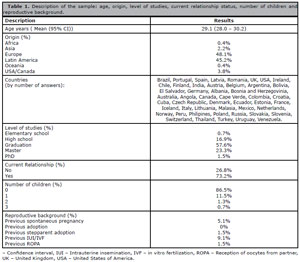
Table 1. Description of the sample: age, origin, level of studies, current relationship status, number of children and reproductive background.
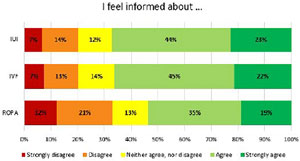
Figure 1. Level of knowledge about assisted reproduction techniques - Answers to the question “To what extent do you agree with the following statements? I feel informed about ...”
IUI – Intrauterine insemination
IVF – In vitro fertilization
ROPA – Reception of Oocytes from Partner.
Only 19% of the participants stated that being a mother is not or is slightly important. Regarding the importance of pregnancy and sharing genes with their children, opinions were diverse among the respondents. Studying the variable as a continuous scale from 1 to 5, there were no differences in the scores attributed to both factors (p=0.84). Likewise, the importance given to both pregnancy and genetics to mother-child connection was also variable among the sample studied. Interestingly, when doing the same analysis on a continuous scale, participants tended to attach more importance to pregnancy compared to genetic ties for mother-child bonding (p<0.01) (Figure 2).
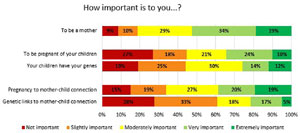
Figure 2. Importance of becoming mother, pregnancy, and genetics - Answers to the question “How important is it to you...?”.
In the future, only 19% did not consider having children and a large majority planned to do it as a couple (Figure 3). The most reported methods as plans for future procreation were the assisted reproduction techniques – IUI, IVF and ROPA. Half of the respondents would also step adopt a child from their partner. In a smaller percentage came adoption and spontaneous pregnancy (Figure 4).
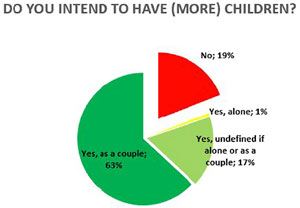
Figure 3. Intention to have more children. Answer to the question “do you intend to have more children?”.
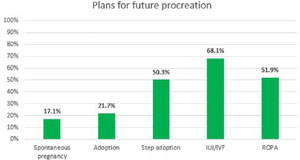
Figure 4. Plans for future procreation.IUI – Intrauterine inseminationIVF – In vitro fertilizationROPA – Reception of Oocytes from Partner.
DISCUSSION
Little is known about how well-informed homosexual women are about the various assisted reproductive treatments. Assisted reproduction had traditionally been largely for heterosexual couples, including associated marketing and patient information provided by fertility clinics (Corbett et al., 2013;Mamo, 2013;Gregg, 2018;Kreines et al., 2018). Interestingly, however, a previous study found that most patients who come to a fertility consultation already have in mind the type of treatment they wish to have, although they often adopt a differing treatment approach following medical advice (Brandão et al., 2022b). In our study, 67% of the participants agree or strongly agree they feel informed about IUI and IVF. This percentage is lower (54%) for the ROPA method. These results suggest that homosexual women, in general, feel informed about methods by which they could achieve biological parenthood, including ART.
In our study, only 19% of women say that becoming a mother is of little or no importance at all. This finding aligns with previous literature; there is a high and increasing number of homosexual women who wish to be a mother (Bos et al., 2003;Turcan et al., 2020).
There are few studies to date on the reproductive intentions of homosexual women, and the available studies are mostly of women already engaging with ART (Carpmello et al., 2016; Brandão et al., 2022b). What guides lesbian couples in their reproductive preferences remains unclear (Brandão et al., 2022c). We addressed the importance of gestational and genetic relationships to understand whether these could be determining factors. Individual opinions regarding these matters were diverse regarding the importance of personal gestational or genetic mother-child relationships, and in beliefs regarding the potential impact of these relationships on future mother-child connection.
No differences were observed in the importance given to pregnancy and genetics in the generation of their own child. However, women assigned slightly more importance to pregnancy regarding future mother-child, compared to genetics, although this difference was small. Literature is conflicting in this respect, some studies pointing to different connections of children with their mothers, while others point to a fairly balanced family situation (Reimann, 1997;Goldberg et al., 2008;Pelka, 2009;Golombok & Badger, 2010).
Regarding reproductive plans in the future, most state they wish to have children and the most reported methods were the assisted reproductive techniques - 68% state they would consider IUI or IVF, 52% consider ROPA. Half of the respondents consider step-adopting the biological child of their partner. Adoption and spontaneous pregnancy (with a friend or acquaintance) are plans of only a minority. Our data suggest that homosexual women value biological motherhood, as previous studies have indicated, although this is not yet clear and obviously varies greatly from patient to patient (Di Nucci, 2016;Voultsos et al., 2019;Costa et al., 2020).
One of the main limitations of this study is the fact that the questionnaire is not validated. The online application and dissemination of the questionnaire does not allow and interface between the researchers and the participants, which means that the inclusion criteria cannot be confirmed. Furthermore, given that an electronic tool was used for data collection, the group of participants comprises a cohort with both internet access and a degree of digital literacy. Additionally, it is important to interpret these results, particularly self-reported knowledge, in the context of the significantly above average background educational attainment of the observed cohort.
Although the study was carried out at a global level and several countries were represented, the vast majority came from countries with high or very high human development indexes, making it impossible to extrapolate the results to the reality of less developed countries, where access to ART is significantly reduced. In addition, there may be a response bias, since we could not find out the proportion of people receiving and seeing the survey who responded.
CONCLUSION
Homosexual women seem to be well informed about the assisted reproductive technology treatments. The majority of the sample studied considers it important to become a mother and plan to do so as a couple, mainly through assisted reproduction or step adoption of their partner’s child. The importance given to gestation or genetic mother-child relationships varies greatly between women, and it seems they believe pregnancy may have a slightly greater impact on the future mother-child connection compared to genetics.
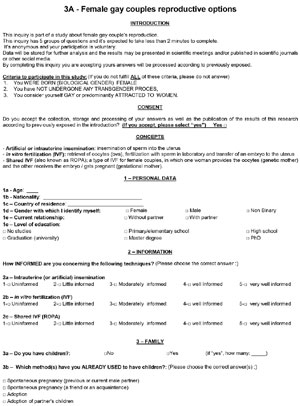
Supplement 1.