JBRA Assist. Reprod. 2026;00(0):00-00
REVIEW
doi: 10.5935/1518-0557.20260000
Quality Control in Assisted Reproduction Centers
1Universidade do Vale do Itajaí (UNIVALI); Santa Catarina, Brazil
2FertiBC, Balneário Camboriú, Santa Catarina, Brazil
3Quantor - Centro de Medicina Integrada, São Paulo, Brazil
CONFLICTS OF INTEREST
The authors declare that no support in the form of loans, equipment, or drugs was received for the preparation of this manuscript.
ABSTRACT
Assisted Reproductive Technologies (ART) demand rigorous quality standards to ensure clinical safety, efficacy, and ethical responsibility. This review outlines key elements of Quality Management Systems (QMS) in ART laboratories, addressing technical, infrastructural, regulatory, and human dimensions essential to successful outcomes. Core components include standardized protocols, validation and maintenance of equipment, environmental monitoring, biosafety procedures, and robust traceability. Laboratory infrastructure must meet ISO cleanroom standards to support the microenvironment necessary for gamete and embryo viability. Biosafety in ART requires BSL-2 compliance, risk zoning, personal protective equipment, proper waste disposal, and comprehensive training, including ergonomic and psychological safety measures. Personnel qualification is essential, requiring academic credentials, continuing education, and structured competency assessments. Equipment such as incubators and cryogenic tanks must undergo regular validation, given their direct impact on embryo development. Performance indicators (KPIs), including fertilization, blastocyst formation, and cryosurvival rates, serve as benchmarks for quality improvement. Documentation and traceability systems must track all clinical and laboratory stages, supported by electronic platforms and witnessing systems. Regulatory adherence and accreditation by agencies reinforce institutional reliability and transparency. Ethical compliance remains foundational, including informed consent, embryo disposition policies, and data confidentiality. While the implementation of a comprehensive QMS involves significant investment, it yields measurable benefits: improved clinical outcomes, error reduction, enhanced patient satisfaction, and long-term sustainability. Quality management in ART is thus not only a regulatory mandate but a strategic imperative that aligns technological precision with ethical and clinical excellence.
Keywords: reproductive techniques, assisted, quality assurance, health care, laboratories, biosafety, accreditation, ethics, medical
INTRODUCTION
Assisted Reproductive Technologies (ART) have dramatically expanded the possibilities of reproductive medicine. Initially experimental, ART procedures have evolved into highly specialized clinical and laboratory practices, necessitating that demand the highest standards of technical excellence, ethical responsibility, and operational safety (ESHRE Guideline Group on Good Practice in IVF Labs et al., 2016; College of American Pathologists, 2025; RedLara, 2020).
With the increasing complexity and sensitivity of ART procedures, the need for comprehensive Quality Management Systems (QMS) has grown. These systems must integrate physical infrastructure design, biosafety protocols, operational workflows, personnel qualification, ethical compliance, and clinical documentation. International and national regulatory bodies, including ANVISA, ESHRE, and CAP, have established guidelines to ensure technical consistency, clinical safety, and ethical transparency in ART centers. Brazilian legislation, particularly RDC No. 771/2022, consolidates and updates previous regulations, setting rigorous standards for operations, biosafety, traceability, risk management, and staff training (ESHRE Guideline Group on Good Practice in IVF Labs et al., 2016; College of American Pathologists, 2025; RedLara, 2020; ANVISA, 2022).
This review provides a detailed overview of the key elements involved in Quality Control for ART laboratories, addressing fundamental concepts, infrastructure requirements, biosafety practices, personnel training, performance monitoring, documentation strategies, ethical considerations, economic implications, and future perspectives.
FUNDAMENTALS OF QUALITY CONTROL IN ART LABORATORIES
Quality Control (QC) in ART laboratories is built upon the pillars of standardization, documentation, validation, and continuous monitoring to ensure consistency, reproducibility, safety, and transparency of procedures and outcomes. An effective QMS must integrate all laboratory activities into a coherent, risk-based framework that minimizes errors and optimizes results, ensuring traceability, biosafety, staff competency, equipment validation, environmental control, and ethical compliance (World Health Organization, 2004; Esteves et al., 2013).
The essential components of a comprehensive QC framework in ART laboratories encompass several interdependent elements. Standard Operating Procedures (SOPs) must be established and accompanied by personnel competency assessments, which involve initial and periodic evaluations to ensure technical proficiency, theoretical knowledge, ethical awareness, and adherence to biosafety protocols (World Health Organization, 2004; RedLara, 2006). Equipment validation and maintenance are also critical, requiring all essential devices to undergo installation, operational, and performance qualification, followed by routine recalibration and documented preventive maintenance. Environmental monitoring is indispensable, involving continuous tracking of temperature, humidity, CO₂ and O₂ concentrations, particulate matter, and volatile organic compounds (VOCs), all of which influence the microenvironment essential for optimal gamete and embryo viability (World Health Organization, 2004; RedLara, 2006). Auditing and management review processes must be implemented to systematically assess the performance of the Quality Management System (QMS), identify areas for improvement, and ensure compliance with updated standards. Laboratories are further required to maintain structured systems for incident and non-conformity reporting, allowing for thorough documentation and investigation of deviations, errors, and adverse events. These events must trigger root cause analysis and the implementation of Corrective and Preventive Actions (CAPA), which are designed to address underlying causes and prevent recurrence, thereby reinforcing a culture of quality and accountability within the organization (World Health Organization, 2004; RedLara, 2006).
International standards such as ISO 9001 and ISO 17025 offer robust frameworks for ART laboratory standardization, emphasizing risk management, continuous improvement, and objective documentation of quality processes. Total Quality Management (TQM) models further advocate the embedding of quality principles at all organizational levels, engaging leadership and all staff members alike (Esteves et al., 2013).
The Brazilian regulation RDC No. 771/2022 explicitly mandates the development and maintenance of a comprehensive QMS by all ART centers, consolidating earlier resolutions and stipulating requirements for internal audits, staff training, traceability, risk analysis, and non-conformity management (ANVISA, 2022). Institutions that successfully implement and cultivate their QMS frameworks consistently demonstrate improved pregnancy rates, reduced laboratory errors, enhanced team morale, and increased patient satisfaction (Wikland & Sjoblom, 2000; Fabozzi et al., 2020).
LABORATORY INFRASTRUCTURE AND ENVIRONMENTAL CONTROL
The architectural design and environmental control of ART laboratories are critical determinants of clinical success, biosafety, and operational efficiency. A well-planned infrastructure reduces contamination risk, supports aseptic workflows, and maintains the stable microenvironment required for optimal gamete and embryo viability. Brazilian regulations such as RDC 50/2002, RDC 23/2011, and RDC 771/2022 provide detailed requirements for the structural and operational organization of ART centers. These regulations emphasize the need for physical separation of clean and potentially contaminated areas, functional sectoral division, and environmental monitoring (ANVISA, 2002; ANVISA, 2011; ANVISA, 2022).
1. Regulatory and Structural Framework
In Brazil, RDC 50/2002, RDC 23/2011, and RDC 771/2022 outline detailed structural and operational requirements for ART centers. These include:
• Physical separation between clean and potentially contaminated areas.
• Functional zoning to ensure logical workflow and reduce cross-contamination.
• Unidirectional movement from lowto high-sterility zones.
Typical functional areas comprise reception and consultation rooms, operating rooms, embryology laboratories, cryopreservation units, and recovery rooms.
2. Cleanroom Classifications
• ISO Class 5: Required for embryo handling areas; maximum 3,520 particles ≥0.5 μm per cubic meter.
• ISO Class 7-8: Suitable for preparation and storage areas, with maximums between 352,000 and 3,520,000 particles ≥0.5 μm per cubic meter.
This classification ensures that procedures such as micromanipulation, intracytoplasmic sperm injection (ICSI), and embryo transfer occur in highly controlled environments.
3. Environmental Control Measures
Maintaining cleanroom standards demands advanced engineering solutions:
• HEPA filtration to remove airborne particles.
• Positive air pressure differentials to direct airflow from cleaner to less clean zones.
• Non-shedding, antimicrobial materials for floors, walls, and ceilings.
• Supplemental UV disinfection in high-risk areas.
4. Microenvironment Stability
Continuous monitoring systems must track in real time:
• Temperature within ±0.5°C.
• Relative humidity between 30% and 60%.
• CO₂ concentration to maintain culture media pH.
• O₂ concentration around 5% to improve blastocyst development.
• VOCs at minimal levels due to their embryotoxic potential.
• Airborne particulate matter within ISO standards.
Automated alert systems and backup controls are essential to respond to deviations and preserve environmental integrity during power failures or equipment malfunctions.
5. Evidence and Best Practices
Scientific studies demonstrate that even minor fluctuations in incubator CO₂ or temperature can negatively impact blastocyst quality. Similarly, poor air quality correlates with lower implantation rates, emphasizing the need for:
• Routine environmental audits.
• Preventive maintenance of filtration and monitoring systems.
• Strict adherence to cleanroom protocols.
6. Materials and Anti-static Measures
Recommended materials include epoxy-coated flooring, stainless steel or laminate work surfaces, low-VOC paints, and UV-resistant antimicrobial wall coverings. Anti-static measures should be implemented to avoid electrostatic discharges that could harm gametes and embryos.
7. Cryogenic Storage Safety
Cryogenic storage areas must have:
• Dedicated liquid nitrogen storage facilities.
• Alarm systems for continuous tank level monitoring.
• Detailed chain-of-custody logs for all cryopreserved.
Biosafety and Biosecurity Protocols
Biosafety and biosecurity are critical components of the operational framework in ART laboratories. Given the manipulation of human gametes, embryos, and biological fluids, ART centers must rigorously implement systems that protect laboratory personnel, patients, and biological materials from contamination, infection, and procedural errors. Biosafety in ART encompasses both physical protection (against biological agents and contaminants) and organizational structures (policies, training, and culture) designed to minimize risk at every operational level (World Health Organization, 2004).
1. Regulatory Context
In Brazil, RDC 771/2022 requires ART centers to:
• Maintain updated biosafety manuals.
• Classify laboratory zones according to biosafety risk level.
• Document training programs and all exposure incidents.
• Implement biosecurity strategies for sample protection and facility security.
These requirements align with international guidelines for Biosafety Level 2 (BSL-2) facilities.
2. Core Structural and Procedural Safeguards
To ensure safe handling of biological materials, ART laboratories must have:
• Certified Class II biosafety cabinets for specimen manipulation.
• Personal Protective Equipment (Björndahl et al., 2022) such as gloves, lab coats, masks, and eye protection, selected according to procedural risk.
• Waste management SOPs covering segregation, decontamination, and disposal of biological and chemical waste.
• Vaccination programs for personnel against relevant occupational risks.
• Access control and risk zoning to restrict movement between areas and reduce contamination.
3. Training and Emergency Preparedness
Biosafety is strengthened by continuous education and preparedness:
• Regular, documented biosafety training for all staff.
• Contingency plans for biological spills, accidental exposures, equipment failures, and power outages.
• Periodic drills to evaluate and improve emergency response capacity.
4. Facility Design for Risk Reduction
Infrastructure should support biosafety goals by including:
• Separate entry and exit points for personnel and materials.
• Anterooms for donning and doffing PPE.
• Controlled air pressure differentials to direct airflow from clean to less clean areas.
• Strategically located handwashing and decontamination stations.
5. Beyond Infection Control
Modern biosafety frameworks recognize that staff safety also involves:
• Ergonomic measures, such as adjustable workstations and anti-fatigue flooring, to reduce repetitive strain injuries.
• Psychological safety strategies, including workload management, to reduce stress and cognitive fatigue-factors that can lead to procedural errors.
6. Integration with Quality Management Systems (QMS)
Biosafety protocols must be fully embedded into the laboratory’s QMS:
• All incidents, even minor breaches, should be openly reported and investigated.
• Root cause analysis should guide corrective and preventive actions (CAPA).
• Periodic biosafety audits must verify adherence to protocols and identify areas for improvement.
MANAGEMENT AND VALIDATION
The proper functioning, validation, and maintenance of laboratory equipment are vital to the integrity of ART procedures, directly influencing operational accuracy and gamete and embryo viability. An integrated equipment management program within the QMS is essential for ensuring consistent, high-quality outcomes. Critical equipment must undergo structured validation processes, verifying installation per manufacturer specifications, assessing operational functions like temperature and gas regulation, and confirming performance consistency under routine clinical conditions (Esteves et al., 2013; Practice Committee of the American Society for Reproductive Medicine et al., 2014; ESHRE Guideline Group on Good Practice in IVF Labs et al., 2016).
Equipment must undergo initial validation at installation and after relocation or major repair, with periodic revalidation-typically annually or after deviations-to ensure ongoing compliance. A proactive preventive maintenance schedule must be established, following manufacturer guidelines and regulatory standards, with regular calibration of critical parameters by certified professionals and systematic documentation. Continuous monitoring through internal sensors and external data loggers is essential, and any deviations must trigger immediate investigation, corrective actions, and incident reporting. Critical devices must also have routinely tested auditory and visual alarms, and essential systems-such as incubators, cryogenic tanks, and environmental controls-must be supported by backups like UPS and additional liquid nitrogen supplies to mitigate power outage risks (Higdon et al., 2008; Esteves et al., 2013; Practice Committee of the American Society for Reproductive Medicine et al., 2014; ESHRE Guideline Group on Good Practice in IVF Labs et al., 2016; College of American Pathologists, 2025; ANVISA, 2022).
Minimal fluctuations in gas concentrations, such as CO₂ and O₂, or in temperature within incubators can significantly impair blastocyst development and compromise embryo quality. Even slight deviations, as small as 0.5°C, can adversely affect cleavage and blastulation rates, highlighting the critical need for stringent environmental control to ensure optimal conditions for gamete and embryo viability (Fujiwara et al., 2007; Morbeck et al., 2014; Meldrum, 2020).
Cryopreservation systems require careful management due to the risks of long-term storage of gametes and embryos. Cryogenic storage tanks must be rigorously validated for internal temperature uniformity and resistance to external fluctuations, with continuous monitoring of liquid nitrogen levels and established alarm thresholds. Chain of custody logs must be meticulously maintained with dual verification to ensure specimen traceability and integrity. Additionally, comprehensive risk mitigation plans, including access to emergency storage capacity, must be in place to protect cryopreserved materials in the event of tank failures (Higdon et al., 2008; Esteves et al., 2013; Practice Committee of the American Society for Reproductive Medicine et al., 2014; ESHRE Guideline Group on Good Practice in IVF Labs et al., 2016; College of American Pathologists, 2025; ANVISA, 2022).
Every equipment-related activity-including installation, validation, calibration, maintenance, alarm testing, and repairs-must be thoroughly documented. Records must be retained in a centralized, secure, and auditable system and be available for review during internal audits and external inspections. Equipment management protocols must be fully integrated into the laboratory’s QMS. Non-conformities or deviations must trigger CAPA procedures, with root cause analysis guiding corrective actions and preventive strategies (Higdon et al., 2008; Esteves et al., 2013; Practice Committee of the American Society for Reproductive Medicine et al., 2014; ESHRE Guideline Group on Good Practice in IVF Labs et al., 2016; College of American Pathologists, 2025; ANVISA, 2022).
Only trained and authorized personnel should operate, maintain, and troubleshoot critical equipment. Ongoing training programs must ensure that staff remain proficient in equipment handling, basic troubleshooting, and emergency response protocols (Esteves et al., 2013; ESHRE Guideline Group on Good Practice in IVF Labs et al., 2016; RedLara, 2020; ANVISA, 2022).
PERSONNEL QUALIFICATION AND CONTINUOUS TRAINING
The competence of personnel in ART laboratories is a critical factor for ensuring clinical success, patient safety, ethical compliance, and institutional credibility. A highly skilled, ethically responsible, and continually trained workforce is essential for maintaining excellence in ART services. Therefore, the development, implementation, and maintenance of structured personnel qualification and continuous training programs are fundamental components of an effective QMS (Keck et al., 2005; Esteves et al., 2013).
According to regulatory frameworks and best practices, ART laboratory personnel must hold academic degrees in fields such as biology, biomedicine, or biochemistry, with specialized postgraduate education in reproductive biology, embryology, or clinical ART techniques highly recommended. Professional roles include clinical embryologists, laboratory technicians, andrologists, and quality managers, each responsible for specific technical and quality functions. Before engaging in clinical activities, personnel must have their academic credentials, licenses (if applicable), immunization records, and prior experience verified. Certification in biosafety, emergency response, and ethical conduct is also mandatory and must be systematically documented (Keck et al., 2005; Esteves et al., 2013; Practice Committee of the American Society for Reproductive Medicine et al., 2014; ESHRE Guideline Group on Good Practice in IVF Labs et al., 2016).
ART centers must implement formalized training programs covering both theoretical and practical aspects of laboratory operations, including technical protocols, biosafety, equipment handling, quality assurance, and regulatory compliance. Competency must be systematically assessed through direct observation, written and oral examinations, evaluation of adherence to SOPs and biosafety standards, and analysis of clinical outcomes such as fertilization and blastocyst development rates. These assessments must occur after initial training, significant procedural changes, or extended periods of clinical inactivity (Keck et al., 2005; Esteves et al., 2013; Practice Committee of the American Society for Reproductive Medicine et al., 2014; ESHRE Guideline Group on Good Practice in IVF Labs et al., 2016).
Continuous professional development is essential in ART due to the field’s evolving nature. Staff must engage in accredited workshops, courses, conferences, internal seminars, literature reviews, journal clubs, and external proficiency testing to maintain updated knowledge and skills. All training activities, competency evaluations, certifications, and development records must be meticulously documented and stored in centralized personnel files for audit purposes. Additionally, ART centers must integrate training focused on empathy, patient-centered communication, and ethical sensitivity, as these soft skills significantly impact patient satisfaction and treatment outcomes (Keck et al., 2005; Esteves et al., 2013; Practice Committee of the American Society for Reproductive Medicine et al., 2014; ESHRE Guideline Group on Good Practice in IVF Labs et al., 2016).
Training novel technologies-such as preimplantation genetic testing (PGT), AI-assisted embryo selection algorithms, and new cryopreservation techniques-is critical for maintaining a cutting-edge laboratory. Personnel must be trained not only to operate these technologies but also to understand their biological, clinical, and ethical implications (Cannarella et al., 2023; Vaiarelli et al., 2023).
Brazilian RDC 771/2022 mandates that ART centers maintain up-to-date, verifiable training records for all staff involved in ART procedures. Compliance with these standards is crucial for licensure maintenance, accreditation eligibility, and institutional reputation (ANVISA, 2022).
PERFORMANCE INDICATORS AND KPIS
Key Performance Indicators (KPIs) are essential metrics for monitoring, evaluating, and continuously improving the technical and clinical performance of ART laboratories. By establishing objective and clinically relevant benchmarks, KPIs enable early identification of deviations, support corrective actions, and promote a culture of excellence centered on patient outcomes. Integrating KPI monitoring into the QMS ensures regulatory and accreditation compliance while enhancing operational efficiency, clinical success rates, and patient satisfaction (ESHRE Special Interest Group of Embryology and Alpha Scientists in Reproductive Medicine, 2017; ANVISA, 2022; Vaiarelli et al., 2023).
For KPIs to be meaningful and actionable, they must meet specific criteria such as clarity and objectivity, clinical relevance, sensitivity to change and benchmarkability (College of American Pathologists, 2025). Oocyte retrieval rate, mature oocyte rate, normal fertilization rate, abnormal fertilization rate, day-3 cleavage rate, blastocyst development rate, embryo cryosurvival rate, catheter retention rate, clinical pregnancy rate per transfer and miscarriage rate are widely recognized KPIs essential for ART laboratory performance monitoring (ESHRE Special Interest Group of Embryology and Alpha Scientists in Reproductive Medicine, 2017; Vaiarelli et al., 2023) (Table 1).
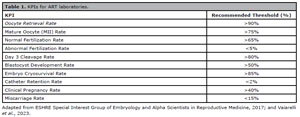
Table 1. KPIs for ART laboratories.
Accurate and complete data entry is paramount. Electronic Laboratory Management Systems (LIMS) facilitate real-time data capture and minimize transcription errors. Monthly and quarterly trend reviews enable early detection of performance drifts before clinical outcomes are adversely affected (Awadalla et al., 2021).
Comparing KPIs with external data sources, such as the RedLara Registry or ESHRE ART monitoring reports, allows ART centers to assess their competitive position and identify improvement areas. Monitoring and documenting KPIs are fundamental for compliance with accreditation standards set by bodies like CAP, ESHRE, and RedLara. Regular internal audits must verify that KPI monitoring is active, accurate, and effectively used to drive continuous improvement (ESHRE Special Interest Group of Embryology and Alpha Scientists in Reproductive Medicine, 2017; Vaiarelli et al., 2023).
Deviation from established KPI thresholds must prompt structured investigations regarding root cause analysis, corrective actions and documentation of findings, actions taken, and outcome evaluations (ANVISA, 2022).
Emerging technologies and evolving practices necessitate the introduction of new KPIs, such as embryo euploidy rates, time-lapse morphokinetics and consistency between embryologist and AI-derived embryo grading (Meldrum, 2020; Vaiarelli et al., 2023; Basar et al., 2024).
Through systematic KPI monitoring, rigorous analysis, timely corrective actions, and commitment to continuous improvement, ART centers can optimize their practices, advance scientific understanding, and fulfill their mission to deliver the highest standards of reproductive care.
TRACEABILITY AND DOCUMENTATION
Traceability and meticulous documentation are foundational elements of QA systems in ART laboratories. Given the ethical and clinical sensitivities inherent in ART, the ability to reconstruct the complete history of gametes, embryos, culture conditions, equipment usage, and personnel interventions is not merely desirable but mandatory under Brazilian regulations (ANVISA, 2022) and international standards (Practice Committee of the American Society for Reproductive Medicine et al., 2014; ESHRE Special Interest Group of Embryology and Alpha Scientists in Reproductive Medicine, 2017; College of American Pathologists, 2025; RedLara, 2020).
Traceability and documentation serve fundamental roles in ART laboratories by ensuring legal and ethical compliance, safeguarding patient rights, and maintaining verifiable records. They enhance clinical safety and risk management by enabling the identification of root causes in non-conformities or adverse events and support timely corrective actions. Additionally, they promote reproducibility and quality monitoring through continuous process validation, audit facilitation, and institutional learning for ongoing improvement (Kastrop, 2003; Warnes & Norman, 2007; Esteves et al., 2013; Meldrum, 2020; ANVISA, 2022).
Effective traceability systems in ART laboratories must cover every stage of clinical and laboratory operations to ensure full accountability and quality assurance. This includes patient and donor identification using unique identifiers and cross-verification protocols at each critical step, from initial consultation to embryo transfer or cryopreservation. Gamete and embryo tracking must be meticulously maintained through unique identification codes integrated with real-time monitoring via Laboratory Information Management Systems (LIMS) (Kastrop, 2003; Warnes & Norman, 2007; Esteves et al., 2013).
Culture media and consumables batch control requires documentation of lot numbers, expiration dates, certificates of analysis, and detailed usage logs to ensure supply integrity. Equipment monitoring involves logging usage data, calibration records, alarm events, and maintenance activities for critical devices such as incubators, laminar flow hoods, and cryogenic tanks. Additionally, personnel involvement must be clearly recorded, identifying the staff responsible for each procedural step to maintain traceability, accountability, and support competency assessments (Kastrop, 2003; Warnes & Norman, 2007; Esteves et al., 2013; Practice Committee of the American Society for Reproductive Medicine et al., 2014; Fabozzi et al., 2020; Meldrum, 2020).
Environmental monitoring data-including temperature, humidity, gas concentrations, and particulate counts-must be systematically stored and linked to the specific time and location of each critical event. Additionally, chain of custody for cryopreserved materials must be rigorously maintained with detailed logs documenting storage locations, transfer events, maintenance activities, and dual-verified identity checks. Together, these traceability measures form the foundation of a comprehensive quality management framework, safeguarding clinical process integrity and ensuring the highest standards of patient care in ART laboratories (Kastrop, 2003; Warnes & Norman, 2007; Esteves et al., 2013; Meldrum, 2020; ANVISA, 2022).
According to best practices and RDC 771/2022, all documentation in ART laboratories must meet stringent standards to ensure reliability, traceability, and legal compliance. Completeness requires that every action, observation, or deviation be meticulously recorded without omissions. Accuracy must be maintained to reflect reality precisely, avoiding subjective interpretation. Timeliness is also critical, with records needing to be completed contemporaneously with the events they describe to preserve their integrity and chronological accuracy (ANVISA, 2022).
Legibility and integrity must be ensured in ART laboratory documentation: handwritten records must be clearly legible, and electronic records must include security measures to prevent unauthorized alterations or data loss. Confidentiality must also be rigorously maintained, restricting access to patient-identifiable information to authorized personnel and adhering to data protection regulations such as the GDPR and national laws. Together, these standards ensure that documentation supports clinical excellence, operational efficiency, and fulfills ethical and legal responsibilities toward patients and society (ANVISA, 2022).
All clinical, laboratory, and traceability records must be securely archived and maintained for a minimum of 20 years, including canceled cycles and embryo cryopreservation records. This long-term retention ensures that any future investigation, clinical follow-up, or legal inquiry can access the necessary information (ANVISA, 2022).
Several technological tools enhance traceability, accuracy, and operational efficiency in ART laboratories. Barcode systems automate labeling and scanning of samples and consumables, reducing human error and enabling rapid data retrieval. Electronic Witnessing Systems (Padwal et al., 2011) provide dual verification at critical steps, minimizing risks of sample mix-ups and associated complications. Laboratory Information Management Systems (LIMS) integrate patient data, procedural documentation, traceability logs, environmental monitoring, and KPI tracking into a centralized platform, supporting real-time monitoring and regulatory compliance. Additionally, audit trails must be maintained to permanently record all data entries, modifications, and user activities, ensuring data integrity and transparency (Wikland & Sjoblom, 2000; RedLara, 2006; ESHRE Special Interest Group of Embryology and Alpha Scientists in Reproductive Medicine, 2017; Fabozzi et al., 2020; Sciorio et al., 2021).
Internal audits of documentation and traceability systems must be conducted at least annually, with findings reported to the laboratory’s quality management leadership. Audits must evaluate compliance with regulatory standards, data integrity, confidentiality protections, and system performance (Esteves et al., 2013).
A robust traceability system in ART laboratories provides critical advantages, enabling rapid and accurate investigation of clinical incidents and procedural deviations, facilitating timely corrective actions, and minimizing patient risk. It also protects against litigation by ensuring detailed, verifiable records, supports external audits and accreditation through transparent documentation, and enhances patient confidence and institutional reputation. Additionally, strong traceability systems support research activities by providing reliable datasets for retrospective analysis, advancing scientific knowledge and clinical practice (Esteves et al., 2013; Practice Committee of the American Society for Reproductive Medicine et al., 2014; ESHRE Special Interest Group of Embryology and Alpha Scientists in Reproductive Medicine, 2017).
Despite their benefits, implementing and maintaining robust traceability systems in ART laboratories presents challenges. Human factors remain critical, requiring comprehensive training focused on meticulous documentation, protocol adherence, and vigilance in sample handling. System failures also pose risks, necessitating redundancies such as offline backups, contingency plans, and regular maintenance. Moreover, seamless integration between laboratory management and clinical record systems is essential to ensure comprehensive traceability, enhance patient care coordination, and optimize operational efficiency (Esteves et al., 2013; Practice Committee of the American Society for Reproductive Medicine et al., 2014; ESHRE Special Interest Group of Embryology and Alpha Scientists in Reproductive Medicine, 2017).
ACCREDITATION AND REGULATORY COMPLIANCE
Accreditation and regulatory compliance are fundamental pillars of QMS in ART laboratories, ensuring adherence to legal requirements, ethical standards, patient safety principles, and the highest levels of technical and clinical excellence. As ART procedures become more complex and societal expectations for transparency and outcomes increase, ART centers must maintain rigorous internal controls and subject their practices to independent external verification through formal accreditation processes.
In Brazil, Assisted Reproductive Technology (ART) centers operate under a comprehensive legal framework established by multiple regulatory instruments. RDC No. 33/2006 governs the cryopreservation of gametes and embryos, defining specific requirements related to their storage, documentation, and ethically appropriate use. RDC No. 23/2011 outlines the technical and operational standards for ART services, including specifications for infrastructure, biosafety protocols, staff qualifications, and patient care procedures. RDC No. 771/2022 represents a significant consolidation and update of previous resolutions, mandating the implementation of comprehensive Quality Management Systems (QMS), structured risk management programs, internal audits, traceability mechanisms, and formal documentation procedures covering all activities involving human germ cells and embryos. Complementing these technical regulations, CFM Resolution No. 2.320/2022 provides a detailed ethical framework for ART practice, establishing guidelines for gamete donation, surrogacy, the ethical conduct of embryo research, and the requirements for obtaining and maintaining informed consent. Together, these regulations form a robust legal and ethical foundation that governs the safe, transparent, and responsible operation of ART centers throughout Brazil (ANVISA, 2006; ANVISA, 2011; ANVISA, 2022; CFM, 2022).
Compliance with these regulations is mandatory for licensure renewal, institutional operation, and the legal and ethical protection of both patients and professionals.
In addition to national regulations, ART centers seeking to demonstrate excellence often pursue accreditation through recognized international organizations, including ESHRE, CAP, ISO Standards and RedLara (ESHRE Special Interest Group of Embryology and Alpha Scientists in Reproductive Medicine, 2017; College of American Pathologists, 2025; RedLara, 2020).
The accreditation process in ART laboratories follows a structured sequence to ensure compliance with accrediting body standards. It begins with a self-assessment to identify strengths and deficiencies, followed by corrective actions. A formal application is then submitted, including policies, SOPs, staff qualifications, KPIs, risk management plans, and audit evidence. Upon acceptance, an on-site audit is conducted, where external auditors verify compliance through staff interviews, document reviews, facility inspections, and observation of operational procedures (RedLara, 2020).
After the on-site audit, a report and certification phase follows. Laboratories meeting all standards receive accreditation, while those with deficiencies are given a detailed corrective action report. Accreditation requires ongoing surveillance, including periodic re-accreditation assessments and interim audits, to ensure continuous compliance with evolving standards, promote a culture of continuous improvement, and sustain high levels of patient care and operational excellence. (RedLara, 2020).
Accreditation offers strategic benefits to ART laboratories by strengthening clinical excellence and institutional reputation. It enhances patient confidence, provides benchmarking and competitive advantages, and fosters continuous improvement through systematic monitoring and optimization of procedures. Accredited centers are better prepared for regulatory inspections and legal requirements and demonstrate improved clinical outcomes, including higher fertilization rates, better blastocyst development, and increased clinical pregnancy rates (Knudtson et al., 2022; Vaiarelli et al., 2023).
Accreditation and compliance processes present several challenges for ART laboratories. Significant
resource allocation is required, involving substantial investments of time, personnel effort, and financial resources. Change management is also a difficulty, as implementing new systems and protocols may face resistance from staff accustomed to previous practices. Maintaining accreditation status demands ongoing vigilance through regular staff training, continuous KPI monitoring, systematic internal audits, and readiness for unannounced surveillance audits by accrediting bodies. (College of American Pathologists, 2025; RedLara, 2020).
To overcome accreditation challenges, ART laboratories must adopt several strategies. Leadership engagement is vital, requiring active support for quality initiatives, resource allocation, and empowerment of quality managers. Staff training and involvement are equally critical to ensure understanding of accreditation’s importance and contribution to continuous improvement. Developing integrated, robust, and flexible QMS is essential to adapt to evolving regulatory requirements. Additionally, embedding risk-based thinking into the organizational culture promotes proactive identification and mitigation of risks related to patient safety, laboratory operations, and ethical compliance (College of American Pathologists, 2025; RedLara, 2020).
Beyond technical and operational requirements, accreditation bodies increasingly demand the integration of ethical principles into ART laboratory practices. Centers must strictly adhere to ethical standards by implementing comprehensive informed consent processes, robust data protection protocols, responsible embryo storage and disposition policies, and transparent reporting of clinical outcomes. Ethical practices must be deeply embedded in the organizational culture and reflected in daily operations, reinforcing the institution’s commitment to patient-centered care, regulatory compliance, and societal trust (College of American Pathologists, 2025; RedLara, 2020).
ECONOMIC CONSIDERATIONS IN QUALITY MANAGEMENT
The implementation and maintenance of a comprehensive QMS in ART laboratories involve significant financial investment. However, when analyzed critically, the cost of quality is outweighed by its measurable benefits in operational efficiency, clinical outcomes, patient satisfaction, regulatory compliance, and institutional sustainability (Awadalla et al., 2021).
Economic planning in ART must recognize quality management as a strategic investment rather than an ancillary cost. Centers that proactively allocate resources toward quality initiatives consistently achieve superior clinical performance, enhanced institutional reputation, and greater resilience against market fluctuations and regulatory challenges (Awadalla et al., 2021).
The proactive investment in quality correlates directly with improved embryo development rates, higher clinical pregnancy rates, lower miscarriage rates, and greater patient satisfaction. Accredited centers also tend to experience enhanced staff retention, increased patient referrals, success in competitive tenders and research collaborations, lower long-term operational costs through preventive maintenance and error reduction (Esteves et al., 2013; Fabozzi et al., 2020; Meldrum, 2020).
ETHICAL AND LEGAL CONSIDERATIONS
Ethical and legal compliance is a fundamental and inseparable part of Quality Management in ART centers. Beyond technical and clinical excellence, ART centers have an ethical responsibility toward patients, donors, offspring, and society. Conducting all procedures within a clearly defined legal and ethical framework protects patient autonomy, promotes trust, minimizes legal risks, and reinforces the legitimacy of reproductive medicine. In Brazil, ART centers operate under interrelated regulations that establish these ethical and legal standards. (ANVISA, 2022; CFM, 2022).
Ethical and legal compliance is an inseparable component of quality management in ART, ensuring patient autonomy, institutional transparency, and societal trust.
1. Donor Anonymity - International Perspectives
• Brazil: Law mandates complete donor anonymity.
• ESHRE (Europe): Growing trend toward identity disclosure at adulthood.
• ASRM (USA): Mixed approach-supports both anonymous and identity-release donation, with emphasis on informed choice.
• Debate: Advocates of disclosure highlight the rights of donor-conceived individuals to know their genetic origins; opponents stress privacy rights and donor availability.
2. Embryo Disposition Dilemmas
• Options include donation to other couples, research use, or discard under ethical guidelines.
• Legal disputes in Brazil have reached courts when ex-partners disagree on embryo fate-often termed judicialization.
• Ethical implications: Balancing reproductive autonomy, respect for potential life, and contractual obligations.
3. Cross-Border ART
• Patients increasingly seek treatment abroad due to cost, access, or legal restrictions.
• Challenges arise when importing gametes/embryos to Brazil-requiring compliance with both foreign and national regulations.
• Ethical questions: Equity of access, exploitation risks, and varying standards of care.
4. Integration with Laboratory Practice
• Informed consent procedures must detail laboratory-specific protocols (e.g., storage duration, handling of surplus embryos).
• Traceability systems protect both ethical integrity and sample security.
• Embryo cryostorage policies must align with legal retention periods and clear disposition agreements.
5. Emerging Trends and Judicialization in Brazil
• Courts have intervened in cases of posthumous reproduction, disputes over frozen embryos, and cross-border transfers.
• Laboratories must proactively align SOPs with evolving case law to reduce legal vulnerability.
By embedding ethical awareness into daily laboratory operations-through robust consent processes, transparent reporting, and compliance with evolving guidelines-ART centers strengthen their QMS and reinforce both patient trust and legal security.
CONCLUSIONS
The successful implementation of a comprehensive QMS in ART laboratories represents not merely a regulatory or operational obligation but a fundamental commitment to clinical excellence, patient safety, ethical integrity, and sustainable innovation. Throughout this chapter, it has been demonstrated that robust quality control, strategic infrastructure design, biosafety, personnel development, performance monitoring, traceability, regulatory compliance, and ethical vigilance are interdependent components that must be seamlessly integrated to achieve the highest standards of ART practice.
REFERENCES
Awadalla MS, Ingles SA, Ahmady A. Design and validation of a model for quality control monitoring of dichotomous in vitro fertilization outcomes. Fertil Steril. 2021;116:453-61. PMID: 33762113 DOI: 10.1016/j.fertnstert.2021.02.002 Medline
Basar M, Unsal E, Ergun Y. Embryology with precision: effective quality control in the in vitro fertilization laboratory. Curr Opin Obstet Gynecol. 2024;36:200-7. PMID: 38572581 DOI: 10.1097/GCO.0000000000000945 Medline
Björndahl L, Barratt CLR, Mortimer D, Agarwal A, Aitken RJ, Alvarez JG, Aneck-Hahn N, Arver S, Baldi E, Bassas L, Boitrelle F, Bornman R, Carrell DT, Castilla JA, Cerezo Parra G, Check JH, Cuasnicu PS, Darney SP, de Jager C, De Jonge CJ, et al. Standards in semen examination: publishing reproducible and reliable data based on high-quality methodology. Hum Reprod. 2022;37:2497-502. PMID: 36112046 DOI: 10.1093/humrep/deac189 Medline
Cannarella R, Shah R, Boitrelle F, Saleh R, Durairajanayagam D, Harraz AM, Agarwal A. Need for Training in Research Methodology Prior to Conducting Systematic Reviews and Meta-Analyses, and the Effectiveness of an Online Training Program: The Global Andrology Forum Model. World J Mens Health. 2023;41:342-53. PMID: 36593714 DOI: 10.5534/wjmh.220128 Medline
ESHRE Guideline Group on Good Practice in IVF Labs; De los Santos MJ, Apter S, Coticchio G, Debrock S, Lundin K, Plancha CE, Prados F, Rienzi L, Verheyen G, Woodward B, Vermeulen N. Revised guidelines for good practice in IVF laboratories (2015). Hum Reprod. 2016;31:685-6. PMID: 26908842 DOI: 10.1093/humrep/dew016 Medline
ESHRE Special Interest Group of Embryology and Alpha Scientists in Reproductive Medicine. The Vienna consensus: report of an expert meeting on the development of ART laboratory performance indicators. Reprod Biomed Online. 2017;35:494-510. PMID: 28784335 DOI: 10.1016/j.rbmo.2017.06.015 Medline
Fabozzi G, Cimadomo D, Maggiulli R, Vaiarelli A, Ubaldi FM, Rienzi L. Which key performance indicators are most effective in evaluating and managing an in vitro fertilization laboratory? Fertil Steril. 2020;114:9-15. PMID: 32532495 DOI: 10.1016/j.fertnstert.2020.04.054 Medline
Fujiwara M, Takahashi K, Izuno M, Duan YR, Kazono M, Kimura F, Noda Y. Effect of micro-environment maintenance on embryo culture after in-vitro fertilization: comparison of top-load mini incubator and conventional front-load incubator. J Assist Reprod Genet. 2007;24:5-9. PMID: 17160731 DOI: 10.1007/s10815-006-9088-3 Medline
Higdon HL, 3rd, Blackhurst DW, Boone WR. Incubator management in an assisted reproductive technology laboratory. Fertil Steril. 2008;89:703-10. PMID: 17524397 DOI: 10.1016/j.fertnstert.2007.03.040 Medline
Kastrop PM. Quality management in the ART laboratory. Reprod Biomed Online. 2003;7:691-4. PMID: 14748969 DOI: 10.1016/s14726483(10)62092-5 Medline
Keck C, Fischer R, Baukloh V, Alper M. Staff management in the in vitro fertilization laboratory. Fertil Steril. 2005;84:1786-8. PMID: 16359993 DOI: 10.1016/j.fertnstert.2005.06.051 Medline
Knudtson JF, Robinson RD, Sparks AE, Hill MJ, Chang TA, Van Voorhis BJ. Common practices among consistently high-performing in vitro fertilization programs in the United States: 10-year update. Fertil Steril. 2022;117:42-50. PMID: 34674830 DOI: 10.1016/j.fertnstert.2021.09.010 Medline
Meldrum D. Quality control, best practices and variability of IVF results. JBRA Assist Reprod. 2020;24:95-6. PMID: 32301598 DOI: 10.5935/15180557.20200021 Medline
Morbeck DE, Krisher RL, Herrick JR, Baumann NA, Matern D, Moyer T. Composition of commercial media used for human embryo culture. Fertil Steril. 2014;102:759-66 e9. PMID: 24998366 DOI: 10.1016/j.fertnstert.2014.05.043 Medline
Sciorio R, Rapalini E, Esteves SC. Air quality in the clinical embryology laboratory: a mini-review. Ther Adv Reprod Health. 2021;15:2633494121990684. PMID: 33629068 DOI: 10.1177/2633494121990684 Medline
Vaiarelli A, Zacà C, Spadoni V, Cimadomo D, Conforti A, Alviggi C, Palermo R, Bulletti C, De Santis L, Pisaturo V, Vigiliano V, Scaravelli G, Ubaldi FM, Borini A. Clinical and laboratory key performance indicators in IVF: A consensus between the Italian Society of Fertility and Sterility and Reproductive Medicine (SIFES-MR) and the Italian Society of Embryology, Reproduction and Research (SIERR). J Assist Reprod Genet. 2023;40:1479-94. PMID: 37093443 DOI: 10.1007/s10815-023-02792-1 Medline
Warnes GM, Norman RJ. Quality management systems in ART: are they really needed? An Australian clinic’s experience. Best Pract Res Clin Obstet Gynaecol. 2007;21:41-55. PMID: 17085076 DOI: 10.1016/j.bpobgyn.2006.09.005 Medline
Wikland M, Sjöblom C. The application of quality systems in ART programs. Mol Cell Endocrinol. 2000;166:37. PMID: 10989201 DOI: 10.1016/S0303-7207(00)00290-2 Medline