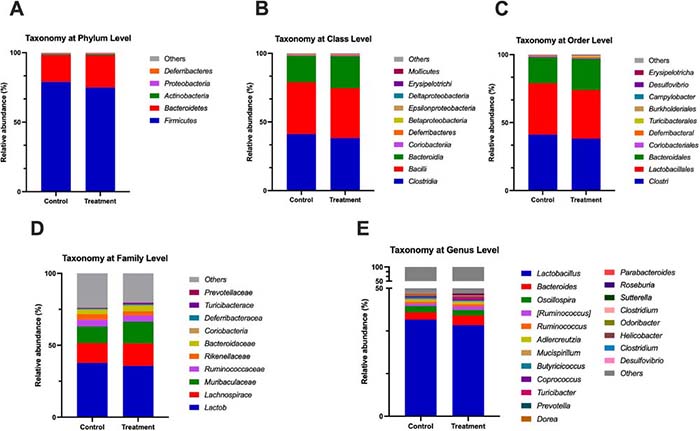
Figure 3. Taxonomic Composition of Gut Microbiota at Multiple Levels Following Repeated Controlled Ovarian Hyperstimulation (COH) in Female Mice. This figure presents the relative abundance (%) of bacterial taxa at the phylum (A), class (B), order (C), family (D), and genus (E) levels in control mice (n=10) and mice subjected to 10 weeks of COH (n=10). At the phylum level (A), Firmicutes and Bacteroidetes dominated both groups, with a modest reduction in the Firmicutes:Bacteroidetes ratio in the treatment group. At the class level (B), Clostridia and Bacteroidia remained predominant, while minor increases in Erysipelotrichi and Coriobacteriia were observed after COH. At the order level (C), Bacteroidales showed a slight increase in treated mice, whereas Clostridiales were more abundant in controls. At the family level (D), Lactobacillaceae, Lachnospiraceae, and Ruminococcaceae were the major families across groups, with Rikenellaceae showing a small decrease in the COH group. At the genus level (E), Lactobacillus was the dominant genus in both groups, followed by Bacteroides and Parabacteroides, which were slightly more abundant in treated animals, while genera such as Rikenellaceae_RC9 and Clostridium were relatively enriched in controls. These patterns indicate largely conserved community structure, with subtle COH-associated shifts in specific taxa.