JBRA Assisted Reproduction 2025;29(Suppl.2 SBRA 2025):3
29th Annual Congress of the SBRA. São Paulo/SP - Brazil, 2025
doi: 10.5935/1518-0557.20263517
O-03. Comparison of key performance indicator score (KPIs score) with artificial intelligence (AI) algorithms for the prediction of blastocysts human implantation
JBRA Assisted Reproduction 2025;29(Suppl.2 SBRA 2025):3
Oral Presentation
29th Annual Congress of the SBRA. São Paulo/SP - Brazil, 2025
doi: 10.5935/1518-0557.20263517
O-03. Comparison of key performance indicator score (KPIs score) with artificial intelligence (AI) algorithms for the prediction of blastocysts human implantation
1 Center for Human Reproduction Prof. Franco Jr - Ribeirão Preto - SP - Brazil
2 Paulista Center for Diagnosis-Research and Training - Ribeirão Preto - SP - Brazil
Objective: To compare KPIs score with AI algorithms for the prediction of human blastocyst implantation.
Methods: This study is a prospective cohort study with a total of 92 IVF/ICSI cycles during 2023 to2024. KPIs score was obtained by analysis of age (≥40y: 1point, 37-39y: 3points, ≤36y:5points) AMH (ng/ml) (<1: 1point, ≥1-<2:3points, ≥2:05points), number of metaphase-II oocyte (≤3:1point, 4-6:3points, ≥7:05points), fertilization rates (<50%:1point, ≥50-<65%:3points, ≥65%:05points) and blastocyst morphology according to cavity expansion and morphology of inner cell mass and trophectoderm (Only low quality embryos GI, GII or ≥ GIII (CC): 1 point, at least one embryo ≥ GIII(BB/BC/CB):3points, at least one embryo ≥ GIII(AA/AB/BA):5 points. The total KPIs score was correlated with the presence or absence of pregnancy. The maximum total KPIs score was 25 points. For artificial intelligence (AI) algorithms (EMBRYOAID-MIMFERTILITY) automatically rank and identify the highest quality embryos based on a large collection of time-lapse photos of human embryos by describing a grade (raging from to 0 to 10), according to the blastocyst picture. Grading was classified according to embryo potential implantation (pi) as: ranges from 0.0 to 0.3 (very low pi), 0.3 to 2.5 (low pi), 2.5 to 5.0 (moderate pi), 5.0 - 7.5 (high pi) 7.5to 10 (very high pi). The blastocyst grades were correlated with the presence or absence of pregnancy.
Results: A total of 41 clinical pregnancies were obtained, from 92 cycles of 92 patients aged 36.6±4.2. The mean KPIs was 18.7±3.7 and mean AI grade was 6.11±2.74. The regression analysis revealed significant moderate/strong positive correlation between the KPI and AI results. Logistic regression revealed that the KPI (OR:1.20) and AI (OR:1.05) values were both significantly associated with the likelihood of clinical pregnancy. On the other hand, the ROC curve showed an area under the curve (AUC): 0.67 and AUC:0.78 regarding the probability of clinical pregnancy according to the KPI and AI values. Table 1 shows the results.
Conclusion: These preliminary data showed this AI present a better performance than KPIs score as a test to predict the clinical pregnancy. Since the AUC of this AI model only reflects satisfactory performance in predicting pregnancy, the interpretation and application of the results in clinical practice should still be approached with caution (not “Very Good AUC”: 0.80-0.89 or “Excellent AUC”:0.90-1.00, really useful for clinical decision-making). Additionally, the potential for continuous improvement in this AI model's performance should be considered.
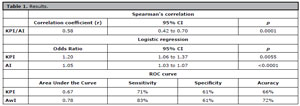
Table 1. Results.