JBRA Assisted Reproduction 2025;29(Suppl.2 SBRA 2025):8
29th Annual Congress of the SBRA. São Paulo/SP - Brazil, 2025
doi: 10.5935/1518-0557.20263522
O-08. Invisible environmental footprint: estimated disposable waste from IVF cycles in Brazil (2017–2024)
JBRA Assisted Reproduction 2025;29(Suppl.2 SBRA 2025):8
Oral Presentation
29th Annual Congress of the SBRA. São Paulo/SP - Brazil, 2025
doi: 10.5935/1518-0557.20263522
O-08. Invisible environmental footprint: estimated disposable waste from IVF cycles in Brazil (2017–2024)
1Faculdade Santa Marcelina - São Paulo - SP - Brasil
2Universidade do Extremo Sul Catarinense - Criciúma - SC - Brasil
Objective: To estimate the volume of disposable waste generated by in vitro fertilization (IVF) cycles in Brazil between 2017 and 2024, and to assess regional and temporal variations.
Methods: This ecological study analyzed secondary data from the Brazilian National Embryo Production System (SIS-EMBRIO/ANVISA) on the annual number of IVF cycles performed by region from 2017 to 2024. The waste parameter was defined as the arithmetic mean of disposable items used per cycle, based on reports from four Brazilian assisted reproduction clinics (38.5 items/cycle). The disposable items considered in this estimate included plates, tubes, catheters, pipettes, needles, syringes, gloves and pipette tips. National and regional totals were calculated by multiplying the number of cycles by this parameter. The Shapiro–Wilk test was used to assess data normality. As all variables met the assumption of normality, a one-way analysis of variance (ANOVA) was conducted to compare mean values among the five Brazilian regions, followed by Bonferroni’s multiple comparison test for pairwise analyses. Statistical significance was set at p<0.05. Analyses were performed using GraphPad Prism.
Results: Between 2017 and 2024, an estimated 14,816,419 disposable items were discarded from IVF cycles in Brazil. The Southeast (1,219,000±185,706) accounted for the largest share (65.83%), followed by the South (265,732±36,161; 14.34%) and Northeast (210,345±74,046; 11.35%). The greatest relative increases over the period occurred in the Central-West (132,633±32,295; +81.25%) and Northeast (+65.86%). The total national waste increased by 54.16% from 2017 to 2024. ANOVA revealed significant differences among regional means (p<0.0001; R² = 0.9618). Bonferroni’s post-hoc test indicated that the Southeast had higher means than the South, Central-West, Northeast, and North (24,101±3,991), while the South and Northeast had higher means than the North. No other pairwise comparisons reached statistical significance.
Conclusion: The analysis demonstrated a considerable generation of disposable waste attributed to assisted reproduction services in Brazil with great regional representation and temporal ascension, mainly in the Central-West and Northeast. The results emphasize a need for nationwide implementation of environmental monitoring, waste reduction strategies, and sustainable management practices in IVF protocols.
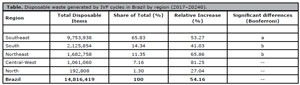
Table Disposable waste generated by IVF cycles in Brazil by region (2017–20240).