JBRA Assisted Reproduction 2025;29(Suppl.2 SBRA 2025):46
29th Annual Congress of the SBRA. São Paulo/SP - Brazil, 2025
doi: 10.5935/1518-0557.20263585
P-34. Beyond Weight Loss: Reproductive Outcomes of GLP-1 Use in Women with PCOS - A Review of Current Evidence
JBRA Assisted Reproduction 2025;29(Suppl.2 SBRA 2025):46
Poster Presentation
29th Annual Congress of the SBRA. São Paulo/SP - Brazil, 2025
doi: 10.5935/1518-0557.20263585
P-34. Beyond Weight Loss: Reproductive Outcomes of GLP-1 Use in Women with PCOS - A Review of Current Evidence
1Serviço de Ginecologia e Obstetrícia da Santa Casa de Porto Alegre - Porto Alegre - RS - Brasil
2 Pontifícia Universidade Católica do Rio Grande do Sul - Porto Alegre - RS - Brasil
3 Fertilitat - Porto Alegre - RS - Brasil
Objective: To analyze the reproductive outcomes associated with GLP-1 receptor agonists (GLP-1RAs) in women with polycystic ovary syndrome (PCOS) and infertility.
Methods: Narrative literature review conducted in June 2025 across PubMed, SciELO, and LILACS databases. The search included the descriptors: “weight loss medication,” “GLP-1 receptor agonists,” “liraglutide,” “semaglutide,” “fertility,” “PCOS,” and “reproductive outcomes.” Studies published between 2014 and 2025 were included, totaling 47 relevant articles.
Results: GLP-1RAs have demonstrated consistent metabolic benefits in women with PCOS and emerging positive reproductive outcomes. Clinical trials report improved menstrual regularity, ovulation, and pregnancy rates, both spontaneous and assisted, especially when combined with metformin. Liraglutide (1.2–3.0 mg/day) and exenatide (10 µg twice daily) have been associated with enhanced follicular development, restored ovulatory function, and improved endometrial receptivity. Recent evidence shows GLP-1 receptors are expressed in reproductive tissues, where these agents exert anti-inflammatory, antifibrotic, and androgen-lowering effects. Mechanistic studies demonstrate that liraglutide suppresses the chemokine CXCL10, restoring granulosa–oocyte communication. A randomized controlled trial showed that combining liraglutide with metformin yielded a pregnancy rate of 69.2%, versus 35.4% with metformin alone (p<0.05). Ovulation rates up to 86% have been reported with exenatide–metformin, surpassing monotherapies significantly (Table 1). Regarding pregnancy, GLP-1RAs are contraindicated during pregnancy due to insufficient human data and fetal risks in animal models. Semaglutide and tirzepatide require an 8–10 week washout period preconceptionally. Tirzepatide may also impair oral contraceptive efficacy due to delayed gastric emptying.
Conclusion: GLP-1RAs represent a promising preconceptional therapy in women with PCOS and obesity-related infertility. Their use has been linked to improved ovulation, endometrial receptivity, and pregnancy rates, especially in combination with metformin. While evidence in males is emerging, their use during pregnancy and lactation remains contraindicated. Individualized counseling is essential to align fertility planning with GLP-1RA therapy. legenda: SHBG - Sex Hormane-Binding Globulin; IMF -In Vitro Fertilization BID - Bis In Die FAI - Fat Attenuation Index.
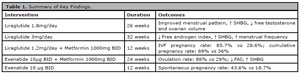
Table 1. Summary of Key Findings.
legenda: SHBG - Sex Hormane-Binding Globulin; IMF - In Vitro Fertilization BID - Bis In Die FAI - Fat Attenuation Index.