JBRA Assisted Reproduction 2025;29(Suppl.2 SBRA 2025):62
29th Annual Congress of the SBRA. São Paulo/SP - Brazil, 2025
doi: 10.5935/1518-0557.20263603
P-50. Correlation between Oocyte Maturity Rate and Development to Blastocyst: Analysis of Laboratory Indicators in the First Semester of 2025
JBRA Assisted Reproduction 2025;29(Suppl.2 SBRA 2025):62
Poster Presentation
29th Annual Congress of the SBRA. São Paulo/SP - Brazil, 2025
doi: 10.5935/1518-0557.20263603
P-50. Correlation between Oocyte Maturity Rate and Development to Blastocyst: Analysis of Laboratory Indicators in the First Semester of 2025
1 Bios Centro de Medicina Reprodutiva - Fortaleza - Ceará - Brasil
Objective: Oocyte quality is a determining factor for the success of in vitro fertilization (IVF). The quality of the oocyte cohort is essential for the success of in vitro fertilization (IVF), and the presence of immature eggs can significantly influence the results. Although immature eggs are not directly used, their quantity may reflect a decrease in the efficiency of the fertilization process and embryonic development, impacting the progression to blastocyst. This study aimed to evaluate the correlation between the oocyte maturity rate and the blastulation rate in IVF cycles performed between January and June 2025, and to discuss the possible impact
of immaturity on the collection yield.
Methods: Monthly data from cycles with intracytoplasmic sperm injection (ICSI) were analyzed. The laboratory indicators used
were:
Maturity rate: proportion of MII oocytes in the total oocytes retrieved.
Blastulation rate: proportion of embryos at the blastocyst stage in relation to the number of 2PN zygotes.
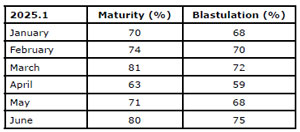
A positive correlation trend was observed between the two variables. Months with greater maturity (March and June) also presented the highest blastulation rates. On the other hand, April showed a significant decrease in both indicators.
Results: High oocyte immaturity not only affects the potential for embryonic development, but can also compromise the overall yield of the cohort, since the number of oocytes that can actually be used for ICSI is reduced. This early loss of potential, already at the time of collection, can negatively impact the outcomes of the cycle. Although immature eggs were not used, their presence may have compromised the microenvironment and the synchrony of embryonic development.
Conclusion: The presence of a high proportion of immature eggs, even without their direct use, can negatively impact the results of the IVF cycle, reducing the blastulation rate. The analysis reinforces the importance of oocyte maturity as a functional and strategic marker in the evaluation of laboratory quality. This suggests that, in addition to egg maturation, it is essential to monitor the quality of the cohort as a whole to optimize IVF success rates. Continuous monitoring allows adjustments in stimulation protocols, collection time and laboratory procedures, optimizing IVF results.