JBRA Assist. Reprod. 2026 2026;00(0):00-00
CASE REPORT
doi: 10.5935/1518-0557.20260110
Religious Beliefs and Refusal of Assisted Reproductive Technologies: A Qualitative Case Study
1Fertility Medical Group - São Paulo/SP, Brazil
2Fertility Medical Group / Fertgroup Medicina Reprodutiva - São Paulo/SP, Brazil
3Sapientiae Institute - São Paulo/SP, Brazil
CONFLICTS OF INTEREST
None.
ABSTRACT
This exploratory and descriptive qualitative case study examined how religious beliefs shaped decision-making and emotional experiences in a couple facing infertility who re-fused assisted reproductive technologies (ART), with partic-ular attention to moral distress concerning embryo status and the psychosocial implications of treatment refusal. Psy-chological follow-up in the context of reproductive counseling involved a heterosexual couple and a potential gestational carrier. Data were obtained from semi-structured interviews and projective graphic techniques within the House-Tree-Person framework, emphasizing human figure and family drawings. Interpretive qualitative analysis was used to iden-tify thematic categories and integrate narrative data with psychological assessment material. Three central processes emerged: moral distress anchored in the perceived moral status and anticipated fate of surplus embryos; value-based boundary-setting, in which embryo donation or disposal was considered morally unacceptable; and relational coping characterized by asymmetrical expressions of distress with-in the couple. Psychoeducation elicited repeated questions about embryo status, the number of embryos transferred, cryopreservation, and uterus transplantation, which func-tioned as markers of moral conflict. Projective material was interpreted as consistent with vulnerability, perceived impo-tence, and conflict between life projects and moral impera-tives. In this case, religiosity operated not only as a coping resource but also as a decisive framework that constrained acceptable reproductive options. Clinicians should provide non-coercive, empathic, and value-sensitive counseling that supports informed refusal while addressing grief, identity disruption, and moral distress.
Keywords: infertility, religiosity, assisted reproduction, treatment refusal, moral distress, psychological assess-ment
INTRODUCTION
Infertility often constitutes an individual and family crisis, requiring psychological adaptation, mourning of expected life trajectories, and redefinition of reproductive projects (Gameiro et al., 2015). The meaning assigned to infertility and to potential solutions is shaped by cultural and religious frameworks, which can organize suffering and hope while also delimiting morally acceptable pathways to parenthood (Oti-Boadi & Oppong Asante, 2017; Romeiro et al., 2017).
Assisted reproductive technologies may intensify ethical tension when procedures are interpreted as creating life outside the body or as interfering with divine order, particularly in contexts where embryos are granted full moral status (Leite & Henriques, 2014). Such tension can culminate in treatment refusal, an outcome that deserves clinical attention given its association with grief, relational strain, and potential long term distress. In Brazil, the ethical use of ART is guided by professional regulation, yet ethical permissibility does not necessarily translate into moral acceptability for patients (Leite & Henriques, 2014).
This case study explores how religious beliefs intersected with infertility related suffering and decision making in a couple confronted with ART options that were medically plausible but morally unacceptable to them. The aim is not to generalize, but to deepen clinical understanding of value anchored refusal and to articulate practice implications for psychological care in reproductive settings.
METHODS
Design
Exploratory and descriptive qualitative case study using multiple sources of clinical material.
Setting and timeframe
Participants were referred by the fertility service, and psychological follow up occurred in a hybrid format (private office and online). The assessment and follow up reportedly took place between September and October 2025.
Participants and clinical context
The focal unit was a married heterosexual couple: the woman (28 years) diagnosed during adolescence with MRKH syndrome, and her husband (29 years). The couple had been married for 3 years and, since the beginning of the relationship, openly discussed the possibility that biological parenthood might not be feasible. After medical clarification, they opted to consider gestational surrogacy.A third participant, the woman’s mother (47 years), was considered as a potential gestational carrier; she was separated, not currently in a relationship, and reported feeling pleased to support her daughter’s project. The children’s father was informed about the procedure. Three family members aged 12, 17, and 26 years also completed a semi directed interview and expressed support for the family project. The family identified as practicing Catholic.
Data sources and procedure
Data were collected through two complementary strategies:
1. Semi-structured interviews: Conducted in individual and joint/collective formats to observe family dynamics. Interviews explored emotional reactions to diagnosis, expectations of parenthood, religious and moral meanings, perceived acceptability of proposed options, and couple decision-making. The couple participated in one joint interview; the male partner additionally participated in one individual interview. The gestational carrier participated in three interviews (two individual and one joint with her daughter, the intended mother). The intended mother participated in three interviews (one individual, one joint with her husband, and one joint with her mother). The gestational carrier’s other children participated in one collective interview.Psychoeducation was provided during psychological sessions, and recurrent questions raised by participants were documented as clinically meaningful indicators of moral concern and decision-making conflict.
2. Projective graphic techniques: Within the HTP framework, the assessment emphasized the human figure drawing and family drawing as projective material to explore self-image, relational representations, and affective themes (Hammer, 1991; Machover, 1949; Trinca, 2020).
Analytic strategy
An interpretive qualitative approach was applied. Interview notes and salient statements were organized into thematic categories. Projective material was described first in concrete terms (content, omissions, positioning, salient elements) and then interpreted cautiously, integrating it with interview themes to avoid over interpretation (Hammer, 1991; Machover, 1949; Trinca, 2020). The analysis prioritized convergence across sources rather than single indicator conclusions.
Ethics
All identifying information was anonymized. The clinician received verbal authorization to use the case material for academic purposes. Ethical regulation governing reproductive care in Brazil is recognized as part of the contextual frame.
RESULTS
Overview of the decision making trajectory
During reproductive counseling, three broad reproductive pathways were discussed: (1) uterus transplantation, (2) IVF using the woman’s oocytes with embryo transfer to a gestational carrier (including the possibility of the woman’s mother as a solidarity carrier), and (3) adoption. Uterus transplantation was considered conceptually but not pursued as a near term option, consistent with its complexity and limited availability (Brännström, 2017). Counseling also addressed practical steps in IVF, including embryo creation, transfer strategies, and cryopreservation.As counseling progressed, the couple’s distress concentrated increasingly on a specific moral problem: what would happen to embryos that were created but not transferred. This anticipated scenario became the decisive factor in treatment refusal.
Theme 1. Moral distress centered on embryo sta-tus and the fate of surplus embryos
A core feature of the case was the couple’s persistent questioning about embryo status. They repeatedly sought clarity on whether an embryo should be understood as a cell cluster or as a living being with full moral standing. Their question was not merely informational. It functioned as a moral boundary test, reflecting fear of becoming responsible for outcomes they viewed as incompatible with their faith.Psychoeducation revealed recurrent questions that clarified the structure of their moral conflict:
• “Is the embryo a cell or a living being?” This emerged while completing the consent form; participants reported discomfort with disposal and fear regarding donations to others.These questions mapped directly onto ethical possibilities such as indefinite cryopreservation, donation to other couples, or embryo disposal. The couple expressed that donation would be experienced as giving away a child, whereas disposal would violate their religious principles, consistent with bioethical discussions in which embryo moral status becomes the hinge of moral reasoning and distress (Leite & Henriques, 2014; Straube & Melamed, 2018).
• “How many embryos will be transferred?”
• “For how long the embryo can remain frozen?”
• “Given my mother’s age, we believe she may carry only one child; my sister cannot carry now. How would uterus transplantation work?”
Theme 2. Value based refusal and narrowing of acceptable options
Although the couple initially engaged in the idea of IVF, their values progressively narrowed acceptable options. The prospect of creating multiple embryos and facing decisions about surplus embryos became intolerable. After reflection, the woman reported she could not continue the procedure for moral and emotional reasons. The couple described being shaken by the future scenario presented to them, particularly the obligation to decide what to do with surplus embryos.The gestational carrier option involving the woman’s mother was also ultimately rejected. In addition to practical concerns, the couple perceived that the carrier would likely not undergo another pregnancy and considered embryo donation unviable. Adoption emerged as the only pathway that felt aligned with their moral framework, despite grief related to genetic parenthood.
Theme 3. Couple and family dynamics: asymme-try of expression and protective containment
Interview material suggested different emotional styles between partners. The male partner was described as quiet for long periods, speaking less but offering key contributions. This dynamic can be understood as protective containment: one partner holding emotion internally while supporting the couple’s cohesion. Clinically, such asymmetry may reduce overt conflict but can obscure unmet support needs (Straube & Melamed, 2018).Importantly, interviews occurred both individually and in group format to observe family dynamics. The mother expressed satisfaction in contributing to her daughter’s project, and other family members who completed a semi directed interview also reported support for the family plan.
Projective material: descriptive findings and inte-grative interpretation (Figures 1 to 3)
Projective drawings were analyzed in a two-step manner: description followed by cautious interpretation, always triangulated with interview material (Hammer, 1991; Machover, 1949; Trinca, 2020).

Figure 1. Human figure drawing: The human figure drawing was treated as a window into self representation. Specific features in human figure drawings, including omissions or constrained expressiveness, are traditionally discussed in relation to insecurity, perceived inadequacy, and vulnerability, though such indicators are non specific and must be interpreted in context (Hammer, 1991; Machover, 1949). In this case, the human figure material was considered broadly consistent with reported feelings of impotence and constraint in relation to the life project of gestation. The omission/“amputation” of the feet may be interpreted as a symbolic representation of an absence or loss of the bodily capacity required to gestate one’s own child.
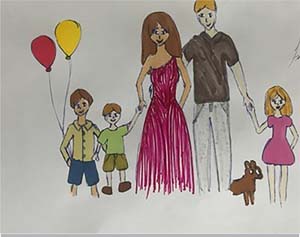
Figure 2. Family drawing (color): The family representation suggested strong investment in family formation and an idealized family scenario. The drawing was interpreted as compatible with ambivalence: intense desire alongside a boundary that prevents specific means of achieving parenthood (Trinca, 2020). The selective preservation of feet in the youngest child, contrasted with their omission in the couple and the two older children, may suggest differential perceived constraints across imagined family trajectories. One tentative reading is that the two older children may be read as foreclosed pathways to parenthood (e.g., spontaneous conception and ART), whereas the youngest child may be read as the only scenario experienced as remaining viable or intact.

Figure 3. Family with house (black and white): The inclusion of a house alongside the family group was considered a potential sign of emphasis on domestic stability, belonging, and protection. In narrative terms, it paralleled the couple’s prioritization of moral security and relational integrity over medical pursuit. This reading was treated as tentative and grounded in triangulation rather than as a stand alone conclusion (Hammer, 1991; Trinca, 2020).
Outcome: discontinuation of ART pursuit
Following the psychoeducational and reflective process, the woman reported she could not continue the procedure for moral and emotional reasons. Treatment pursuit was discontinued, and adoption remained the favored plan.
DISCUSSION
This case illustrates how ART refusal can be clinically coherent and value consistent, even when it intensifies grief. The findings underscore three relevant practice points.
1. Moral distress can become the central mecha-nism of refusal
The couple’s distress crystallized around moral responsibility for embryos. This aligns with bioethical analyses of ART, where the embryo’s moral status and the management of surplus embryos are among the most contested issues across religious traditions (Leite & Henriques, 2014). Clinically, moral distress is not resolved by providing more information only; counseling must facilitate values clarification and grief processing rather than persuasion.
2. Religiosity can function both as coping and as constraint
Religiosity often provides meaning, hope, and community support in infertility (Trevisan et al., 2023). In this case, it also functioned as a boundary setting system restricting acceptable options. Respecting refusal is consistent with ethical principles and with non coercive psychosocial care guidance in reproductive settings (Straube & Melamed, 2018).
3. Clinical implications: value sensitive counsel-ing and the ethics of refusal
For reproductive teams, the challenge is to support informed decision making while honoring value anchored limits. Practical implications include:
• using explicit language about embryo creation, transfer strategies, cryopreservation, and possible outcomes early in counseling
• screening for moral distress signals, such as repetitive questioning focused on embryo status and disposal
• providing space for structured values clarification and grief work, including mourning of genetic and gestational expectations
• documenting informed refusal clearly, consistent with ethical guidance in Brazilian practice.
Limitations
As a single case study, findings are not generalizable. Projective material is inherently interpretive and must be used cautiously and in triangulation with narrative data (Hammer, 1991; Trinca, 2020). Procedural details were not available for full reporting, including the duration of each interview. Verbatim transcripts were not available, and results rely on clinical documentation and summarized material.
CONCLUSION
Religious beliefs may decisively shape infertility related decision making and can lead to refusal of ART even when medical options are available. In this case, anticipated moral responsibility for surplus embryos became the decisive factor, producing moral distress and narrowing acceptable pathways. Clinicians should provide empathic, non-coercive, value sensitive counseling and support couples in processing grief and identity disruption while respecting informed refusal.
REFERENCES
Brännström M. Uterus transplantation and beyond. J Mater Sci Mater Med. 2017;28:70. PMID: 28357688 DOI: 10.1007/s10856-017-5872-0
Medline
Gameiro S, Boivin J, Dancet E, de Klerk C, Emery M, Lewis-Jones C, Thorn P, Van den Broeck U, Venetis C, Verhaak CM, Wischmann T, Vermeulen N. ESHRE guideline: routine psychosocial care in infertility and medically assisted reproduction-a guide for fertility staff. Hum Reprod. 2015;30:2476-85. PMID: 26345684 DOI: 10.1093/humrep/dev177
Medline
Oti-Boadi M, Oppong Asante K. Psychological health and religious coping of Ghanaian women with infertility. Biopsychosoc Med. 2017;11:20. PMID: 28706562 DOI: 10.1186/s13030-017-0105-9
Medline