JBRA Assisted Reproduction 2025;29(Suppl.2 SBRA 2025):64
29th Annual Congress of the SBRA. São Paulo/SP - Brazil, 2025
doi: 10.5935/1518-0557.20263626
P-52. Consulting with Dr. Google about fertility preservation and oocyte freezing: an analysis of the quality and reliability of the information shared
JBRA Assisted Reproduction 2025;29(Suppl.2 SBRA 2025):64
Oral Presentation
29th Annual Congress of the SBRA. São Paulo/SP - Brazil, 2025
doi: 10.5935/1518-0557.20263626
P-52. Consulting with Dr. Google about fertility preservation and oocyte freezing: an analysis of the quality and reliability of the information shared
1 Clinica ARTBH - Belo Horizonte - MG - Brasil
2 FALE-UFMG - Belo Horizonte - MG - Brasil
3 Clinica Origen - Belo Horizonte - MG - Brasil
4 UFMG - Belo Horizonte - MG - Brasil
Objective: To determine the quality and reliability of the top internet search results on fertility preservation and oocyte
cryopreservation available on Google using the DISCERN instrument.
Methods: A search was performed on Google in January 2025 using the terms: “Fertility preservation” and “oocyte cryopreservation”.
Pages containing information related to fertility preservation and oocyte cryopreservation were eligible but videos and ads were excluded. The first 3 pages of a search were evaluated as individuals rarely go beyond that. The DISCERN tool (http://www.discern.org.uk/discern_instrument.php) which comprises 16 questions was used to check the quality and reliability of the information.
SECTION 1: Is the publication reliable?
D1. Are the aims clear?
D2. Does it achieve its aims?
D3. Is it relevant?
D4. Is it clear what sources of information were used to compile the publication (other than the author or producer)?
D5. CIs it clear when the information used or reported in the publication was produced?
D6. Is it balanced and unbiased?
D7. Does it provide details of additional sources of support and information?
D8. Does it refer to areas of uncertainty?
SECTION 2: How good is the quality of information on treatment choices?
D9. Does it describe how each treatment works?
D10. Does it describe the benefits of each treatment?
D11. Does it describe the risks of each treatment?
D12. Does it describe what would happen if no treatment is used?
D13. Does it describe how the treatment choices affect overall quality of life?
D14. Is it clear that there may be more than one possible treatment choice?
D15. Does it provide support for shared decision-making?
SECTION 3. Overall Rating of the Publication
D16. Based on the answers to all of the above questions, rate the overall quality of the publication as a source of information
about treatment choices
Questions were scored from 1 to 5 (1 = no agreement; 3= partially agree; 5 = highest agreement) and the mean score among 3
authors was calculated. For each question, the mean score among three authors was calculated. No ethical approval was necessary
as only publicly available online information were used.
Results: Twenty-two Google pages were selected, all but one belonged to fertility clinics. DISCERN questions mean scores for each
question are shown on table 1.
Conclusion: Information on fertility preservation and oocyte freezing available on Google is heterogeneous despite being mostly provided by fertility clinics. DISCERN analysis reveals both quality and reliability are moderate. The information shared on Google on both topics is relevant and the aims are clearly presented, but it fails in terms of providing additional sources of support and areas of uncertainty nor does it properly describe the risks involved. Moreover, the quality of information on treatment choices is poor. As Google is a relevant source used by many people, the quality and reliability of information must be assessed as poorquality information can adversely impact and misguide users.
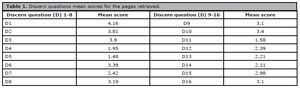
Table 1. Discern questions mean scores for the pages retrieved.