JBRA Assisted Reproduction 2025;29(Suppl.2 SBRA 2025):73
29th Annual Congress of the SBRA. São Paulo/SP - Brazil, 2025
doi: 10.5935/1518-0557.20263635
P-61. Does Ejaculatory Abstinence Time Affect Oocyte Fertilization Rate?
JBRA Assisted Reproduction 2025;29(Suppl.2 SBRA 2025):73
Oral Presentation
29th Annual Congress of the SBRA. São Paulo/SP - Brazil, 2025
doi: 10.5935/1518-0557.20263635
P-61. Does Ejaculatory Abstinence Time Affect Oocyte Fertilization Rate?
1 Androlab - Clínica da Fertilidade - Curitiba - PR - Brasil
Objective: According to the World Health Organization´s Laboratory Manual for the Examination of Human Semen, 2 to 7 days of abstinence before ICSI is recommended, while the European Society of Human Reproduction and Embryology (ESHRE, 2011) suggests a shorter interval of 3 to 4 days. This study aims to evaluate fertilization rates in ICSI cycles using sperm samples collected after different durations of ejaculatory abstinence. Recent studies have suggested that the duration of ejaculatory abstinence prior to semen collection may influence sperm quality and, consequently, fertilization outcomes in assisted reproductive technologies (ART). Shorter abstinence has been associated with improved sperm motility and DNA integrity, potentially enhancing ICSI outcomes.
Methods: A retrospective analysis was conducted on 561 ICSI cycles performed between 2023 and 2025 at a private assisted reproduction clinic. Semen samples were categorized by abstinence duration: Group 1 (<24 hours; n=181), Group 2 (24–36 hours; n=231), Group 3 (36–48 hours; n=82), Group 4 (48–60 hours; n=26), Group 5 (60–72 hours; n=20) and Group 6 (72–96 hours; n=21). Fertilization rates were analyzed across groups considering the presence of 1, 2 or 3 pronuclei between 16,5 and 18 hours post ICSI or cell cleavage on day 3. Statistical analysis was performed using a chi-square test (7 degrees of freedom); with p<0.05 considered statistically significant.
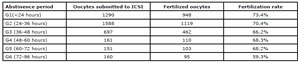
Results: Fertilization rates varied according to abstinence duration. Group 1 showed the highest fertilization rate (73.4%), whereas longer abstinence periods were generally associated with reduced fertilization outcomes (see table). Increasing abstinence hours prior to ICSI was associated with a significant decrease in fertilization rates (p=0.002). Notably, the decline in fertilization rates was more pronounced in the group with the longest abstinence (72–96 hours), which showed a reduction of over 14 percentage points compared to the shortest abstinence group (<24 hours), highlighting a clear negative trend with increasing abstinence duration.
Conclusion: Ejaculatory abstinence duration plays a significant role in fertilization success. An abstinence period shorter than 24 hours seems to optimize fertilization rates in ICSI treatments, showing significant better outcomes compared to longer abstinence periods. Further prospective studies evaluating blastocyst formation, implantation and clinical pregnancy rates are warranted to confirm these findings and refine clinical recommendations.