JBRA Assisted Reproduction 2025;29(Suppl.2 SBRA 2025):104
29th Annual Congress of the SBRA. São Paulo/SP - Brazil, 2025
doi: 10.5935/1518-0557.20263691
P-92. Factors Influencing Oocyte Yield in Infertile Patients: A Retrospective Cohort Analysis of Antral Follicle Count, Anti-Müllerian Hormone, and Age.
JBRA Assisted Reproduction 2025;29(Suppl.2 SBRA 2025):104
Poster Presentation
29th Annual Congress of the SBRA. São Paulo/SP - Brazil, 2025
doi: 10.5935/1518-0557.20263691
P-92. Factors Influencing Oocyte Yield in Infertile Patients: A Retrospective Cohort Analysis of Antral Follicle Count, Anti-Müllerian Hormone, and Age.
1 Clínica ProSer - Porto Alegre - RS – Brasil
2 Hospital de Clínicas de Porto Alegre - Porto Alegre – RS - Brasil
Objective: To evaluate the individual and combined influence of Antral Follicle Count (AFC), Anti-Müllerian Hormone (AMH), and Age on oocyte yield in a cohort of infertile patients undergoing IVF.
Methods: This retrospective cohort study was conducted at a clinic in Brazil, following ethical approval (CAAE: 89877325.9.0000.5327). An a priori sample size calculation estimated that a minimum of 47 patients would be necessary to detect a minimum expected effect of 10% in oocyte yield, considering an alpha error of 5%, a power of 80%, and a variance in oocyte count of 59. Inclusion criteria required patients to have complete baseline data for Age, AFC (measured on cycle days 2–3 via transvaginal ultrasonography, 2-10 mm follicles, adhering to international standards), and AMH (assayed using the Elecsys® AMH kit, Roche Diagnostics) prior to commencing the IVF cycle. Patients were excluded if they had incomplete data, did not undergo an IVF cycle, or lacked oocyte retrieval data. The primary outcome was the total number of oocytes collected during follicular aspiration in the IVF cycle that followed the initial AMH and AFC measurements. Data were extracted anonymously through the clinic's IT department, covering records from September 1, 2024, to May 30, 2025. For statistical analysis, a Negative Binomial Regression model was employed. This model was selected for its suitability in handling count data (oocyte numbers) and its ability to account for potential overdispersion, a common characteristic in biological data where the variance exceeds the mean. Model assumptions were assessed visually and analytically. Statistical analyses were conducted in R via Google Colab. Gemini 2.5 Flash, an AI assistant, was utilized for the generation of analytical scripts, interpretation of results, and grammatical refinement of the manuscript.
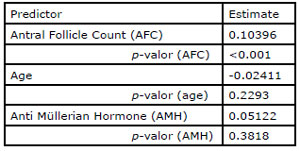
Results: From an initial cohort of 61 patients, 47 met the inclusion criteria. The descriptive statistics for the cohort were: a median age of 38 years (Interquartile Range [IQR]: 36-40), a median AMH level of 1.06 ng/mL (IQR: 0.4-2.2), and a median AFC of 12 (IQR: 7-16). The median number of retrieved oocytes for this group was 10 (IQR: 4-15). The Negative Binomial Regression model for oocyte count revealed that AFC emerged as a highly significant predictor of oocytes (estimate=0.10396, Std. Error=0.01486, p<0.001). Conversely, Age (estimate= -0.02411, Std. Error=0.02006, p=0.2293) and AMH (estimate=0.05122, Std. Error=0.05856, p=0.3818) did not demonstrate statistically significant effects on oocyte count in this multivariate model.
Conclusion: Antral Follicle Count is the most robust and significant predictor of oocyte yield in our patient cohort, superseding the predictive value of Age and AMH when all three are considered simultaneously in a multivariate model. A clinical implication is that AFC can be used as the primary tool for counseling patients on their expected oocyte retrieval numbers. For instance, based on our model, a patient with an AFC of 15, assuming typical age (e.g., 30 years) and AMH levels (e.g., 2.0 ng/mL), would be expected to yield approximately 16 oocytes. This study is limited by its retrospective nature and single-center design, which may affect the generalizability of the results. Nonetheless, by utilizing a robust statistical model (Negative Binomial Regression) that accounts for the nature of count data, these results can enhance patient counseling by providing more accurate expectations regarding oocyte retrieval based on individual AFC values, thereby supporting clinical decision-making.
Negative Binomial Regression Model