JBRA Assisted Reproduction 2025;29(Suppl.2 SBRA 2025):132
29th Annual Congress of the SBRA. São Paulo/SP - Brazil, 2025
doi: 10.5935/1518-0557.20263767
P-120. How Well do Antral Follicle Counts Correlate with Anti-Müllerian Hormone?
JBRA Assisted Reproduction 2025;29(Suppl.2 SBRA 2025):132
Poster Presentation
29th Annual Congress of the SBRA. São Paulo/SP - Brazil, 2025
doi: 10.5935/1518-0557.20263767
P-120. How Well do Antral Follicle Counts Correlate with Anti-Müllerian Hormone?
1 Clinica Proser - Porto Alegre - RS - Brasil
2 Hospital de Clinicas de Porto Alegre - Porto Alegre - RS - Brasil
Objective: To evaluate the predictive value of Antral Follicle Count (AFC) for estimating Anti-Müllerian Hormone (AMH) levels.
Methods: This cross-sectional, retrospective cohort study was conducted at a clinic in Brazil, following ethical approval (CAAE: 89877325.9.0000.5327). An a priori sample size calculation—based on an expected 70% correlation between AMH and AFC, with 1% alpha and beta errors—indicated a minimum of 35 participants. Infertile patients with recorded AMH and AFC values (measured on cycle days 2–3) were included; those with incomplete data were excluded. Data were extracted anonymously through the clinic's IT department, covering records from September 1, 2024, to May 30, 2025. AFC was measured via transvaginal ultrasonography (2–10 mm follicles), following international standards. AMH was assayed using the Elecsys® AMH kit (Roche Diagnostics). Due to AMH's skewed distribution and heteroscedasticity observed in initial linear models, a Generalized Linear Model (GLM) with a Gamma distribution and logarithmic link was applied. Model assumptions were assessed both visually and analytically (goodness-of-fit tests and Q–Q plots of standardized deviance/Pearson residuals). Statistical analyses were performed using JASP (version 0.19.3).
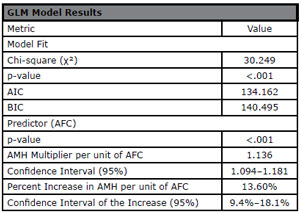
Results: From a total of 60 patients, the Generalized Linear Model demonstrated superior fit compared to a null model (χ2=30.249, p<.001; AIC=134.162; BIC=140.495). Residual diagnostics confirmed the GLM's suitability using a Gamma distribution and log link, with randomly dispersed residuals and improved normality compared to Ordinary Least Squares. AFC was a highly significant predictor of AMH levels (p<.001): for every one-unit increase in AFC, the expected mean AMH was multiplied by 1.136 (95% confidence interval [CI]: 1.094–1.181). This corresponds to a 13.6% increase (95%CI: 9.4%–18.1%) in expected mean AMH per additional antral follicle.
Conclusion: Our findings indicate that for each one-unit increase in AFC, the expected mean AMH is multiplied by 1.136 (95% CI: 1.094–1.181), corresponding to a 13.6% per-follicle increase. This multiplicative relationship is clinically relevant, with greater absolute changes at higher baseline AMH levels, consistent with the biomarker's underlying biology. These results reinforce AFC as a robust and predictive ovarian reserve marker. The developed model enables estimation of the expected mean AMH for any given AFC value, enhancing fertility counseling and clinical decision-making. The prediction formula is: AMH expected(ng/mL)=(2.7182818)(−1.216+(0.128×AFC)). For example, a patient with eight antral follicles is expected to have an AMH level of approximately 0.825 ng/ mL. Utilizing a Gamma GLM accounts for AMH variability, allowing for valid predictions and optimized patient-centered fertility management.