JBRA Assisted Reproduction 2025;29(Suppl.2 SBRA 2025):217
29th Annual Congress of the SBRA. São Paulo/SP - Brazil, 2025
doi: 10.5935/1518-0557.20263866
P-205. Semen quality of patients under fertility evaluation in an Andrology Laboratory
JBRA Assisted Reproduction 2025;29(Suppl.2 SBRA 2025):217
Poster Presentation
29th Annual Congress of the SBRA. São Paulo/SP - Brazil, 2025
doi: 10.5935/1518-0557.20263866
P-205. Semen quality of patients under fertility evaluation in an Andrology Laboratory
1 Universidade Federal Fluminense – Niteroi – RJ - Brasil
2 Banco de Sêmen do Rio de Janeiro - Rio de Janeiro – RJ -Brasil
Objective: To investigate the semen parameters (volume, concentration, progressive motility, and morphology) of patients under fertility investigation at an andrology laboratory.
Methods: This retrospective study was approved by the Research Ethics Committee of Universidade Federal Fluminense (protocol number 6.767.871). The study included 1,122 male patients who underwent to fertility evaluation at an andrology laboratory between May 2022 and January 2024. Semen samples were analyzed by volume, sperm concentration, motility, and morphology, according to the WHO manual (2021). Data are presented as mean and standard deviations, and compared with the reference values provided by the WHO manual.
Results: The mean age of patients was 39.2 years old (95% CI=38.8–39.6), and the mean ejaculatory abstinence period was 3 days (95% CI=2.9–3.0). The sperm characteristics are described in Table 1. In our study dataset of 1,122 samples, 99.8% (1,120) exhibited at least one semen parameter below the WHO lower reference limit. Semen analysis revealed teratozoospermia (95.5%), as the most prevalent abnormality, followed by asthenozoospermia (28.2%), severe oligozoospermia (22.3%), mild (9.2%), moderate (6.8%), and azoospermia (3%).
Conclusion: The results showed that almost all patients (99.8%) presented at least one semen parameter below the WHO reference limits, with teratozoospermia being the most frequent abnormality (95.5%), followed by asthenozoospermia (28.2%) and severe oligozoospermia (22.3%). These findings indicate a high degree of impaired semen quality in the studied population and reinforce the importance of semen analysis as a fundamental tool in the evaluation of male fertility. Furthermore, they suggest the need for preventive strategies, early diagnosis, and specialized follow-up to improve the reproductive prognosis of these individuals.
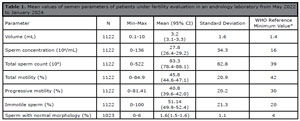
Table 1. Mean values of semen parameters of patients under fertility evaluation in an andrology laboratory from May 2022 to January 2024