JBRA Assisted Reproduction 2025;29(Suppl.2 SBRA 2025):158
29th Annual Congress of the SBRA. São Paulo/SP - Brazil, 2025
doi: 10.5935/1518-0557.20263931
P-146. Influence of Embryo Sex on the Euploidy Rate According to Maternal Age
JBRA Assisted Reproduction 2025;29(Suppl.2 SBRA 2025):158
Poster Presentation
29th Annual Congress of the SBRA. São Paulo/SP - Brazil, 2025
doi: 10.5935/1518-0557.20263931
P-146. Influence of Embryo Sex on the Euploidy Rate According to Maternal Age
1 CENAFERT Centro de Medicina Reprodutiva – SALVADOR – BA – Brasil
Objectives: This study aims to evaluate whether there is any relationship between embryo sex and the euploidy rate, in relation to maternal age, thus verifying differences in the proportions of euploid embryos between male and female sexes.
Methods: This is a retrospective cohort study of patients who underwent IVF (in vitro fertilization) cycles at a Human Assisted Reproduction clinic, whose embryos were submitted to PGT-A (Preimplantation Genetic Testing for Aneuploidies) analysis on days 5 and 6 of development with trophectoderm biopsy, between 2023 and 2024. The technique known as assisted hatching by laser was performed on some embryos on the 3rd day of development, followed by trophectoderm biopsy on the 5th or 6th day (after fertilization), depending on morphological parameters. The laser was also used for the biopsy, with the removal of 3 to 4 trophectoderm cells from these embryos. The samples were then analyzed by one of two partner companies (DASA and Igenomix) for screening of 24 chromosomes, including the sex chromosomes (X and Y). In our cohort, a total of 554 blastocysts from 203 cycles and 172 patients were included in the analysis. Of these, 254 were female embryos and 300 were male embryos. All embryos were inseminated using the ICSI (Intracytoplasmic Sperm Injection) technique. Data collected were grouped according to maternal age: group 1 (up to 34 years), group 2 (35–37 years), group 3 (38–40 years), group 4 (41–43 years), and group 5 (44 years and older). For the comparison of the proportion of euploid embryos between XX and XY sexes in each age group, Chi-square independence tests were used. In age group 5, Fisher's Exact test was applied due to the number being less than 5. Tests were conducted at a 5% significance level. In addition, a binary logistic regression was performed to assess the association between embryo sex and euploidy, adjusting for maternal age as an ordinal variable.
Results: After performing the analyses, it was found that none of the age groups showed a statistically significant difference between sexes regarding the euploidy rate (p>0.05 in all cases). However, in all age groups, XY embryos showed a slightly higher euploidy proportion than XX embryos. The probability of having a euploid embryo decreases with increasing maternal age, regardless of embryo sex. A significant reduction in the chance of euploidy with advancing maternal age is evident, especially from 38 years onwards (p<0.05). Stratified analysis by maternal age revealed that advancing age is strongly associated with a decreased euploidy rate, regardless of embryo sex. Conversely, logistic regression showed that embryo sex was not a significant predictor of euploidy after adjusting for maternal age (OR=1.12; p=0.54).
Conclusion: In summary, this study demonstrates that there is no significant association between embryo sex and embryonic euploidy rate when maternal age is taken into account. The data indicate that the patient's age has a more relevant impact on euploidy than embryo sex, corroborating the findings of Wang et al. (2018) and Fragouli et al. (2014), which reported similar results. Nevertheless, further research with larger samples is needed to confirm these results and expand understanding on the topic.
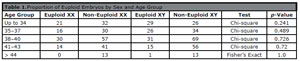
Table 1. Proportion of Euploid Embryos by Sex and Age Group