JBRA Assisted Reproduction
ORIGINAL ARTICLE
doi: 10.5935/1518-0557.20130058
Nurses acting in reproductive medicine: improving patient performance on self- medication
Atuação da enfermeira em Medicina Reprodutiva: melhorando o desempenho da paciente na auto-aplicação das medicações
1 Nurse
2 Clinician
3 Biologist
4 Biomedical
Institution: FERTIPRAXIS Centro de Reprodução Humana – RJ, Brasil.
Accredited Redlara center
RESUMO
Objetivo: As pacientes estão cada vez mais ansiosas com as informações recebidas sobre medicações. Como as enfermeiras podem atuar como elo entre o médico e as pacientes, desenvolvemos estratégia envolvendo-as na orientação às pacientes com suas injeções diárias durante o tratamento.
Metódos: Avaliação exploratória realizada entre médicos e a enfermeira resultou em lista de comentários sinalizando ansiedade relacionada à autoadministração das medicações. Os dois grupos identificaram pacientes inseguras quanto à administração das medicações e acharam que algo deveria ser feito. Em um segundo momento a consulta de enfermagem foi sistematizada com o objetivo de auxiliar as pacientes com suas aplicações diárias de medicação durante o tratamento. A consulta foi introduzida na rotina clínica como um piloto para os casais iniciando ciclos de RA. Um questionário foi introduzido posteriormente para avaliar as consultas de enfermagem.
Resultados: Foram agendadas 41 consultas e destas 35 efetivamente ocorreram, representando 85% de adesão. 24 pacientes receberam e 11 pacientes (46%) devolveram o questionário. Cinco pacientes relataram problemas prévios na manipulação das medicações. Duas pacientes continuaram com dificuldades na diluição das drogas. Três pacientes tiveram dificuldades em encontrar as agulhas apropriadas o que causou estresse adicional. Com relação ao modo de administração as pacientes preferiram canetas em vez de injeções com seringas. Todos os questionários ressaltaram a importância e clareza da consulta de enfermagem. Cinco de um total de 11 pacientes (45%) fizeram comentário adicional sobre a importância da consulta.
Conclusão: Nosso trabalho demonstra que as enfermeiras podem ser mais atuantes nos tratamentos de reprodução assistida.
Palavras chave: enfermeiras, IVF, medicação.
ABSTRACT
Objective: Patients are increasingly anxious about the amount of information received regarding the drugs and their profile. As nurses can act as an important bridge between physician orders and patients, we designed a strategy to enroll them assisting patients with their daily fertility treatment injections.
Methods: An exploratory survey was held by the clinicians and the nurse that resulted in a list of complaints pointing to anxiety concerning self-medication. Both groups were detecting patients characterized as insecure with medications and felt that something was needed to be done. In the second moment a nursing consultation was systematized in order to assist infertile patients with their daily fertility treatment injections. This consultation began being offered as a pilot in the clinical routine for couples who would start ART cycles. A questionnaire was introduced later to obtain feedback from nurse consultations.
Results: There have been 41 accepted and scheduled appointments with 35 consultations that represented 85% of adherence. 24 patients received the questionnaire and 11 (46%) returned. 5 patients related having had problems handling medications previously. Two patients still had problems diluting drugs. Three patients experienced difficulties of finding correct needles, what caused extra distress. Concerning the way of administration patients indicated that they preferred the preloaded pens instead of manually injections with syringes. All questionnaires point that nurse consultation was clear and important and 5 out of 11 (45%) yielded an extra comment marking it as outstanding for their treatment.
Conclusions: Our paper demonstrates that nurses can be involved more in ART treatments.
Key-words: nurses, IVF, medication
INTRODUCTION
The introduction of controlled ovarian stimulation (COS) for multiple follicular development significantly increased pregnancy rates (Trounson et al., 1981) due to many different protocols of ovarian stimulation. The refinement of protocols resulted in multiple protocols that can be used alone or in different combinations.
At the same time, patients are increasingly anxious about the amount of information received regarding the drugs and their profile: preloaded pens with medication, manually loaded injections with syringes needing different reconstituting, pre filled syringes with diluents plus lyophilized powder; pre filled syringe without need of reconstitution, a mix of all of these possibilities, etc.
As nurses can act as an important bridge between highly technical information, physician orders and patients, we designed a strategy to enroll them in our private practice in ART assisting patients with their daily fertility treatment injections and as a consequence to study resulting impacts on the patient`s treatments as well as in the IVF clinic routine.
MATERIALS AND METHODS
In the first moment an exploratory survey was held by the clinical director and the chief nurse, looking for information with their staffs about what they were noticing and/or hearing about problems related to patients performance on medication administration. At that time each physician was in charge of instructing patients on the specific protocol, and the nurse staff could help them, if required, in the beginning or during treatment.
There resulted a list of complaints on each group, both pointing to anxiety and stress concerning self medication. The first exploratory issue resulted that both groups, doctors and nursing staff, were detecting patients characterized by them as insecure with medications. For the doctors this generated several extra calls and for the nurses that patients were coming to the clinic unexpectedly or were referred to them by doctors starting from controls ultrasound to “check” application procedures. Either wrong procedures or inappropriate handling were frequent (around 20%). Both groups felt that something was needed to be done.
In the second moment a nursing consultation was prepared in order to assist infertile patients with their daily fertility treatment injections. This nursing consultation with estimated duration of 45 minutes began being offered as a pilot on August, 2012 in the clinical routine for couples who would start ART cycles.
The systematization included a defined approach for the query:
- Briefing explanation of the steps in ovulation induction with GnRH antagonist (almost 100% of cycles) or agonist protocols.
- Presentation of the medication, in brochures and in their original packaging. A suitcase demonstration kit (Figure 1) was created by nursing and enables patients to handle and simulates administration with special attention to dilutions whenever necessary. A tummy plastic (Nasco®) (Figure 2) and an intra-muscular/subcutaneous pad for simulation injections (Pharmabotics®) (Figure 3) was later introduced.
- The importance of asepsis of hands and area of the body to be injected was emphasized.
The place where the injection will be held and the environment in which the procedure will be performed is advised to be quiet to avoid any disturbance in attention during self- administration. - Advising on the importance of appropriate transport and storage of medications in a refrigerator at temperatures between 2 to 8 º C.
- Guiding for discarding properly the disposables like needles, syringes, used ampoules, etc.
- Giving general instructions for the day of oocyte aspiration.
Additionally, at this time the nurse emphasizes the need of returning the signed consent form prior to oocyte retrieval.
From November 2012 until January 2013 a questionnaire was introduced to obtain feedback from nurse consultations. The questionnaire consisted of eight questions concerning previous experience with ovulation protocols, handling experience with medications during the stimulation period and all approaches established to be explained during the consultation. At the end of each question there was a place to insert comments. Patients were instructed to complete the questionnaires at the end of controlled ovarian stimulation and to return it on the day of oocyte aspiration.
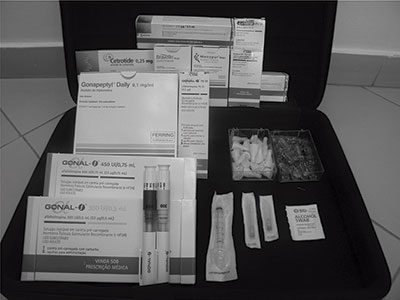
Figure 1. Suitcase demonstration kit
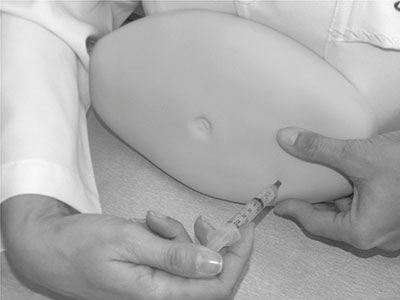
Figure 2. Tummy plastic (Nasco®)
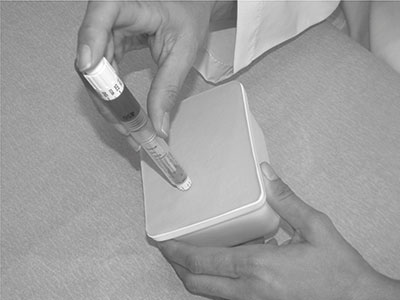
Figure 3. Intra-muscular/subcutaneous pad for simulation injections (Pharmabotics®)
RESULTS
During the period between August 2012 and January 2013, 110 cycles were performed. There have been 41 accepted and scheduled appointments with 35 consultations that represented 85% of adherence. 60% of women coming alone, 31% of couples and the others (9%) came with a friend or a family member.
At first, consultations were scarce, patients did not find important “to mark a schedule with the nurse” while others tried to minimize this query, saying quote, that “there was no time available”. Thus, in the first three months the number of consultations was 7, 2 and 3, respectively. In the following 4 months there happened 23 appointments.
24 patients received the questionnaire with 11 (46%) questionnaires returned. 5 patients related having had problems handling medications previously, including gonadotropins in ovulation induction cycles. Two patients still had problems diluting drugs, and one required a specific support from the nurse staff. The nurse had to go to one patient’s home to help her while the other came daily to the injections. All patients’ pointed that there were no problems in keeping and discharging disposables. Some patients brought the residues to the clinic to be correctly discharged. Even though having the correct needles specifications, three patients experienced difficulties of finding them in pharmacies, what caused extra distress. Concerning the way of administration patients also indicated that they preferred pre loaded pens instead of manually injections with syringes.
All questionnaires point that the nurse consultation was clear and important and 5 out of 11 (45%) yielded an extra comment marking it as outstanding for their treatment.
DISCUSSION
An ART centre is a whole team. So, naturally every arm is bound to developing skills and strategies to patients comfort and nursing practice in ART makes a significant contribution to patient care (Applegarth, 2012). In 2006 our attention was already focused on the importance of building a dialogue between teams and couples that would result in greater cooperation, complicity and attention to minimize adverse situations (Souza et al, 2006).
Along the practice we came to a conclusion that new approaches to the nurse staff were required. From the model of a bureaucratic leader, away from contact with the patients, and commanding others that would just been intermediates following standard guidelines, we aimed at a different perspective to improve nurses activities on our ART program.
Besides obstetrics and gynecology, nurses in this field are required to stay up-dated with knowledge of endocrinology, embryology, genetics and psychology (West, 2011). We have been supporting our group to this goal and this work reinforces that motivated staff is a valuable asset.
Once agreed that there would be a formal schedule for a nurse consultation, all the contents of these proceedings were planned. Photos and brochures were provided to be presented to patients, a time interval of 45 minutes was offered to each patient in the agenda.
In due time there happened new ideas coming from the nurse staff. Allowed to run it, the demonstration suitcase was built and the tummy plastic and an intra-muscular/subcutaneous pad for injection was added.
In our centre most patients do not live near the clinic and so it is very important that they learn to self medicate. Problems were identified to be more frequent whenever patients have to deal with diluting drugs than with the pre loaded pens. Although the use of these pens used to generate several calls and doubts before, even when the patients had already seen a specific video, now every patient declares that it is easier to handle these devices than manually injection with syringes.
Two patients declared that they identified a warm integration between the nurse and medical staff, that helped them to feel more secure about not only the medication but also for the procedures.
As patients began to bring the perforating cutting waste to be discarded in the clinic, we are routinely preventing improperly disposable. Thus we introduce them to the awareness of an ambient innovating care related to discharge of residues in IVF clinic.
Nowadays the adhesion to the nurse consultation is improved. The waiting room conversations between patients, though, as well as patients talk after pick-up or waiting for transfer certainly helped to propagate this opportunity. Every medical staff agrees that the calls regarding medications dropped. Such an individualized approach to COS a treatments protocol moves us into a new era of personalized medicine. It is not just to get patients pregnant (or not), but to be sure of the care they received from us. They must feel whole, and we will be satisfied as well.
CONCLUSIONS
Our paper demonstrates that nurses can be involved more in ART treatments. Additional skills can add expertise into improving patient’s performance on self-medication.
REFERENCES
Applegarth J.; Dwyer T.; Moxham L. Happell B. Identifying and acquiring the contextual skills and knowledge for nursing practice in assisted reproductive technology: a grounded theory study. J Clin Nurs. 2012; doi 10.1111/j.1365-2702.2012.04275.x. (epub ahead of print)
Medline Crossref
Trounson AO, Leeton JF, Wood C, Webb J, Wood J: Pregnancies in humans by fertilization in vitro and embryo transfer in the controlled ovulatory cycle. Science. 1981; 212: 681-682.
Medline Crossref