JBRA Assist. Reprod. 2025;29(Suppl 1):8-9
ORAL PRESENTATION
doi: 10.5935/1518-0557.20250066
O-08. Association between post-warming expansion and clinical pregnancy rate in single euploid embryo transfers
1INMATER fertility clinic. Lima, Perú
Objective: To assess whether the change in embryo expansion, measured immediately after warming and one hour later, is associated with clinical pregnancy in single euploid embryo transfers. Secondary analyses included clinical and embryological variables such as maternal age, oocyte source, embryo morphology, and KIDScore/IDAScore values.
Methods: A retrospective study was conducted at INMATER Fertility Clinic (Lima, Peru) between January 2024 and March 2025, including 753 single euploid embryo transfers with known clinical outcomes and available expansion data. Embryo expansion was assessed immediately after warming and one hour later. Based on the observed changes, embryos were classified into three expansion levels: collapsed (level 1), partially expanded (level 2), and fully expanded or zona pellucida-adhered (level 3). According to the delta (∆) between the two timepoints, embryos were categorized into groups: ∆-1 (decrease in expansion or collapse), ∆0 (no change), ∆+1 (moderate re-expansion with one-level improvement), ∆+2 (complete re-expansion with a two-level jump), and ∆ 3→3 (already expanded and continued development). The ∆0 group was used as the reference category in the multivariate analysis. Chi-square tests were applied for bivariate comparisons, and logistic regression was adjusted for clinical and embryological variables. Results were reported as odds ratios (OR) with 95% confidence intervals (CI).
Results: The overall clinical pregnancy rate was 51.26%. Compared to group ∆0, the likelihood of clinical pregnancy was significantly higher in group ∆+1 (OR 1.75; CI 1.23-2.50), group ∆+2 (OR 1.98; CI 1.21-3.25), and group ∆3→3 (OR 3.92; CI 1.65-9.31). Group ∆-1 showed no significant difference (p=0.505). Other variables, including maternal age, embryo quality, oocyte source, KIDScore/IDAScore, and day of transfer, were not significantly associated with clinical pregnancy, although KIDScore/IDAScore ≥7 showed a positive trend (p=0.075).
Conclusion: In single euploid vitrified embryo transfers, the change in expansion observed one hour after warming is significantly associated with clinical pregnancy. Embryos that did not re-expand (group ∆0) exhibited the lowest implantation potential. Monitoring post-warming expansion dynamics may represent a valuable, non-invasive criterion for embryo selection in deferred transfer cycles.
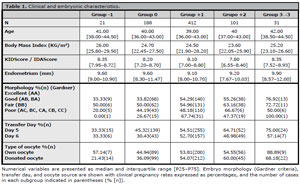
Table 1. Clinical and embryonic characteristics.
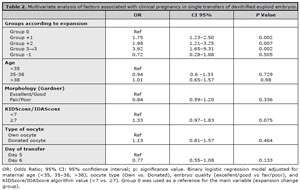
Table 2. Multivariate analysis of factors associated with clinical pregnancy in single transfers of devitrified euploid embryos.