JBRA Assist. Reprod. 2025;29(Suppl 1):57-57
POSTER PRESENTATION
doi: 10.5935/1518-0557.20250111
P-043. Key Findings from a Basic Genetic Screening in 741 Egg Donor Candidates from Argentina
1Igenomix Argentina, Buenos Aires, Argentina
2Igenomix Brasil, Sao Paulo, Brasil
3Igenomix España, Valencia, España
Objective: The screening of carrier candidates for egg donation is an increasingly common practice in gamete banks to confirm genetic compatibility and reduce the risk in offspring. Although there is not a consensus on the number of genes, some diseases are known to have a high number of carriers. We aimed to investigate what is the carrier rate with a limited gene panel designed for the study of egg donors in Argentina.
Methods: This is a retrospective study. A total of 741 Argentinian women, with no history of genetic pathology, underwent a carrier screening panel designed for egg donors between October 2021 and January 2025. The carrier screening panel involved the detection of pathogenic variants in CFTR, CYP21A2, GJB2 (GJB6), HBA, HBB, SMN1, and 64 X-linked genes through exome sequencing or complementary techniques.
Results: 27.4% (n=203/741) of the candidates carried at least one variant: 24.6% were carriers of one disease, and 2.83% were carriers of two diseases. The carrier rates from the positive results were as follows (table 1):
• Cystic fibrosis (CFTR): 25.62% (52/203)
• Congenital adrenal hyperplasia (CYP21A2): 41.87% (85/203)
• Autosomal recessive deafness (GJB2/GJB6): 17.24% (35/203)
• Alpha-thalassemia (HBA1 / HBA2): 12.32% (25/203)
• Hemoglobinopathies (HBB): 3.94% (8/203)
• Spinal muscular atrophy (SMN1): 5.42% (11/203)
Regarding CYP21A2, 56,47% of the carriers had the pathogenic variant c.844G>T/p.Val282Leu, which is associated with the nonclassical form of the disease.Ten women from the 203 positive results were carriers of X-linked diseases (4.92%) (1.3% of the total), including Fragile X syndrome (FMR1), G6PD deficiency (G6PD), Fabry disease (GLA), X-linked spondyloepiphyseal dysplasia (ARSL), and hemophilia A (F8). Additionally, three women were carriers of both a recessive and an X-linked disorder.
Conclusion: It is important to note that at least 25% of the candidates were identified as carriers in a basic screening, highlighting the critical need for genetic matching in egg donation programs. The results of a carrier panel depend on the methodology used, the number of genetic variants analyzed, and the specific study population. Additionally, from the positive carriers, nearly 5% of the candidates were found to have variants predisposing to X-linked conditions, which confer a 25% of risk of having an affected male offspring. This type of genetic panels allows a safer selection of egg donors candidates.
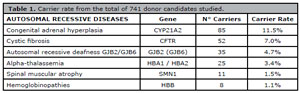
Table 1. Carrier rate from the total of 741 donor candidates studied.