JBRA Assist. Reprod. 2025;29(Suppl 1):61-62
POSTER PRESENTATION
doi: 10.5935/1518-0557.20250114
P-046. Comparative Analysis of Machine Learning Models for Predicting Sperm DNA Fragmentation Index based on Sperm Parameters
1Inmater Fertility Clinic, Lima, Peru
2Keck Graduate Institute, Claremont, CA, USA
Objective: To determine whether the sperm DNA fragmentation index (DFI) can be predicted using sperm parameters from a computer-assisted semen analysis (LensHooke®) and patient age through artificial intelligence models.
Methods: This retrospective study analyzed data from January to December 2023. Inclusion criteria: cases with available DFI results, semen analysis performed using Lenshooke® X1 PRO, and semen culture results from the same sample. Exclusion criteria: positive semen culture, abstinence outside 2-7 days, and sperm concentrations below 2 million spermatozoa/mL. Normality was assessed using the Kolmogorov-Smirnov test. Since data was not normally distributed, Spearman’s correlation identifies variables significantly associated with DFI. The DFI variable was classified into three categories: low (<15), medium (15-30), and high (30≤). The Kruskal-Wallis and Mann-Whitney U tests assessed differences between DFI categories, selecting significant variables for predictive modeling. The dataset was split (80% training, 20% validation) with k-fold cross-validation. Five machine learning models were developed and compared: k-nearest neighbors (KNN), random forest (RF), support vector machine (SVM), logistic regression (LR), and multilayer perceptron (MLP). Model performance was evaluated using accuracy, precision, recall, F1-score, and area under the curve (AUC). All statistical analyses and modeling were performed using Python libraries.
Results: The final filtered dataset included 300 samples. A total of 32 variables showed a correlation with DFI (Table 1). A pairedgroup analysis identified 29 significant variables. These variables were then used to train and validate the five models using the same split ratio and cross-validation strategy. An analysis of the mean performance across the five folds was conducted, and a ranking was established (Table 2). The best-performing model was KNN, followed by RF, both exhibiting similar performances. MLP showed the lowest performance across all evaluated metrics, making it the least effective predictive model in this study.
Conclusion: These findings suggest that artificial intelligence demonstrates potential for predicting DFI using semen parameters and patient age. KNN and RF outperformed other models. Further data collection is planned to validate these findings with a larger dataset, as well as to assess their clinical applicability.
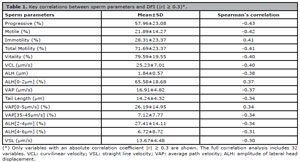
Table 1. Key correlations between sperm parameters and DFI (|r| ≥ 0.3)*.
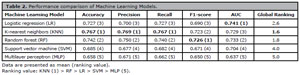
Table 2. Performance comparison of Machine Learning Models.