JBRA Assisted Reproduction 2026;30(3):591-593
ORIGINAL ARTICLE
doi: 10.5935/1518-0557.20260055
Short Communication: Conflicting Conclusions in PGT-A: Live Birth Rates per Initiated Cycle or Oocyte Retrieval Show No Benefit, but Significant Improvement per Embryo Transfer
1Center for Human Reproduction Prof. Franco Jr, Ribeirão Preto, Brazil
2Paulista Center for Diagnosis - Research and Training, Ribeirão Preto, Brazil
3Department of Gynecology and Obstetrics, São José do Rio Preto School of Medicine (FAMERP), São José do Rio Preto, Brazil
4University of Beira Interior - Faculty of Health Sciences, Covilhã, Portugal
5Reproductive Medicine Unit - University Hospital Centre Cova da Beira, Covilhã, Portugal
CONFLICT OF INTEREST
The authors declare no conflict of interest.
ABSTRACT
Objective: To determine whether studies evaluating preimplantation genetic testing for aneuploidy (PGT-A) reach different conclusions depending on the denominator used to calculate live birth rates.
Methods: A systematic review of studies published be-tween 2017 and 2025 was conducted using PubMed, Sco-pus, and Google Scholar. Randomized and non-randomized studies comparing IVF/ICSI cycles with and without PGT-A were included. Outcomes were analyzed per initiated cy-cle, oocyte retrieval, or embryo transfer. Relative risks were calculated using a random-effects model.
Results: Eleven studies were included. No significant difference was observed when live birth rates were ana-lyzed per initiated cycle or oocyte retrieval (RR 1.04, 95% CI 0.91-1.18). However, PGT-A significantly improved live birth rates when analyzed per embryo transfer (RR 1.21, 95% CI 1.05-1.40).
Conclusion: The apparent benefit of PGT-A depends on the denominator used. Reporting outcomes per embryo transfer introduces selection bias and overestimates treat-ment effectiveness. Clinically meaningful outcomes should be reported per initiated cycle or oocyte retrieval.
Keywords: PGT-A, live birth rate, IVF, embryo transfer, initiated cycle
INTRODUCTION
There are several ways to define success in assisted reproductive technologies (ART). Traditionally, researchers place the outcome in the numerator, such as ongoing pregnancy or live birth, and use as the denominator the number of oocyte retrievals or embryo transfers, but rarely the number of initiated cycles.
In some studies, the numerator refers simply to the presence or absence of a live-born infant, without a standardized definition regarding gestational age, derived from a single oocyte retrieval that may include outcomes from both fresh and frozen embryo transfers. In fact, there is no universal consensus regarding the optimal methodology to define success in ART. Even among major ART registries, such as ESHRE, SART, REDLARA, and ICMART, outcome metrics differ substantially (Fauser & Franx, 2026). These discrepancies may significantly influence the final medical interpretation of the effectiveness of any ART intervention. Preimplantation genetic testing for aneuploidy (PGT-A) has been proposed as a strategy to improve IVF/ICSI outcomes by selecting euploid embryos for transfer. Although several studies have suggested improved implantation and live birth rates with PGT-A, its universal clinical benefit remains controversial. One of the main methodological factors contributing to conflicting conclusions is the choice of denominator used to calculate live birth rates. Outcomes may be reported per initiated cycle, per oocyte retrieval, or per embryo transfer. Reporting outcomes per embryo transfer excludes cycles in which no embryos reach the transfer stage, thereby introducing selection bias and potentially overestimating treatment effectiveness.
Therefore, the objective of the present study was to evaluate whether comparative studies of IVF/ICSI cycles with or without PGT-A reach different conclusions depending on the denominator used to calculate live birth rates.
MATERIALS AND METHODS
A comprehensive literature search was conducted in PubMed, Scopus, and Google Scholar covering publications from 2017 to 2025. The search included the keywords “PGT-A”, “morphological embryo selection”, and “live birth rate”. Randomized and non-randomized studies comparing IVF/ICSI cycles using PGT-A versus conventional morphological embryo selection (MES) were eligible. Studies were categorized into two groups according to the reported denominator: Group I included studies reporting live birth rates per initiated cycle or per oocyte retrieval, and Group II included studies reporting live birth rates per embryo transfer only.
Statistical Methods
Data were extracted independently and analyzed using StatsDirect statistical software. Dichotomous outcomes were expressed as relative risk (RR) with 95% confidence intervals (CI). A random-effects model was applied to account for between-study variability. Statistical heterogeneity was assessed using Cochran's Q test and the I2 statistic. Statistical significance was defined as p<0.05.
RESULTS
A total of eleven studies met the inclusion criteria and were included in the quantitative analysis. In Group I, which included studies reporting live birth rates per initiated cycle or oocyte retrieval, no statistically significant difference was observed between PGT-A and conventional morphological embryo selection. The overall live birth rate was 54.7% (696/1273) in the PGT-A group and 54.0% (567/1050) in the control group (RR 1.04, 95% CI 0.91-1.18; I2=44.5%). See Table 1A.
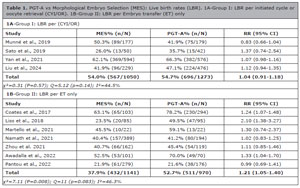
Table 1. PGT-A vs Morphological Embryo Selection (MES): Live birth rates (LBR). 1A-Group I: LBR per initiated cycle or oocyte retrieval (CYI/OR). 1B-Group II: LBR per Embryo transfer (ET) only
χ2=7.11 (P=0.008); Q=11 (p=0.083); I2=46.3%
DISCUSSION
Recent position statements from major reproductive medicine societies have raised important concerns regarding the routine use of PGT-A. The Practice Committees of the American Society for Reproductive Medicine and the Society for Assisted Reproductive Technology (2024). noted that although the use of PGT-A has increased and the underlying technologies continue to evolve, its value as a routine screening test for all IVF patients has not been demonstrated. While earlier single-center studies suggested higher live birth rates among patients with a favorable prognosis, more recent multicenter randomized controlled trials have reported similar outcomes between PGT-A and conventional IVF when frozen embryo transfer is performed. The value of PGT-A in reducing clinical miscarriage also remains uncertain. Similarly, the European Society of Human Reproduction and Embryology concluded that currently available data show only limited improvement in live birth rates with PGT-A, and that claims of reduced miscarriage rates or shorter time to pregnancy in specific subgroups require further validation (ESHRE Add-ons working group, 2023).
Despite these cautious recommendations, the use of PGT-A continues to increase worldwide. The findings of the present study may help explain why conclusions in the literature appear contradictory. The perceived effectiveness of PGT-A depends heavily on the denominator used to calculate live birth rates. When outcomes are reported per initiated cycle or per oocyte retrieval-metrics that more accurately reflect the patient experience and treatment burden-PGT-A does not improve live birth rates compared with conventional embryo selection (Munné et al., 2019; Sato et al., 2019; Yan et al., 2021; Liu et al., 2024). However, when outcomes are reported per embryo transfer only, PGT-A appears to confer a significant benefit (Coates et al., 2017; Liss et al., 2018; Martello et al., 2021; Namath et al., 2021; Zhou et al., 2021; Awadalla et al., 2022; Pantou et al., 2022).
This apparent benefit is largely attributable to selection bias, as cycles without transferable embryos-either because no embryos reach the blastocyst stage or because all embryos are classified as aneuploid-are excluded from the analysis. Consequently, reporting outcomes per embryo transfer artificially enriches the analyzed population with patients of more favorable prognosis. Clinically meaningful outcome measures should reflect the probability of live birth per initiated treatment, as this represents the true effectiveness of IVF from the patient's perspective.
The lack of standardized reporting contributes substantially to the ongoing controversy regarding PGT-A. Until consistent and unbiased outcome definitions are adopted, conflicting conclusions regarding its clinical utility will persist. Future studies should prioritize reporting live birth rates per initiated cycle and per oocyte retrieval. From both a mathematical and clinical standpoint, current evidence does not support a universal benefit of PGT-A when evaluated using unbiased denominators. Reproductive medicine societies should define, with greater precision, which metrics best represent success in ART.
CONCLUSION
The apparent benefit of PGT-A depends on the denominator used. Reporting outcomes per embryo transfer introduces selection bias and overestimates treatment effectiveness. Clinically meaningful outcomes should be reported per initiated cycle or oocyte retrieval.
REFERENCES
Awadalla MS, Agarwal R, Ho JR, McGinnis LK, Ahmady A. Effect of trophectoderm biopsy for PGT-A on live birth rate per embryo in good prognosis patients. Arch Gynecol Obstet. 2022;306:1321-7. PMID: 35821525 DOI: 10.1007/s00404-022-06679-x
Medline
Coates A, Bankowski BJ, Kung A, Griffin DK, Munne S. Differences in pregnancy outcomes in donor egg frozen embryo transfer (FET) cycles following preimplantation genetic screening (PGS): a single center retrospective study. J Assist Reprod Genet. 2017;34:71-8. PMID: 27853913 DOI: 10.1007/s10815-016-0832-z
Medline
ESHRE Add-ons working group; Lundin K, Bentzen JG, Bozdag G, Ebner T, Harper J, Le Clef N, Moffett A, Norcross S, Polyzos NP, Rautakallio-Hokkanen S, Sfontouris I, Sermon K, Vermeulen N, Pinborg A. Good practice recommendations on add-ons in reproductive medicine†. Hum Reprod. 2023;38:2062-104. PMID: 37747409 DOI: 10.1093/humrep/dead184
Medline
Fauser BC, Franx A. Value-based outcome measures for ART: much room for improvement. Reprod Biomed Online. 2026;52:105179. PMID: 41237743 DOI: 10.1016/j.rbmo.2025.105179
Medline
Liss J, Pastuszek E, Pukszta S, Hoffmann E, Kuczynski W, Lukaszuk A, Lukaszuk K. Effect of next-generation sequencing in preimplantation genetic testing on live birth ratio. Reprod Fertil Dev. 2018;30:1720-7. PMID: 29929575 DOI: 10.1071/RD17428
Medline
Liu Y, Lan X, Lu J, Zhang Q, Zhou T, Ni T, Yan J. Preimplantation Genetic Testing for Aneuploidy Could Not Improve Cumulative Live Birth Rate Among 705 Couples with Unexplained Recurrent Implantation Failure. Appl Clin Genet. 2024;17:1-13. PMID: 38322806 DOI: 10.2147/TACG.S441784
Medline
Martello CL, Kulmann MIR, Donatti LM, Bos-Mikich A, Frantz N. Preimplantation genetic testing for aneuploidies does not increase success rates in fresh oocyte donation cycles: a paired cohort study. J Assist Reprod Genet. 2021;38:2909-14. PMID: 34611788 DOI: 10.1007/s10815-021-02339-2
Medline
Munné S, Kaplan B, Frattarelli JL, Child T, Nakhuda G, Shamma FN, Silverberg K, Kalista T, Handyside AH, Katz-Jaffe M, Wells D, Gordon T, Stock-Myer S, Willman S; STAR Study Group. Preimplantation genetic testing for aneuploidy versus morphology as selection criteria for single frozen-thawed embryo transfer in good-prognosis patients: a multicenter randomized clinical trial. Fertil Steril. 2019;112:1071-9.e7. PMID: 31551155 DOI: 10.1016/j.fertnstert.2019.07.1346
Medline
Namath A, Jahandideh S, Devine K, O'Brien JE, Stillman RJ. Gestational carrier pregnancy outcomes from frozen embryo transfer depending on the number of embryos transferred and preimplantation genetic testing: a retrospective analysis. Fertil Steril. 2021;115:1471-7. PMID: 33691932. DOI: 10.1016/j.fertnstert.2021.01.010
Medline
Pantou A, Mitrakos A, Kokkali G, Petroutsou K, Tounta G, Lazaros L, Dimopoulos A, Sfakianoudis K, Pantos K, Koutsilieris M, Mavrou A, Kanavakis E, Tzetis M. The impact of preimplantation genetic testing for aneuploidies (PGT-A) on clinical outcomes in high risk patients. J Assist Reprod Genet. 2022;39:1341-9. PMID: 35338417 DOI: 10.1007/s10815-022-02461-9
Medline
Practice Committees of the American Society for Reproductive Medicine and the Society for Assisted Reproductive Technology. Electronic address: asrm@ asrm.org. The use of preimplantation genetic testing for aneuploidy: a committee opinion. Fertil Steril. 2024;122:421-34. PMID: 38762806 DOI: 10.1016/j.fertnstert.2024.04.013
Medline
Sato T, Sugiura-Ogasawara M, Ozawa F, Yamamoto T, Kato T, Kurahashi H, Kuroda T, Aoyama N, Kato K, Kobayashi R, Fukuda A, Utsunomiya T, Kuwahara A, Saito H, Takeshita T, Irahara M. Preimplantation genetic testing for aneuploidy: a comparison of live birth rates in patients with recurrent pregnancy loss due to embryonic aneuploidy or recurrent implantation failure. Hum Reprod. 2019;34:2340-8. PMID: 31811307 DOI: 10.1093/humrep/dez229. Erratum in: Hum Reprod. 2020;35:255. PMID: 31811307 DOI: 10.1093/humrep/dez289
Medline
Yan J, Qin Y, Zhao H, Sun Y, Gong F, Li R, Sun X, Ling X, Li H, Hao C, Tan J, Yang J, Zhu Y, Liu F, Chen D, Wei D, Lu J, Ni T, Zhou W, Wu K, et al. Live Birth with or without Preimplantation Genetic Testing for Aneuploidy. N Engl J Med. 2021;385:2047-58. PMID: 34818479 DOI: 10.1056/NEJMoa2103613
Medline
Zhou T, Zhu Y, Zhang J, Li H, Jiang W, Zhang Q, Lu J, Yan J, Chen ZJ. Effects of PGT-A on Pregnancy Outcomes for Young Women Having One Previous Miscarriage with Genetically Abnormal Products of Conception. Reprod Sci. 2021;28:3265-71. PMID: 33721295 DOI: 10.1007/s43032-021-00542-1
Medline