JBRA Assist. Reprod. 2009;13(2):39-40
RELATO DE CASO
doi: 10.5935/1518-0557.2010.13.2.08
Efeitos em longo prazo sobre a criopreservação de espermatozóides humanos: 17 anos
Long-term effects of cryopreservation on human spermatozoa: 17 years
1Institute of Biological Sciences (ICBS), Pontifical Catholic University of Minas Gerais
2I.R.H. - Institute of Human Reproduction, BH/MG
3Institute of Gynecology (IG), Federal University of Rio de Janeiro
RESUMO
Este trabalho apresenta viabilidade espermática após 17 anos de congelamento. Um paciente com diagnóstico de câncer renal procurou o serviço de congelamento de sêmen. Após 17 anos, ele procurou o serviço para descarte do material, assinando autorização prévia. O descongelamento e à análise do material ocorreram em seguida. A comparação dos resultados mostrou uma redução da atividade espermática para o sêmen fresco em 59,26%. Considerando-se a morfologia, o descongelamento mostrou uma redução de 32,5% em relação ao sêmen fresco. A motilidade espermática diminuiu 48%. O casal (mulher com 26 anos) realizou uma inseminação intrauterina em 2009, obtendo êxito na primeira tentativa.
Palavras-chave: câncer, banco de sêmen, espermatozóide.
ABSTRACT
This paper presents spermatic feasibility after 17 years of freezing. A young man affected by renal cancer sought the sperm freezing service. After 17 years he asked for disposal and signed an authorization term. The thawing and the analysis of the material took place. The comparison of the findings showed an activity reduction from the thawing to the fresh semen in 59,26%. Considering the morphology, the thawing showed a reduction of 32,5% in relation to the fresh semen. The spermatic motility decreased 48% in relation to the fresh semen. The couple (26 years old woman) held one intrauterine insemination in 2009, obtaining success in the first attempt.
Keywords: cancer, sperm banking, spermatozoa.
INTRODUCTION
Semen freezing techniques present reports since the 18th century through Spallanzani’s works in 1776 with observations on the survival of spermatozoa after freezing. It is generally accepted, however, that Christopher Polge, Andrey Smith and Alan Parkes were the first scientists to demonstrate the possibility of using, in a reproducible way, the technology of semen cryopreservation. They also demonstrated that glycerol had properties and particularities as a cryoprotectant (Polge et al., 1949).
The technological development of the semen cryopreservation is grounded on the need of the survival of cells of spermatogenic lineage for years and, many times, for decades. Thus, the main objective is to cryopreserve man’s fertilizing capacity in liquid nitrogen at the temperature of minus 196o C and to maintain its feasibility after thawing. The addition of cryoprotector solutions diminishes the damages caused to the cells, due to the formation of intracellular ice crystals. Among the most used cryoprotectants are glycerol, dimethylsulfoxide and 1-2 propanediol (Donnelly et al. 2001).
Nowadays, several indications lead to the spread of the human cryopreservation services. Among these indications, the freezing of samples prior to chemotherapy and / or radiotherapy stand out. Therefore, the seminal freezing should precede chemotherapic and radiotherapic treatments as they usually cause aplasia in the germinative cells. The asynchrony of the reproductive activity among patients who undergo assisted reproduction techniques determines another indication with relative incidence (Anger et al., 2003).
CASE REPORT
In February 1992, a 24 year-old man affected by renal cancer sought the sperm freezing service, before the beginning of radiotherapy and chemotherapy. The semen was mixed volume by volume and homogenized in solution containing 6% of glycerol and a tampon solution containing (TES) N-tris (hydroxymethyl) methyl-2- aminoethanol-sulphonic acid and TRIS (hydroxymethyl) amino methane and warmed egg yolk. The final solution was inserted in 0, 5 mL blades from IMV® (France). Next, the blades were put in aluminum racks. The solution was slowly cooled in a liquid nitrogen barrel at minus 80°C and stored in liquid nitrogen at minus196°C. The cooling rate of the dry-shipper and its period of useful time, established under laboratory conditions, were respectively 25.7-30.8 ◦C/min (between 0 and -60 ◦C) and 9 days after charging (Taitson et al., 2008).
In May 2009, 17 years and two months after the freezing, the patient, now 41 years old, no longer needed the maintenance of the frozen semen. After signing the disposal authorization term, the blades were submitted to room temperature for 10 minutes to be thawed.
The comparison of the findings from the fresh sample results and the post-thawed showed an activity reduction in 59,26%. Considering the morphology, the thawing resulted in a reduction of 32,5% in relation to the fresh semen while the spermatic motility (A+B) decreased 48% in relation to the fresh semen (Table 1).
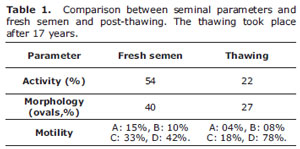
Table 1. Comparison between seminal parameters and fresh semen and post-thawing. The thawing took place after 17 years.
DISCUSSION
High-dose chemotherapy and radiotherapy have increased long-term survival of young patients with cancer. Sometimes however, the price paid is both ovarian and testis failure and sterility. It is important to detect who are the patients at risk in order to verify when fertility preservation is indicated. After conventional chemotherapy, there are significant differences in ovarian and testis failure rate according to patients` age, the disease for which patients were treated for and the drugs used. Bone marrow transplantation in cancer patients almost invariably induced ovarian failure, irrespective of patient age, treatment protocol or administration of hormonal treatment (Meirow, 2000; Taitson & Souza, 2008).
During the cryopreservation process, the cells go through morphological alterations which can cause their death. These alterations occur at the plasmatic membrane level of the head and the intermediate piece of spermatozoa. Therefore, the preservation state of the spermatic membranes is decisive for the success of cryopreservation. The success of this technique requires the cooling rates to be situated, in general, between 10 and 50o C / minute (Anger et al., 2003).
The recrystallization invariably occurs during thawing, creating intracellular ice, which is lethal (the several small ice crystals that exist are converted into few crystals, though bigger, when the thawing is slow). For this reason, a high rate of thawing is usually used in order to diminish the level of recrystallization. When the thawing is rapid, there is not enough time for the dehydrated cells to absorb the quantity of water that was lost during freezing.
In March 2004, it was reported that a baby was born from semen frozen for 21 years and sent to the in vitro fertilization technique. In 2005, it was observed that semen of two individuals was frozen for 21 and 28 years and both sent to intrauterine insemination, resulting in the birth of two babies (Horne et al., 2004; Feldschuh et al., 2005). Rofeim and Gilbert (2005) evaluated the long-term effects of cryopreservation on spermatozoa of men with testicular cancer, lymphoma, and benign conditions. No statistically significant decrease in semen parameters was noted. Duration of follow-up was up to 5 years and mean follow-up was 2 years.
Another study in 2005 evaluated 238 individual semen samples collected from 34 patients (18 had cancer) between 1976 and 1989. The maximum cryopreserved sperm deposits took 21 years. All semen parameters were worse than the fresh ones and semen motility loss was 80%. The semen deterioration criteria were more directly related to the initial freezing than to the length of storage (Bolten et al., 2005).
Clarke et al (2006) studying six semen samples after more than 28 years of storage in liquid nitrogen showed recovery of human sperm motility and ability to interact with the human zona pellucida. Normal acrossomic reaction was established in 4 samples. They call attention to semen cryopreservation prior to chemotherapy.
A recent study showed that only 27% of men who store semen prior to cancer treatment used the samples in ten years’ time. Another relevant point is the fact that many of the patients that ask for semen cryopreservation are young (mean age of 24). Consequently, it is likely for the beginning of the formation of their family to be awaited (Blackhall etal., 2002).
In the present study, the post-thawing spermatic findings proved the spermatic feasibility of semen frozen for 17 years. The couple (26 years old woman) held one intrauterine insemination in 2009, obtaining success in the first attempt. Despite the data in the literature suggesting that the semen cryopreservation and thawing can lead to damage in the seminal DNA in sterile men (Donnelly et al., 2001), there is no data suggesting that the damage is increased by the storage period.