JBRA Assist. Reprod. 2011;15(3):34-37
ARTIGO ORIGINAL
10.5935/1518-0557.2011.15.3.09
Relevance of laser-assisted hatching in an oocyte donation program using egg-cryobanking: a prospective randomized study
Relevância do assited hatching com laser em um programa de ovo-doação utilizando banco de óvulos criopreservados: um estudo prospectivo randomizado
aSapientiae Institute - Educational and Research Centre in Assisted Reproduction Rua Vieira Maciel, 62. São Paulo, SP - Brazil, Zip: 04203-040, Telephone: 55 11 3018-3488
bFertility - Assisted Fertilization Centre, Av. Brigadeiro Luis, 4545. São Paulo, SP - Brazil, Zip: 01401-002, Telephone: 55 11 3018-8181
cDepartment of Gynaecology and Obstetrics - Botucatu Medical, School/UNESP - Distrito de Rubião Junior. Botucatu, SPBrazil. Zip: 18618-970
ABSTRACT
Objective: This prospective randomized trial evaluated if there is an improvement in clinical outcomes when assisted hatching is performed in embryos derived from vitrified oocytes in an ovum donation program.
Methods: Sixty oocyte recipients undergoing donation program using egg-cryobanking were randomly allocated to the assisted hatched (AH, n=30) or control group (n=30). Pregnancy and implantation rates were compared between the groups. Vitrification and warming procedure were carried out according to the Cryotop method. Immediately before embryo transfer, embryos undergoing laser-assisted hatching had the zona pellucida thinned using a 1.48 µm wavelength diode laser.
Results: A total of 288 vitrified MII oocytes were warmed for the 60 recipients (4.8 oocytes per recipient). Out of 288 vitrified oocytes, 273 (94.8%) survived. All surviving oocytes were sperm injected and 228 displayed 2 pronucleus 16-18h after injection (83.5%). There were 172 good quality embryos transferred. Twenty four patients achieved clinical pregnancy (total pregnancy rate of 40%). The clinical pregnancy rate did not differ between AH and control groups (44.4% and 33.3%, respectively, p=0.1967), however AH resulted in a significant higher implantation rate (31.6% and 18.4%, p=0.0206). These findings were confirmed by the regression models either for pregnancy (OR = 1.14; IC 95% = 0.80 - 1.72; p= 0.766), as for the implantation rate (RC:19.45, P=0.041).
Conclusions: Our evidences demonstrated the effectiveness of the AH in embryos derived from warmed oocytes and suggest that oocyte cryopreservation is a valuable tool to provide successful outcomes in an egg donor program.
Key words: oocyte vitrification, assisted hatching, egg donation program, egg-cryobanking
RESUMO
Objetivo: Este estudo prospectivo randomizado avaliou se há melhora nos resultados clínicos quando o assisted hatching é realizado em embriões provenientes de oócitos vitrificados em um programa de ovo-doação.
Métodos: Sessenta receptoras submetidas ao programa de doação usando oócitos vitrificados foram aleatoriamente alocadas no grupo assisted hatching (AH, n = 30) ou grupo controle (n = 30). As taxas de gestação e implantação foram comparadas entre os grupos. A vitrificação e procedimento de aquecimento foram realizados de acordo com o método Cryotop. Imediatamente antes da transferência de embriões, os embriões submetidos ao assisted hatching tiveram sua zona pelúcida aberta com um laser de diodo de comprimento de onda igual a 1,48 mM.
Resultados: Dos 288 oócitos vitrificados, 273 (94,8%) sobreviveram. Os oócitos sobreviventes foram injetados e 228 fertilizaram 16-18h após a injeção (83,5%). Um total de 172 bons embriões foi transferido. Vinte e quatro pacientes (40%) obtiveram gestação clínica. A taxa de gestação não diferiu entre os grupos AH e controle (44,4% e 33,3%, respectivamente, p = 0,1967), porém o AH resultou em uma taxa de implantação significativamente maior (31,6% e 18,4%, p = 0,0206). Estes resultados foram confirmados pelos modelos de regressão, tanto para a gestação (OR = 1,14; IC 95% = 0,80-1,72, p = 0,766), quanto para a implantação (RC: 19,45, P = 0,041).
Conclusões: Nossas evidências demonstram a eficácia do AH em embriões derivados de oócitos aquecidos e sugerem que a criopreservação de oócitos é uma ferramenta valiosa para obtenção de sucesso em um programa de ovo-doação.
Palavras-chave: vitrificação de oócito, assisted hatching, programa de ovo-doação, banco de oócitos criopreservados.
INTRODUCTION
Ovum donation is a successful practice that is commonly applied as a response to many clinical situations, and leads to the highest pregnancy rates reported for any assisted reproductive method (Sauer and Kavic, 2006). The clinical outcome of oocyte donation requires a receptive endometrium, usually prepared by exogenous hormone replacement (Pados et al., 1994; Nadalini et al., 2009), and a well-synchronized replacement of goodquality embryos. For the synchronization, several strategies have been employed with varying levels of success, but certainly the most crucial factor is the availability of oocyte banks. The establishment of banks of donated oocytes considerably simplified the logistics and means by which oocytes could be donated.
In spite of the numerous studies conducted over the last 20 years, the reliability of oocyte cryopreservation has only recently been confirmed. Since the first report of a child birth after oocytes cryopreservation has been reported (Chen, 1986), the slow cooling method has been applied with varying success (Fabbri et al., 2001; Allan, 2004; Levi Setti et al., 2006; Oktay et al., 2006; Nadalini et al., 2009). Novel approaches to slow freezing have been introduced with improved oocyte survival rates and subsequent embryo development. As an alternative to slow freezing, the vitrification procedure has been recently applied for human oocytes and embryos (Kupker et al., 1995; Vajta and Nagy, 2006), allowing improvements in cell survival, fertilization, embryo development and clinical outcomes (Kuwayama et al., 2005a; Lucena et al., 2006; Vajta and Nagy, 2006; Kuwayama, 2007; Chian et al., 2008).
This procedure uses very high cooling rates and high concentrations of cryoprotectants in which a solution or specimen solidifies to form a glass-like, or vitreous, structure without any ice crystal formation during cooling. This state is maintained throughout the whole warming procedure (Kuwayama, 2007).
The difficulties associated with oocyte cryopreservation are mostly related to the special structure and sensitivity of this cell, the exposure time to the cryoprotectant solutions, the concentration of the cryoprotectants, the equilibrium temperature and the extraand intracellular ice formation that affect the viability and physiology of oocytes (Gardner et al., 2007). Moreover zona pellucida hardening of cryopreserved oocytes was also shown to be increased by the freeze-thaw process (Manna et al., 2001). Hatching of the blastocyst from the zona pellucida is a prerequisite for implantation in the uterus. In fact, it has been demonstrated that an reduced implantation ability observed following in vitro fertilization (IVF) embryo transfers may be because of the inability of the embryo to hatch out of the zona pellucida (Hazout et al., 2006). In the past decade, several techniques for assisted hatching (AH) in IVF programmes have been introduced to breach or to thin the zona pellucida and assist in the natural process of hatching. However, few randomized studies have specifically addressed the issue of AH performed on frozen-thawed embryos during IVF cycles, and previous studies reported controversial results with decreased (Primi et al., 2004), similar (Hughes et al., 1994) or increased (Gabrielsen et al., 2004) implantation rates in the AH group compared to the control group. Moreover, there is no available literature supporting the AH relevance in embryos derived from vitrified/warmed oocytes.
The goal of this current prospective randomized trial was to verify whether there is an improvement in clinical outcomes when AH is performed in embryos derived from vitrified/warmed oocytes in an ovum donation program using egg-cryobanking.
METHODS
Study Design
Sixty oocyte recipients undergoing donation program using egg-cryobanking were randomly allocated to the assisted hatched (AH, n=30) or control group (n=30). Patient’s randomization was carried out using SAS System for Windows and performed just before embryo transfer by IVF laboratory staff. Pregnancy and implantation rates were compared between the groups.Pregnancy was defined as the presence of fetal heart activity by ultrasound at 6 to 7 week’s gestation and implantation was defined as the presence of gestational sac visualized on ultrasound 4 to 6 weeks after embryo transfer.A written informed consent was obtained, in which patients agreed to share the outcomes of their own cycles for research purposes, and the study was approved by the local Institute review board.
Preparation of oocytes and vitrification/warming process
Retrieved oocytes were maintained in culture media (global® for fertilization, LifeGlobal, Connecticut, USA) supplemented with 10% protein supplement (LGPS, Life-Global, Connecticut, USA) and covered with paraffin oil (Paraffin oil P.G., LifeGlobal, Connecticut, USA ) for two to three hours before cumulus cell removal. Surrounding cumulus cells were removed after exposure to a HEPES buffered medium containing hyaluronidase (80IU/mL., LifeGlobal, Connecticut, USA). The remaining cumulus cells were then mechanically removed by gently pipetting with a hand-drawn Pasteur pipette (Humagen Fertility Diagnostics, Charlottesville, USA).Denuded oocytes were then assessed for nuclear status. Oocytes that were observed to have released the first polar body were considered mature and vitrified three hours after collection and cryo-stored. Vitrification and warming procedure were performed using the Cryotop method (Kuwayama, 2007).
Intracytoplasmic sperm injection and assisted hatching
Intracytoplasmic sperm injection (ICSI) was performed two hours after warming, in micro-injection dish, prepared with 4 µL droplets of buffered medium (Global® w/HEPES, LifeGlobal, Connecticut, USA), and covered with paraffin oil on a heated stage at 37.0 ± 0.5°C of an inverted microscope. Approximately 16 hours after ICSI, fertilization was confirmed by the presence of two pronuclei and the extrusion of the second polar body. Embryos were kept in a 50ul drop of culture medium (Global®, LifeGlobal, Connecticut, USA) supplemented with 10% protein supplement covered with paraffin oil in a humidified atmosphere under 6% CO2 at 37ºC for three days. Good quality embryos were defined as those having all of the following characteristics: 7 to 10 cells, less than 15% fragmentation, symmetric blastomeres, absence of multinucleation, colorless cytoplasm with moderate granulation with no inclusions, absence of perivitelline space granularity and absence of zona pellucida dysmorphism. Immediately before embryo transfer, embryos undergoing laser-assisted hatching had the zona pellucida drilled by making a small (30µm) opening, away from the edges of the holes, using a 1.48 µm wavelength diode laser (Fertilase, OCTAX Laser ShotTM, Herbron Germany), under an inverted Nikon Diaphot microscope (Eclipse TE 300; Nikon®, Tokyo, Japan).
Statistical analysis
Mean values were compared by a Student’s t or Mann-Whitney test as appropriate and proportions were compared by the chi-squared test. Results are expressed as the mean ± standard deviation (SD) for numeric variables and proportions (%) for categorical variables.To study the influence of the AH on pregnancy outcome, binary logistic regression was performed, and to study the influence of the AH on implantation, linear logistic regression was conducted.All regression analysis was adjusted for maternal age, number of retrieved oocytes, endometrium thickness, and fertilization rate, as these would be considered potential confounders of the association between the factor evaluated and the ICSI outcomes.Results were expressed as odds ratios (OR) and 95% confidential interval (CI) or regression coefficients (RC), and P value.Results were considered to be significant at the 5% critical level (p < 0.05). Data analysis was carried out using the Minitab (version 14) Statistical Program.
RESULTS
A total of 288 vitrified MII oocytes were warmed for the 60 recipients (4.8 oocytes per recipient). Out of 288 vitrified oocytes, 273 (94.8%) survived. All surviving oocytes were submitted to ICSI and 228 displayed two pronucleus 16-18h after injection (83.5%). There were 172 good quality embryos selected for transfer (75.4%), in which 43 implanted (25.0%, Figure 1).
Demographic and cycles characteristics were not significantly different between the groups (Table 1).
A total of 24 patients achieved clinical pregnancy after vitrification/warming oocyte donation (total pregnancy rate of 40%). The clinical pregnancy rate did not differ between AH and control groups (44.4% and 33.3%, respectively, p=0.1967), however AH resulted in a significant higher implantation rate (31.6% and 18.4%, p=0.0206).
These findings were confirmed by the regression models either for pregnancy (OR = 1.14; IC 95% = 0.80 - 1.72; p= 0.766), as for the implantation rate (RC:19.45, P=0.041).
DISCUSSION
The successful hatching of embryos is thought to be a key event in the implantation process. If the hatching does not take place, further embryo development will not occur. It has been reported that cryopreservation-thawing procedure may impact on embryos implantation potential by hardening of the zona pellucida (Hazout et al., 2006). Therefore, assisted zona hatching was introduced in IVF programmes to breach the zona pellucida and assist on the natural process of hatching (Hazout et al., 2006). The present study investigated the contribution of laser AH in embryos derived from vitrified/warmed oocytes and a positive effect on embryo implantation potential was noted.
While some authors reported the benefits of AH in frozen/ thawed embryos (Gabrielsen et al., 2004; Antinori et al., 2008; Valojerdi et al., 2008), other failed in detect the same effect (Hughes et al., 1994; Sifer et al., 2006). In addition, the literature regarding the effects of AH in embryos derived from vitrified/warming oocytes is quit scarce.
Oocyte freezing may offer the possibility of extending the reproductive capability of young women with malignant diseases in cases where the treatment involving surgery, chemotherapy or radiotherapy may compromise the ovarian reserve (Yang et al., 2007). Cryopreservation can also offer alternatives for infertile patients who are subject to ovarian hyper-stimulation syndrome, those who are poor responders to ovarian stimulation or women who are undergoing premature ovarian failure (Esfandiari et al., 2005). Moreover, human oocyte cryopreservation solves the legal restrictions and ethical problems associated with the cryopreservation of embryos in patients undergoing IVF (Parmegiani et al., 2008).
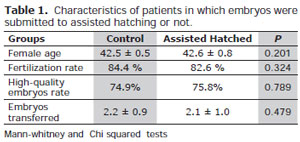
Table 1. Characteristics of patients in which embryos were submitted to assisted hatching or not.
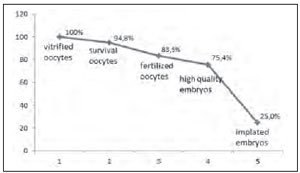
Figure 1. Graphic illustration of the percentage of vitrified oocytes, survival oocytes, fertilized oocytes, high quality embryos and implanted embryos.
Additionally, successful oocyte freezing/thawing technology would potentially aid donation programs (Adams et al., 1985), which are strongly limited currently in their efficiency by different factors including availability of qualifying donors, expense, delay in synchronization, and ethical concerns regarding supernumerary embryo disposition. Oocyte cryo-bank would provide the more efficient sharing of donor eggs between multiple recipients, improving the cost effectiveness through better use of resources.
Clearly, the most crucial prerequisite for a successful egg cryo-banking program is to have an efficient oocyte freezing/thawing technology. However, in spite of the evident clinical relevance, the development of efficient cryopreservation techniques has represented a real challenge, as both freezing and thawing exposes cells to severe stress and can potentially cause cell damage. On the other hand, oocyte cryopreservation by vitrification represents a feasible alternative that has been producing satisfactory outcomes (Grifo and Noyes, 2010).
These gametes must withstand the vitrification/warming process to generate competent embryos capable of implanting. Although it is well known that several factors my influence this intricate process, in the present study satisfactory survival, fertilization and implantation rates were observed for warming oocytes. Moreover, concerns related to the zona pellucida hardening, was alleviated, as demonstrated by the higher implantation rate observed when AH was performed.
Our rates are consistent with other studies which have reported improved survival, implantation, and pregnancy rates, when vitrification was used instead of the slow freezing method (Kuwayama et al., 2005b; Lucena et al., 2006; Antinori et al., 2008; Cobo et al., 2010).
Together with the above cited studies, the current study results support the concept that oocyte cryopreservation can be performed successfully in a routine IVF program, providing the foundation for the egg-cryobanking employment especially in donor-recipient programmes.
Nagy et al (Vajta and Nagy, 2006) compared the results of fresh and frozen oocyte donation cycles and showed that the number of oocytes allocated per recipient was about five times higher in fresh cycles. The number of warmed oocytes per recipient was relatively low as a consequence of high survival rates, confirming previous observations when vitrification was used. In fact, since many or most recipients end up having many more embryos in a fresh donation cycle than they would possibly ever use; most of them remaining frozen, adding to the ever-increasing problem of cryo-stored embryos.
In the present study, the implantation rate calculated on the number of oocytes warmed thus reached almost 15.0%. This favorable outcome confirms the potential of oocyte vitrification and suggests that the efficiency of oocyte donation can be significantly improved using cryobanking. Oocyte cryo-banking may also reduce frozen embryo storage and, as described before, may help with donor-recipient synchronization and possibly reduce cost.
CONCLUSIONS
Our evidences demonstrated the effectiveness of the AH in embryos derived from warmed oocytes and suggest that oocyte cryopreservation can be considered as a tool to provide highly successful outcomes in an egg donor program.
Chen C. Pregnancy after human oocyte cryopreservation. Lancet. 1986;1:884-6.