JBRA Assist. Reprod. 2011;15(6):20-23
ARTIGO ORIGINAL
doi: 10.5935/1518-0557.2011.15.6.04
The effects of general anaesthesia with sevoflurane on intracytoplasmic sperm injection outcomes
Os efeitos da anestesia geral com sevoflurano nos resultados da injeção intracitoplasmática de espermatozóides
1Sapientiae Institute - Educational and Research Center in Assisted Reproduction
2University of São Paulo Faculty of Medicine Clinics Hospital (HCFMUSP) - Children’s Institute (ICr)
3Fertility - Assisted Fertilization Center
Objetivo: investigar os potenciais efeitos adversos da anestesia geral, utilizada para recuperação oocitária, nos resultados da injeção intracitoplasmática de espermatozóides (ICSI).
Material e métodos: Um total de 444 ciclos de ICSI, em que uma combinação de fentanil, propofol e sevoflurano foi utilizada para anestesia geral durante a aspiração folicular, foram avaliados. Modelos de regressão foram utilizados para avaliar a influência do período médio de anestesia por folículo aspirado (∆T) nos resultados da ICSI. Os ciclos foram divididos em grupos de acordo com o ∆T, e os resultados da ICSI foram comparados entre os grupos.
Resultados: análise de regressão demonstrou uma correlação negativa entre o ∆T e a taxa de embriões de boa qualidade (Slope: -5,015, R2: 4,4%, p <0,001). O ∆T foi determinante para a diminuição da probabilidade de gravidez (OR: 0,77, IC: 0,64-0,93, p = 0,005) e transferência de embriões (OR 0,17, IC: 0,06-0,48, p = 0,001). Quando os ciclos foram divididos de acordo com o ∆T, diferenças significativas nas taxas de embriões de boa qualidade (55,6% e 44,2%, p = 0,001) e de gestação (58,2% vs 41,8%, p = 0,045) foram observadas para valores de ∆T ≤ 2 e> 2 min, respectivamente.
Conclusão: nosso estudo sugere que a anestesia geral influencia negativamente o desenvolvimento do embrião e as taxas de gestação e de cancelamento de ciclo.
Palavras-chave: ICSI, recuperação oocitária, anestesia.
ABSTRACT
Objective: to investigate the potential adverse effects of general anaesthesia, used for oocyte retrieval, in intracytoplasmic sperm injection (ICSI) outcomes.
Material and methods: A total of 444 ICSI cycles in which a combination of fentanyl, propofol and sevoflurane was used for general anaesthesia during follicle aspiration were evaluated. Regression models were carried out to assess the influence of the mean period of anaesthesia per aspirated follicle (?T) on ICSI outcomes. In a further analysis, the cycles were split into groups according to the ?T, and ICSI outcomes were compared between the groups.
Results: regression analysis demonstrated a negative correlation between ?T and the percentage of high-quality embryos (Slope: -5.015, R2: 4.4%, p<0.001). The ∆T was determinant to the decreased likelihood of pregnancy (OR: 0.77, CI: 0.64-0.93; p= 0.005) and embryo transfer (OR 0.17, CI: 0.06-0.48, p= 0.001). When the cycles were split according to ∆T, significant differences in the highquality embryos rate (55.6% and 44.2%, p=0.001) and the pregnancy rate (58.2% vs. 41.8%, p=0.045) were observed for values of ∆T ≤ 2 and > 2 min, respectively.
Conclusion: Our study suggests that the general anesthesia negatively influences embryo development, pregnancy rate and cycle cancellation rate.
Keywords: ICSI, oocyte retrieval, anesthesia.
INTRODUCTION
Since 1978, when the first successful in vitro fertilization (IVF) occurred (Steptoe and Edwards, 1978), there has been a constant increase in the use of IVF in couples with untreatable infertility. The IVF treatment requires the harvesting of oocytes from the patients’ ovaries. Initially, oocyte retrieval was performed by laparoscopy; through refinements in ultrasound technologies, however, oocyte retrieval has progressed from laparoscopic to transvaginal aspiration.
Transvaginal follicular aspiration is generally performed with the administration of anaesthesia, such as conscious sedation, neuraxial anaesthesia, general anaesthesia, injection of local anesthetic agents, or any combination of the above (Vlahos et al., 2009). The optimal choice for assisted reproductive technology ART anaesthesia is controversial; in part because of the unclear impact anaesthesia may have on IVF outcomes.
Any anesthetic technique may potentially interfere with certain aspects of human oocyte fertilization or embryo implantation (Van de Velde et al., 2005). Because the majority of anesthetic agents have been detected in follicular fluid within minutes of their administration (Imoedemhe et al., 1992; Soussis et al., 1995; Wikland et al., 1990), an increased awareness of the potential adverse effects of different types of anaesthesia on the quality of the oocytes, which may eventually interfere with embryo development and pregnancy success, has developed.
Different anesthetic doses, combinations, and exposure durations may potentially affect IVF results. Indeed, the duration of exposure to anesthetic agents appears to play an important role, as observed by Boyers et al. (Boyers et al., 1987), who compared the first and last oocytes collected by laparoscopy under general anaesthesia and reported that the last oocyte uniformly had lower fertilization rates.
General anaesthesia, which is defined as a depressed level of consciousness, can be accomplished by inhalational agents (Vlahos et al., 2009), which represent basic drugs used in modern balanced anaesthesia (Torri). Halogenated compounds are inhalational agents, which have been hypothesized to increase cytoplasmic cleavage alterations (Tsen, 2007) and mitotic abnormalities (Kusyk and Hsu, 1976), and to reduce reproductive success in clinical practice (Wilhelm et al., 2002). Sevoflurane is an ether inhalation general anesthetic agent (Patel and Goa, 1996) that provides rapid anesthetic induction and emergence from anaesthesia, compared to other inhalational anesthetic agents (Kanazawa et al., 1999).
Several studies have evaluated the effects of general anaesthesia on IVF outcome (Christiaens et al., 1999; Critchlow et al., 1991; Fishel et al., 1987; Hammadeh et al., 1999; Wilhelm et al., 2002). However, the effects of general anaesthesia with sevoflurane on IVF outcomes have never been investigated. The purpose of this study was to investigate the potential adverse effects of general anaesthesia with sevoflurane used for oocyte retrieval, in intracytoplasmic sperm injection (ICSI) outcome.
MATERIAL AND METHODS
Experimental design
Using our center’s computerized database, we retrospectively identified 444 women who, from July 2009 to March 2010, underwent ultrasound-guided follicular aspiration, under general anaesthesia through halogenated agents, for an ICSI cycle.In order to avoid bias, the following ICSI cycles were excluded from the study: (i) cycles in which six or less oocytes were retrieved, because, generally, the duration of ovarian puncture increases in the presence of fewer follicles; (ii) cycles performed in women over 35 years of age, because these patients present diminished ovarian response to gonadotrophins; (iii) cycles combined with preimplantational genetic diagnosis (PGD), and (iv) cycles which used non-ejaculated sperm.Written informed consent, in which the patients agreed to share the outcomes of their cycles for research purposes, was obtained. The study was approved by the local Institutional Review Board.
Controlled ovarian stimulation
Controlled ovarian stimulation was achieved by long pituitary down regulation using a gonadotropin-releasing hormone agonist (GnRH agonist, Lupron Kit™, Abbott S.A Societé Française des Laboratoires, Paris, France). This was followed by ovarian stimulation with recombinant follicle-stimulating hormone (FSH) (Gonal-F®, Serono, Geneve, Switzerland). Oocyte retrieval was performed 35 hours after the administration of recombinant human chorionic gonadotrophin (rhCG, Ovidrel™, Serono, Geneve, 135 Switzerland) through transvaginal ultrasonography.
Anesthetic Procedure
All patients had fasted for at least eight hours. For general anaesthesia, the patients received anesthetic induction with fentanyl (1-3 µg/kg) and propofol (2 mg/kg). For maintenance, patients received sevoflurane and 100% oxygen. At the end of the procedure, the patients received ondansetron 4 milligrams as prophylaxis for nausea and vomiting, and dipirone (20-30 mg/kg) for postoperative analgesia.
Intracytoplasmic sperm injection and assessment of fertilization
Oocytes were transferred into a micro-injection dish, prepared with 4 μL droplets of buffered medium (HEPES, Irvine Scientific, Santa Ana, USA), and covered with mineral oil on a heated stage at 37.0 ± 0.5°C of an inverted microscope. Approximately 16 hours after ICSI, fertilization was confirmed by the presence of two pronuclei and the extrusion of the second polar body.
Embryo quality and embryo transfer
Embryos were kept in a 50ul drop of HTF medium supplemented with 10% HSA covered with mineral oil in a humidified atmosphere under 6% CO2 at 37ºC until transfer. Embryonic development was evaluated on days 2 and 3. The following parameters were recorded: (i) number of blastomeres, (ii) fragmentation percentage, (iii) variation in blastomere symmetry, (iv) presence of multinucleation and (v) defects in the zona pellucida and cytoplasm. High-quality embryos were defined as those having all of the following characteristics: eight to ten cells, less than 15% fragmentation, symmetric blastomeres, absence of multinucleation, colourless cytoplasm with moderate granulation and no inclusions, absence of perivitelline space granularity and absence of zona pellucida dysmorphism. Embryos lacking any of the above characteristics were considered to be of low quality. Embryo transfer was performed on day 3 of development. One to three embryos were transferred per couple.
Clinical Follow-up
A pregnancy test was performed 12 days after embryo transfer; a positive pregnancy test was considered to define a biochemical pregnancy. All women with a positive test had a transvaginal ultrasound scan at 2 weeks after the positive test; a clinical pregnancy was diagnosed when fetal heartbeat was detected. To calculate the implantation rate, the number of gestational sacs was divided by the number of embryos transferred. Miscarriage was defined as spontaneous abortion before 20 weeks’ gestation.
Statistical analysis
Regression models were carried out to assess the influence of the mean period of anaesthesia per aspirated follicle (∆T) on ICSI outcomes. The results are expressed as slopes and R-squared (R2) or odds ratios (OR), with their 95% of confidence intervals (CI) and p values. The results were considered to be significant at the 5% critical level (p < 0.05). In a further analysis, the cycles were split into groups according to the ∆T: Group≤2min, which included patients with ∆T ≤ 2 minutes, and Group>2min, which included patients with ∆T > 2 minutes. The ICSI outcomes were compared between the groups. The results are expressed as means ± standard deviation (SD) for numeric variables and proportions (%) for categorical variables. The results are expressed as odds ratios (OR), confidence intervals (CI) and p-values and considered to be significant at the 5% critical level (p < 0.05). Data analysis was carried out using the GraphPad Prism version 4.0 Statistical Program.
RESULTS
In the first analysis, the cycles’ general characteristics were as follows: female age = 30.7 ± 3.1 y-old, total dose of FSH administered = 1985.6 ± 631.1, oocyte yield = 71.8 ± 17.8, number of embryos transferred = 2.4 ± 0.9, and mean period of anaesthesia per aspirated follicle = 2.0 ± 1.2 minutes. ICSI outcomes were as follows: fertilization rate = 74.3%, percentage of high-quality embryos = 51.2%, implantation rate = 24.1%, pregnancy rate = 44.6% and miscarriage rate = 12.1%. The regression analysis demonstrated a negative correlation between ∆T and the percentage of high-quality embryos (Slope: -5.015, R2: 4.4%, p< 0.001). Moreover, ∆T was determinant to the likelihood of pregnancy (OR: 0.77, CI: 0.64 - 0.93; p= 0.005) and cycle cancellation (OR 0.17, CI: 0.06 - 0.48, p= 0.001). No correlations were observed between ∆T and the fertilization (Slope: 20.111, R2: 0.2%, p= 0.322), implantation (Slope: 44.291, R2: 0,2%, p= 0.155), or miscarriage rate (OR: 0.87, CI: 0.51 - 1.48, p= 0.604).
In the second analysis, the cycles were split into groups according to ∆T. A total of 261 ICSI cycles were included in Group≤2min. The remaining 183 cycles were included in Group>2min. The cycles’ general characteristics were equally distributed between the two groups. Similar female age (30.6 ± 3.2 vs. 31.4 ± 2.6, p=0.1341), total dose of FSH administered (1962.0 ± 530.6 vs. 2143.0 ± 662.1, p=0.0534), oocyte yield (71.2 ± 16.5 vs. 70.4 ± 22.3, p=0.8515), and number of embryos transferred (2.4 ± 0.9 vs. 2.3 ± 0.8, p=0.4263) were observed between Group≤2min and Group>2min. The comparison of ICSI outcomes between the groups is shown in Table 1.
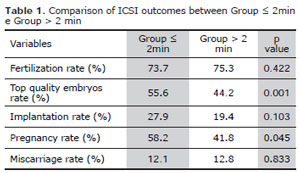
Table 1. Comparison of ICSI outcomes between Group ≤ 2min e Group > 2 min
DISCUSSION
Previous reports have suggested that halogenated agents have a negative impact on assisted reproduction outcomes (Critchlow et al., 1991; Fishel et al., 1987; Gonen et al., 1995). Our results suggest that the mean period of general anaesthesia per aspirated follicle, with the combination of sevoflurane, fentanyl and propofol, adversely affects ICSI outcome.
Anesthetic agents have been proposed to reach the follicular fluid within minutes after administration, and may have deleterious effects on IVF outcomes (Bailey-Pridham et al., 1990; Imoedemhe et al., 1992; Soussis et al., 1995; Wikland et al., 1990). Hammadeh et al. (Hammadeh et al., 1999) compared the effects of general anaesthesia (with propofol, remifentanil and isoflurane) versus sedation (with midazolam, diazepam, or propofol) on fertilization rate, cleavage rate and pregnancy rate. The authors reported that despite the fact that general anaesthesia seemed to improve the success rate for oocyte retrieval-probably by the improved patient comfort during the transvaginal puncture-the higher number of retrieved oocytes had a lower fertilization rate. Nevertheless, no adverse effects were found in cleavage and pregnancy rates.
Conversely, Wilhelm et al. (Wilhelm et al., 2002) observed that pregnancy rates in women undergoing transvaginal oocyte retrieval for assisted reproductive technologies were significantly higher with a remifentanil-based technique than with a general anesthetic technique. Another study observed similar embryo quality, but reduced pregnancy rates associated with general anaesthesia when compared with epidural or paracervical anaesthesia (Gonen et al., 1995).
Our study suggests that exposure to general anaesthesia is determinant to the likelihood of pregnancy in ICSI cycles. Indeed, general anaesthesia may suppress the secretion of gonadotrophin-releasing hormone and gonadotrophins by the stimulation of prolactin release (Sarkar et al., 1976; Sherwood et al., 1980). It has been suggested that the reduction in gonadotrophin levels and the transient elevations of serum prolactin levels have a deleterious effect on the subsequent luteal phase, with the suppression of progesterone production by the corpus luteum (Lehtinen et al., 1987) and endometrial development (Hammadeh et al., 1999). However, in an attempt to evaluate the effect of prolactin levels on IVF, Forman et al. (Forman et al., 1985) observed that elevated plasma or follicular fluid prolactin concentrations have no effects on oocytes or embryo development. Nevertheless, although the difference was not significant, the incidence of pregnancy was highest in the group of patients with the lowest preanesthetic plasma prolactin levels.
Moreover, our results suggest that the higher the period of exposure to general anaesthesia, the lower the percentage of high-quality embryos. Additionally, in our study, exposure to general anaesthesia was determinant to the likelihood of cycle cancellation, given the non-availability of embryos to be transferred. Indeed, halogenated agents have been proposed to cause cytoplasmic cleavage alterations (Tsen, 2007). In animal and human studies, these compounds appear to compromise cell division by disrupting the spindle-forming apparatus, leading to multipolar spindles, unequal divisions, and chromosome lagging (Kusyk and Hsu, 1976; Sturrock and Nunn, 1975). Considering these findings, and considering that, due to our exclusion criteria, only cycles in which more than six follicles were produced were included in this study, we could hypothesize that general anaesthesia with sevoflurane has deleterious effects on embryo development.
To our knowledge, this is the first study to evaluate the effects of the combination of fentanyl, propofol and sevoflurane in ICSI outcomes. However, a weakness of this study is the combined use of propofol to induce general anaesthesia, which could create a confounding factor related to propofol’s adverse effects in the analyzed cycles. Propofol is a 2,6 diisopropylphenol used as a short-acting intravenous anesthetic agent, suitable for induction and maintenance of anaesthesia, and its accumulation in follicular fluid has also been detected (Christiaens et al., 1999; Coetsier et al., 1992). Christiaens et al. (Christiaens et al., 1999) reported that the diffusion and accumulation of propofol in follicular fluid were time-dependent in relation to the dose of propofol administered.
Moreover, Alsalili et al. (Alsalili et al., 1997) reported a significant reduction in the ability of mouse oocytes, exposed to concentrations of 10 µg/mL of propofol for 30 minutes, to mature in vitro. However, no effects were observed in fertilization and cleavage rates compared with the controls. Another study addressed the potentially adverse effects of propofol on the ability of oocytes to fuse with spermatozoa (Tatone et al., 1998). The investigators showed that oocytes exposed to concentrations superior to 0.4 µg/mL had a significant decrease in fusion rates. Another study correlated the accumulation of propofol in follicular fluid with negative effects on early embryo development (Coetsier et al., 1992). However, although propofol concentrations in the follicular fluid are related to the amount administered and to the duration of administration, there is no evidence that propofol can have any significant adverse effect on pregnancy rates. Nevertheless, considering that the use of propofol is often associated with general anaesthesia through halogenated agents, it is difficult to isolate one from another and analyze their individual effects.
In a further analysis, this study divided ICSI cycles into two groups according to the mean period of anaesthesia per aspirated follicle, in an attempt to suggest a cut-off point at which general anaesthesia can lead to ICSI cycle impairment. Our results found a negative influence of general anaesthesia on embryo development and pregnancy rate when the mean period of anaesthesia per aspirated follicle was greater than two minutes, suggesting that the timing of the exposure to anesthetic agents plays an important role in ICSI outcome.
The period of exposure to anesthetics has been assessed in a study performed by Boyers et al. (Boyers et al., 1987), which compared the in vitro fertilization rates of paired firstand last-recovered human oocytes that were retrieved under general anaesthesia. They observed that when the time of retrieval from the first to the last oocyte elapsed up to five minutes, the firstand last-recovered oocytes fertilized at comparable rates. When this period was greater than five minutes, the difference in fertilization rates between first and last oocytes was significant. However, the investigator found no significant differences in cleavage rates for firstand last-recovered oocytes that fertilized, regardless of the exposure interval.
Limited recent information is available about the optimal anesthetic technique for IVF. Many different drugs may be used, and it is difficult to assess whether a specific anesthetic carries more risks than another because many other factors, such as maternal age, semen quality, and endometrial receptivity, may influence the IVF success rate.
Our findings suggest that the period of exposure to general anaesthesia, with the combination of fentanyl, propofol and sevoflurane, has adverse effects on ICSI outcomes. It could be hypothesized that exposure to this anesthetic combination for periods longer than two minutes per follicle may have deleterious effects on oocyte competence, compromising embryo development and pregnancy potential in ICSI cycles. (Boyers et al., 1987)
Steptoe, PC, Edwards, RG. Birth after the reimplantation of a human embryo. Lancet. 1978;2:366.
Torri, G. Inhalation anesthetics: a review. Minerva Anestesiol. 76:215-28.
Tsen, LC. Anesthesia for assisted reproductive technologies. Int Anesthesiol Clin. 2007;45:99-113.