JBRA Assist. Reprod. 1999;03(01):6-8
ARTIGO ORIGINAL
doi: 10.5935/1518-0557.1999.3.1.02
The use of a commercial medium compared with “in house” manufactured medium. The need to move with the times.
O uso de meio comercial comparado com meio feito “em casa”. A necessidade de mudar com o tempo
Abstract
Introduction: A small study was done to determine the efficacy of a pharmaceutical grade medium as compaied with our own “in house” formulation.
Materiais and Methods “In house” medium (IHM) was compared with Ferticult (Fertipro) a similar formulation of pharmaceutical grade which is available commercially. For the study 38 consecutive IVF patients were treated with IVF alterately assigned to using either IHM or Ferticult medium.
Results Fertilization rates (Ferticult-56% vs IHM-58%) were very similar between the two media. Ferticult produced a higher pregnancy rate (Ferticult-35% vs IHM-16.7%), but this difference was not statistically significant. Following the adoption of Ferticult for routine use following completion of the study, results from the most recent series of 60 cases has been provided as data for further for comparison.
Conclusions The availability of pharmaceutical grade medium now means that the manufacture of “home brew” media is only justifiable if better results are obtainable. Results showed that no benefit accrues from the use of IHM. Since pharmaceutical grade medium is just as good and lacks the risks to the patient of IHM, in the interests of greater patient safety, we feel that where possible it is now practicable to such products wherever they exist and are widely avaliable.
Keywords: medium, house medium , fertilization rate, pregnancy rate
Introduction
Edwards et al. (1980) and Edwards and Steptoe (1983) used Earle‘s salts medium which was made “in house” to produce the first IVF babies. Since then, IVF has spread throughout the world and until about 1988, there were few commercially available sources of media. Since 1992, in the UK, there have been more than five sources of commercially manufactured media for IVF. Until recently, we have still been using an “in house” formulated and manufactured medium for our IVF programme. Before making the final switch to a commercial product, we decided to carry out a small study to determine the efficacy of Ferticult compared with our own “in house” product.
Material and Methods
Media
“In house” medium (IHM) based on Earle’s salts solution supplemented with 004 % HSA (Albuminar 20, Armour) was compared with Ferticult (Fertipro) a similar formulation of pharmaceutical grade, which is available commercially.
Patients
For the study 38 consecutive IVF patients were recruited and included in the study. They were alternately assigned to either IHM or Ferticult medium. Categories of infertility were as follows:
Ferticult: tubal and unexplained 20
IHM: tubal and unexplained 18
The average ages for each group were as follows: 33.3 years and 33.2 years, respectively.
Sperm preparation
Sperm were prepared using Sil-Select (Fertipro) by constructing a discontinuous gradient of 45% and 90% in a test tube (Falcon). The semen sample was gently placed on top of the Sil-Select and then the tube was centrifuged for 20 minutes at 600g. Pellets were retrieved and washed in the appropriate medium and then resuspended in fresh medium at concentration of about 1 million per ml.
IVF procedures
These have been previously described (Hargreaves et al., 1995). Briefly, ovarian stimulation was done using Buserelin (Suprefact, Hoechst) in conjunction with Metrodin HP (Serono). Egg collection was carried out by transvaginally directed ultrasound. Oocytes were collected and washed, after which they were placed in culture, either with Ferticult or IHM. Insemination was carried out using 50-100.000 sperm per ml. Pronuclei check was done 18 to 24 hours later after which embryos were placed in new dishes containing fresh medium (equilibrated for 24 hours in the incubator before use using same medium as the initial culture). Forty two to 48 hours after egg collection, embryos were checked, after which three embryos (when available) were chosen for embryo transfer.
Results
Results of IVF comparing outcome versus medium used
Results shown in Table I show that fertilisation rates (Ferticult-56% vs IHM-58%) were very similar between the two media. When looking at the clinical pregnancy rates (CPR) Ferticult seemed to offer an advantage (Ferticult-35% vs IHM-16.7%), but this difference was not statistically significant (Fisher‘s Test, Instat, Graphpad).
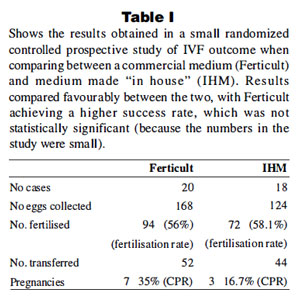
Table I. Shows the results obtained in a small randomized controlled prospective study of IVF outcome when comparing between a commercial medium (Ferticult) and medium made “in house” (IHM). Results compared favourably between the two, with Ferticult achieving a higher success rate, which was not statistically significant (because the numbers in the study were small).
Results from the most recent 60 cases
Following analysis of the results outlined above, a decision was made that continued manufacture of medium in house was no longer justifiable and that commercial medium should be used in the future. Manufacture of IHM has therefore ceased and Ferticult beco me the medium of choice. In Table II, data is presented for the most recent 60 cases. This data provides further material for comparison.
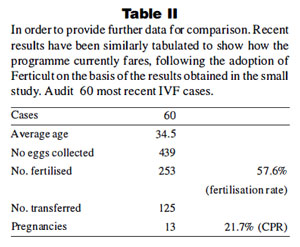
Table II. In order to provide further data for comparison. Recent results have been similarly tabulated to show how the programme currently fares, following the adoption of Ferticult on the basis of the results obtained in the small study. Audit 60 most recent IVF cases.
Discussion
Historically, IVF units in the UK have made their own medium (S Lee, unpublished data). The availability of pharmaceutical grade medium in recent years now means that the manufacture of “home brew” media is only justifiable if better results are obtainable. In light of this, a small study was setup to determine whether the continued use of IHM, which has been used in this unit since its founding in 1987, could be justified. Results shown in Table I, clearly show that continued manufacture of IHM is no longer justifiable. No benefit accrues from its use. Commercial medium is just as good (perhaps in a study with more numbers, it might even prove superior), which means that the risks involved in using medium that has not been prepared under pharmaceutical good manufacturing practice should no longer be undertaken. In the interests of greater patient safety, ali IVF units should now undertake to use commercial pharmaceutical grade products wherever they exist and are widely available.
ACKNOWLEDGEMENTS
Carvalho W. would like to acknowledge the following: the support by way of a trvelling bursary from the Botucatu Medical School, the kind help and advice from Professor J.G. Franco Jr., Sue Smith and Kathryn Parkinson of the Portland Hospital for allowillg me access to the excellent facilities and lastly. but by no means least, all the staff at Unit for their kindness and hospitality.