JBRA Assist. Reprod. 2001;05(02):64-65
ARTIGO ORIGINAL
doi: 10.5935/1518-0557.2001.5.2.04
Treatment with IUI and ICSI for HIV men whose partner remains HIV-free: a risk reduction method
Tratamento com IIU e ICSI para homens HIV positivo com parceiras HIV negativo: método de redução de riscos
Abstract
The authors studied seventeen couples where the male partner, was HIV seropositive men. Firstly washed and prepared the sperm. This preparation was taken for virus assay using a PCR test. A total of sixteen cases of IUI give birth to 4 childrens and one case of ICSI give birth to I child. Until this time, all children was negative test.
Key words: ICSI, IUI, seropositive
Resumo
Os autores estudaram 17 casos do homens positivos para HIV. Basicamente lavaram o esperma e realizaram PCR das amostras preparadas em meio cultura. Um total de 16 casos foram submetidos a inseminação intra-uterina dando ao nascimento de 4 crianças. O único caso de ICSI resultou I recém nascido. Todas as crianças apresentaram negativo até esta data.
Unitermos: ICSI, IIU, soropositivo
Introduction
Many couples, where one partner is HIV-seropositive still want children. They are often so desperate that they risk unprotected intercourse in order to achieve their aims! Previously, it has been demonstrated that by careful semen preparation (Semprini et al., 1992; Kim et al., 1999), IUI samples free from HIV might be obtained. These samples were then used to inseminate the female partner.
A pilot programme was established here in the UK as a follow up to Kim et al., 1999, who were able, for the first time to evaluate the success of semen preparation in removing virus from the sperm, by means of an highly sensitive commercially available PCR assay. We provide evidence that a simple and effective treatment programme may be set up to provide a "risk reduction" option for HIV-infected individuais who wish to become parents.
Materials and Method
Media:Ferticult (Fertipro, Belgium) and Sil Select (Fertipro, Belgium) commercially available media were used to prepare sperm samples for IUI.
Patient: For the study 16 couples where themale partner (aged 33-55, median 44) was HIV-seropositive, were given 2-3 cycles each of IUI. Ali women (aged 29-42, median 35.5) were ovulatory and had demonstrable tubal function (mid luteal progesterone > 30 nM; hysterosalpingogram, respectively). Half of the males (ali received at least two semen analyses for diagnostic purposes) demonstrated single factor male subfertility (e.g. mild oligospermia, mild asthenospermia and teratozoospermia), the remainder being normospermic. The average age of the males was 40 years; and the average ages of females was 35 years.
IUI procedures: Natural cycles were done using either US scans or LH ovulation kits (Assure, Conception Technologies, San Diego). Insemination was carried out 24 hours after hCG (Profasi, Serono, UK) or when an LH surge was recorded.
Sperm preparation: Sperm were prepared using Percoll substitute provided by Fertipro (Belgium) by means of a discontinuous gradient of 45 and 90%, centrifuging for 20 minutes at 600g. Pellets were retrieved and washed twice in the Ferticult medium and then a 30 minute swimup at 37 C was done, using 2 mi of fresh medi um which was very gently overlayered onto the sperm pellet. The upper lml of the layer was carefully extracted after the incubation period. Generally, preparations of 5-10 million per mi were recovered for insemination (ali with > 95% motility. A small sample (100 ul) af every preparation was taken for virus assay using a PCR test previously described by Kim et al., 1999). HIV RNA viral load after sperm preparation.
This was done as previously described by Kim et al. (1999). Briefly, viral load assays were performed using a commercial assay, Nuclisens (Nuclisens HIV-1 RNA Quick's test; Organan Teknika, Cambridge, UK.
Results
Results of IUI treatments for HIV discordant couples
Results shown in Table I show that IUI was effective treatment (25% live birth rate per couple). Ali children were free from HIV at birth and remained so at the time of writing. The vertical transmission rate is therefore nil to date. Table 2. Shows the results obtained in one attempt at ICSI so far. This produced a live birth, which also proved free from transmission of.
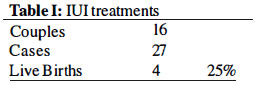
Table I. IUI treatments
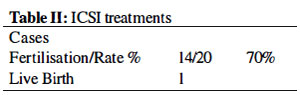
Table II. ICSI treatments
Discussion
This small prospective study of IUI outcome when treating HIV-discordant couples. The treatment proved effective, both in "risk reduction" (ali samples revealed no detectable virus) and in outcome. There was also an absence of maternal seroconversion which also is encouraging. Treating HIV men is controversial. Seroconversion without risk reduction may be occur in up to 10% ofali cases. By offering an IUI programme this risk can be reduced below 1 %, a significant reduction. This small pilot study shows that a medium sized fertility unit should be able to establish an effective programme to offer discordantly infected couples a "safe" way to reproduce, giving both seronegative partner and child(ren) a genuine possibility of avoiding seroconversion.