JBRA Assist. Reprod. 2001;05(03):111-113
ARTIGO ORIGINAL
doi: 10.5935/1518-0557.2001.5.3.05
Frozen embryo results show that embryos created by ICSI do not fare less well than embryos derived from standard IVF
Os embriões congelados resultantes de ICSI não são melhores que os de FIV
Abstract
A group of 100 consecutive FERs from IVF patients were recruited prospectively, randomly assigned to day 2 or day 3 and a group of 54 consecutive FERs from ICSI patients whose cases were carried out during the same time period as IVF cycles were also recruited. The average ages for IVF were 34.8 years and ICSI were 34.4 years. Oocytes collection was carried out by transvaginally ultrasound, Pronuclei check was done 18 to 24 hours later. 42 to 48 hours after egg collection, embryos was chosen for transfer in day 2 or day 3. Surplus embyos were frozen aner IVF or ICSI. In conclusion our results of FER using embryos derived from IVF and ICSI were not significantly different.
Um grupo de 100 pacientes submetidas à F1V e 54 à ICSI com embriões congelados no 2° ou 3° dia foram recrutados, prospectivamente e randomizadamente. A média das idades no grupo de F1V foi 34.8 anos e em ICSI 34.4 anos. Oócitos foram coletados por via vaginal guiado por ultra-som. Após limpeza dos óvulos, foram inseminados. Os pronúcleos foram checados 18 a 24 horas após. 42 a 48 horas após coleta dos óvulos, os embriões foram escolhidos no dia 2 ou 3. Embriões restantes foram congelados após IVF e ICSI. Em conclusão, os resultados de embriões congelados tanto de F1V como de ICSI não apresentam diferença.
Unitermos: Frozen embryo, FIV, ICSI
Key words: frozen embryo, ICSI, IVF
Introduction
Palermo et al (1992) carried out the first ICSI. Many thousands of babies have since been born through the technology. The first frozen embryo live births were achieved by Trounson and colleagues (Downing et al., 1985; Mohr and Trounson, 1985) and Zeilmaker et al., (1984). They were quickly followed by Cohen et al (1985) who perfected blastocyst freezing. It is now routine to of Ter embryo freezing whether with IVF. Lassalle et al. (1985) published a method using propanediol, which has become ubiquitous and has proved reasonably successful for supernumery IVF embryos. The method has been used more recently for freezing and thawing sllpernumery ICSI embryos with apparent success (Tarlatzis and Bili, 2000; Van den Beel et al., 2000). There has even been been one report (Hll et al., 1999) suggesting that ICSI embryos outperform IVF ones after frozen embryo replacement (FER). We have therefore done a study to examine whether FERs with embyos derived from IVF or ICSI offer differences in outcome.
Material and Methods
Patients
For the study 100 consecutive FERs from IVF patients were recruited prospectively, randomly assigned to day 2 (standard protocol-control group) or day 3 (study group) embryo transfer, and included in the study. Furthermore 54 consecutive FERs from ICSI patients, whose cases were carried out during the same time period as the IVF cycles, were also recruited. The average ages for IVF were as follows: 34.8 years. The average ages for ICSI were as follows: 34.4 years.
IVF procedures
Ovarian stimulation was done using buserelin (Suprefact, Hoechst) in conjunction with Gonal-F (Serono, UK). Egg collection was carried out by transvaginally directed 1Iltrasollnd. Oocytes were collected and washed, aner which they were placed in Ferticult medium. The routine protocol for IVF has been previously published Homa et al., 1996, with the only difference being the use of 4-well dishes (NUNC, UK) instead of 3037 Falcon dishes (Becton Dickinson, UK). Insemination was carried out using 50-100000 sperm per ml. Pronuclei check was done 18 to 24 hours later after which embryos were placed in new dishes containing fresh medium (equilibrated for 24 hours in the incubator before use (using same medi um as the initial culture). Forty two to 48 hours after egg collection, embryos were checked, after which three embryos (where available) were chosen for embryo transfer. For day 3 embryo transfer, embryos were placed in G3 for the tinal 24 hours of culture.
Sperm preparation
Sperm were prepared using Percoll substitute provided by Fertipro (Belgium) by means of a discontinuous gradient of 45 and 90%, centrifuging for 20 minutes at 600g. Pellets were retrieved and washed in lhe appropriate medium and then resuspended in fresh medi um at concentrations of about 1 million per ml.
ICSI - Criteria for Patient Selection
Patients were advised to have ICSI treatment if they have previously undergone IVF which has resulted in failed or poor fertil isation rates, or where the semen parameters are too poor for standard IVF treatmen!.
Semen Evaluation - Guidel ines for ICSI
Semen was assessed according to count, motility, progression and abnormal forms. Total motile count less than 3 x 10⁶, less than 5% motile sperm, if progression is very poor and/or < 5% abnormal forms, or a combination of the above; these cases needed ICSI. If there are in the semen, ICSI can be suggested if the spenn preparation is equally asthenozoospennic. Ifthe spenn are completely immotile, a hypo-osmotic swelling test for viability will be carried out (see below).
Cryptozoospermia
Sperm prepared using Sil-Select. The resulting pellet was spread out in one large droplet of medium under oil in Falcon 1006 dish. Motile sperm swim to the edge where they may be picked out for use.
PESA and MESA
For percutaneous or micro-epididymal sperm aspiration, Sil- Select preparation was performed. The resulting pellet was washed and then placed in a 250111 eppendorf. The pellet was layered with approximately 2.5ml medium on top and allowed to swim up for an hour of SO.
Testicular Biopsy (no Sil-Select preparation required)
Tissue was minced with green gauge injection needles (Becton Dickinson, Oxford) and then placed in a large 500111 droplet of medium under oil in a Falcon 1006 dish. The droplet was then scrutinised carefully for up to 3 hours in order to obtain sperm for microinjection.
Methods
Eggs were treated with 80 iu/ml Hyaluronidase (Medicult, Denmark; Microm, Oxford ; Scandinavian IVF Science, Hunter Scientitic, Essex) for a maximum ofthree minutes. The cumulus and corona were then removed by repeated passage through a Cook micropipetter and 140 Cook pipettes (Cook, Herts). The eggs were then washed well in fresh medium and then placed into dishes for ICSI. The eggs were placed in 20111 droplets of culture medium (covered in mineral oil) in Falcon 1006 dishes. Dishes were filled with 6-8 eggs at a time and also contained two droplets of polyvinylpyrrolidine (PVP) to act as reservoirs for the sperm. ICSI was done using a Narishige setup mounted on a Nikon inverted microscope. Holding and injection pipettes wereprovided by Cook (Herts)or Hunter Scientific (Essex).
Freezing and thawing methods
Surplus embryos were frozen after IVF or ICSI. A commercial folmulation (Scandinavian IVF Science, Hunter Scientific, Saffron Walden) was used to freeze and thaw. Brietly, embryos were washed in freeze I and then placed into freeze 2 for 15 minutes, then freeze 3 for 15 minutes, then loaded into a straw (Embryo freezing straw, Rocket of London, Watford) (1 -3 at a time). The dish is originally at 37°C, but allowed to cool during the freezing process, so when the straw is filled, the embryos are at room temperature. The straw(s) were then placed in a KRYO 10 Series III automated freezer (Planar Products, Berkshire) and the standard on board embryo freezing programme was used. Seeding was done manually after the temperature has been at -7°C for 5 mino After the programme was complete, the straws were quickly placed into storage under liquid nitrogen in an MVE (Planar Products, Berkshire) liquid nitrogen holding canister until needed for frozen embryo replacementFor thawing, straws were removed from the MVE canister and allowed to thaw at room temperature. The embryos were then expelled into thaw 1 and washed, then placed into thaw 2 for 5 minutes, then thaw 3 for 5 minutes, then into thaw 4 and washed before placing into a culture dish for preincubation prior to embryo transfer. During the thaw, the dish starts at room temperature, is then placed on a heated plate at 37C until the embryos are moved into a culture dish and placed into the incubator.
Results
Results of FER using embryos derived from IVF and from ICSI. Table 1. shows that success rates (lCSI 16.7% vs IVF 26%) were not significantly ditferent (p>0.1, Fisher's Test, Instat, Graphpad, San Diego, USA).
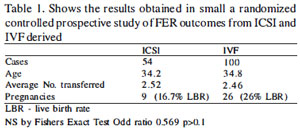
Table 1. Shows the results obtained in small a randomized controlled prospective study of FER outcomes from ICSI and IVF derived
Discussion
In the UK, most fertility clinics now have successful embryo freezing programmes. Generally, in the UK, the average live birth rate for FER, including both lCSl and lVF derived embryos is about 12% per FER (HFEA Annual Report, 2000. The results from this study indicated a lower success rate of 16.9% live birth rate per ICSI FER, as compared with 26% for IVF FERs. However, tests of significance (Fisher's Test, Instat, Graphpad, San Diego) showed no difference.
There have been a few studies done, which have reported variable findings for FER with ICSI derived embryos. Bergh et al., 1999 reported no significant difference between ICSI and IVF FER success rates, Damario et al., (1999) likewise. It is possible that FER outcome is reduced when embryos have been created through ICSI, but no study has borne this out (Bergh et al., 1999; Damario et al., 1999; Emiliani et al., 1999; Hu et al., 1999) others discount this. Part of the problem may be in the heterogeneity of study cases, since if cases which would normally be treatable with standard lVFare included in the lCSl arm, a skewness might appear in the data, if we subscribe to the theory that the "problem" lies in the sperm rather than in the ICSl process itself.
In spite of Hu et al., 1999 findings, our results tend to support the view that there is no difference between lCSI or IVF derived embryos when carrying out FER treatment.
Mohr LR, Trounson AO. Cryopreservation of human embryos. Ann N. Y. Acad. Sci., 442:536-43, 1985.