JBRA Assist. Reprod. 2002;06(01):12-14
ARTIGO ORIGINAL
doi: 10.5935/1518-0557.2002.6.1.04
Extended culture using a two step commercially available medium. - A prelude to blastocyst culture
Cultura prolongada usando dois tipos de meio comercializados. - O início para cultura de blastocistos
1Chelsea & Westminster Hospital Fulham Road SW10 - London - UK
2Fertility Unit Portland Hospital, 214 G reat Portland Street W1N 5HG - London - UK
Abstract
A group of 21 O patients was submitted to assisted reproduction techniques, by which embryos of a control group were transferred on day 2, and of the IVF (in vitro fertilization) study group on day 3. Average ages of the groups were control group, 35.7 years; IVF study group, 345 years. ICSI averages: controls 34.7 years; study, 34.5 years. It was concluded that pregnancy rates were very similar for the culture media on the 2nd and the 3,d days, both for IVF and for ICSL Therfore, no significant differences were evidenced.
Key words: media, blastocyst culture, ICSI, IVF
Resumo
Um grupo de 210 pacientes foi submetido as técnicas de reprodução assistida, onde o grupo controle transferiu embriões no dia 2 e o grupo de estudo no dia 3. A média de idade dos grupos foram: FIV controle: 35.7, estudo 34.6 e a média de ICSI: controle 34.7 e estudo 34.5. Conclui-se que as taxas de gravidez são muito similares nos meios para cultura de 2° e 3° dia tanto para FIV como para ICSI. Sendo assim não se evidenciou diferenças significantes.
Unitermos: meio de cultura, cultura de blastocisto, ICSI, FIV
Introduction
Since Steptoe and Edwards produced the first IVF baby, embryos have been routinely transferred at the four-cell stage. More recently, with the appearance and routine use of commercially available culture, there have been reports of viable blastocysts attaining a relatively high rate of success when they are transferred into the uterus on day 5 or 6 of culture (Behr et al., 1999; Gardner et al. 1997). These early reports are promising. Here in the UK, blastocyst transfer is still in its infancy (see Butterworth, 2001; Jones and Trounson, 1999) with few centres having tried. The sequential media approach seems to have resulted in higher numbers of blastocysts, but more importantly in blastocysts that are more viable, as evidenced by the high implantation rates achieved (Behr et al. 1999; Gardner et al. 1997). Moreover, these authors argue that blastocyst morphology is a simpie, more commonly used, indirect assessment of viability.
We have looked at trialling a day 3 transfer system to prepare for the move to a blastocyst programme, as suggested by Behr (personal communication). We have been impressed with the widespread availability these days ofcommercial media (Lee and Carvalho, 1999). With a view to the above successes with commercially available sequential media, we decided to use sequential media from Ferticult and G3 media (Fertipro, Belgium), which has been designed for 48 and up to 144 hours culture respectively. We report below a study to see if day 3 transfer using G3 medium would be deleterious to success. We were interested in firstly, the logistics of how the work pattern of moving to full blastocyst culture might affect resourcing and workload, and secondly in how the change would affect perforrnance and therefore outcome of treatment
Materiais and methods
** Media
Ferticult (Fertipro, Belgium) and G3 (Fertipro, Belgium) commercially available media were used to culture embryos for 2 and 3 days respectively. For the 3 day culture, Ferticult was used for the first two days and G3 for the 3rd day.
** Patients
For the study 120 consecutive IVF patients were recruited prospectively, randomly assigned to day 2 (standard protocolcontrol group) or day 3 (study group) embryo transfer, and included in the study. Furtherrnore 90 consecutive ICSI patients were also recruited. Eleven and 8 of the IVF and ICSI patients abandoned respectively. The average ages for IVF were as follows: Control 35.7 years; Study 34.6. The average ages for ICSI were as follows: Control 34.7 years; Study 34.5.
** IVF procedures
Ovarian stimulation was done using Buserelin (Suprefact, Hoechst) in conjunction with Gonal -F (Serono, UK). Egg collection was carried out by transvagi nally directed ultrasound. Oocytes were collected and washed, after which they were placed in Ferticult medium. The routine protocol for IVF has been previously published Homa et al. ( 1996), with the only difference being the use of 4-well dishes (NUNC, UK) instead of 3037 Fal con dishes (Becton Dickinson, UK).
Insemination was carried out using 50-100000 sp erm per ml. Pronuclei check was done 18 to 24 hours later after which embryos were placed in new dishes containing fresh medium (equilibrated for 24 hours in the incubator before use (using sarne medium as the initial culture). 42 to 48 hours after egg collection, embryos were checked, after which three embryos (where available) were chosen for embryo transfer. For day 3 embryo transfer, embryos were placed in G3 for the final 24 hours of culture.
** Sperm preparation
Sperm were prepared using Percoll substitute provided by Fertipro (Belgium) by means of a discontinuous gradient of 45 and 90%, centrifugi ng for 20 minutes at 6oog. Pellets were retrieved and washed in the appropriate medium and then resuspended in fresh medium at concentrations of about 1 million per ml.
** ICSI
Criteria for Patient Selection
Patients were advised to have ICSI treatment if they have previously undergone IVF, which has resulted in, failed or poor fertilisation rates, or where the semen parameters are too poor for standard IVF treatment.
** Semen Evaluation - Guidelines for ICSI
Semen was assessed accord ing to count, motility, progression and abnormal forms. Total motile count less than 3 x 10⁶, less than 5% motile sperm, if progression is very poor and/or < 5% abnormal forms, or a combination of the above; these cases needed ICSI. If there are in the semen, ICSI can be suggested if the sperm preparati on is equally asthenozoospermic.
** ICSI method
Eggs were treated with 80 IU/ml hyaluronidase (Medicult, Denmark; Microm, Oxford; Scandinavian IVF Science, Hunter Scientific, Essex) for a maximum of three minutes. The cumulus and corona were then removed by repeated passage through a Cook micropipetter and 140( Cook pipettes (Cook, Herts). The eggs were then washed well in fresh medium and then placed into dishes for ICSI. The eggs were placed in 2011 droplets of culture medium (c overed in mineral oil) in Falcon 1006 dishes. Dishes were filled with 6-8 eggs at a time and also contained two droplets of polyvinylpyrrolidine (PVP) to act as reservoirs for the sperm. ICSI was done using a Narishige setup mounted on a Nikon inverted microscope. Cook (Herts) or Hunter Scientific (Essex) provided holding and injection pipettes.
** Cryptozoospermia
Sperm prepared using Sil-Select. The resulting pellet was spread out in one large droplet of medium under oil in Falcon 1006 dish. Motile sperm swim to the edge where they may be picked out for use.
** PESA and MESA
For percutaneous or microepididymal sperm aspirati on, Sil- Select preparation was performed. The resulting pellet was washed and then placed in a 250ul Eppendorf. The pellet was layered with approximately 25ml medium on top and allowed to swim up for an hour or soo
** Testicular Biopsy (no Sil-Select preparation required) Tissue was minced with green gauge i njection needles (Becton Dickinson, Oxford) and then placed in a large ( 500(1) droplet of medium under oil in a Falcon 1006 dish. The droplet was then scrutinised carefully for up to 3 h ours in order to obtain sperm for microinjection.
Results
Results of IVF for 2 and 3 day culture
Results shown in Table I show that live birth rates (Ferticult- 30% vs Ferticult + G3-32%) were very similar between day 2 and day 3 for IVF. Results shown in Table 2 show that live birth rates (Ferticult-22% vs Ferticult + G3-22%) were also very similar between day 2 and day 3 for ICSI. Any differences were not statistically significant (Fisher's Test, Instat, Graphpad, San Diego, USA).
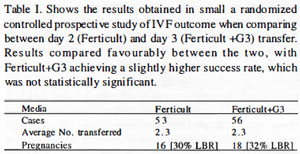
Table I. Shows the results obtained in small a randomized controlled prospective study of IVF outcome when comparing between day 2 (Ferticult) and day 3 (Ferticult +G3) transfer. Results com pared favourably between the two, with Ferticult+G3 achieving a slightly higher success rate, which was not statistically significant.
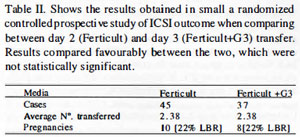
Table II. Shows the results obtained in small a randomized controlled prospective study of ICSI outcome when comparing between day 2 (Ferticult) and day 3 (Ferticult+G3) transfer. Results compared favourably between the two, which were not statistically significant.
Discussion
The virtues of sequential media for blastocyst culture have been extolled in the literature in recent times (Behr et al., 1999; Gardner and Lane, 1998; Jones et al., 1998). The promise that blastocysts will revolutionise fertility treatment and enhance success rates may not be ignored. Butterworth (2001) has raised some issues regarding the potential headlong rush into blastocyst culture and su ggests that there are no 'easy pickings' in fertility treatment. Taking into account the possible pitfalls, we setup a randomised controlled prospective study to see if day3 embryo transfer would enhance or be detrimental to our success rate. Milki et al., (2000) carried out a study comparing day 3 transfer with blastocyst transfer. They showed that blastocyst tran sfer was marginally more successful than day 3 transfer. Rijnders and Jansen (1998) looked at the predictive value of day 3 embryo morphology, but found little correlation; thus only about 50% of blastocysts were identified at the day 3 stage 1 Clearly, from the published data, day 3 embryos in themselves do not stand out, nevertheless, to reach blastocyst stage, the embryos must first negotiate the 8-cell stage (day 3). Therefore, as a prelude to embarking on a blastocyst transfer programme, our study at least showed that day 3 transfer was not deleterious to success.
Jones and Trounson (1999) and others (Behr et al., 1999; Gardner and Lane, 1998) have also alluded to the use of blastocyst culture as a potential diagnostic tool. Those that have ex perienced previous multiple IVF failure may well find extended culture revealing problems in embryo development. Blastocyst culture may well open new territory for advancing our understanding of earl y human embryology.
These results demonstrate that adopting ex tended culture within an established IVF laboratory is not deleterious. The sequential cultu re media from Fertipro, which has been developed for blastocyst culture fared quite adequately in this trial. The logistics required to carry out the extended culture were not prohibitive. In future, a move to blastocyst culture and transfer is now envisaged. The programme is now prepared to make the next step and to adopt blastocyst transfer as a routine procedure without any further need to change our protocols as outlined above. It is to be hoped that the move will not only enhance treatment outcome but also lead to a development of new diagnostic possibilities for patients (Jones and Trounson, 1999).
Note added in proof: since completing this study, we have moved on to blastocyst transfer (using Ferticult and Ferticult G3 media) and currently have achieved 7 out of 13 ongoing pregnancy rate.
Butterworth S. Blastocyst culture: myth or magic? Hum Fertility. 4:109-116, 2001.