JBRA Assist. Reprod. 2002;06(01):20-21
ARTIGO ORIGINAL
doi: 10.5935/1518-0557.2002.6.1.06
A comparison between two commercially avaliable media for human embryo culture
Comparação entre dois meios de cultura comercializado para cultura embrião humana
1Chelsea & Westminster Hospital Fulham Road SW10 London - UK
2Fertility Unit, Portland Hospital, 214 G reat Portland Street, W1N 5HG London - UK
Abstract
A group of 110 patients wcrc recruited for a study of the IVF (in vitro fertilization) procedurc by embryo transter; the control group was transferred on day 2 and the study group on day 3. Seventytive patients of the ICSI program were recruited prospectively and at random for theevaluation ofculture media commercially utilized to maintain human embryos (days 2 and 3), in culture. The results of the IVF and ICSI tests were not signiticantly different at respectively, p= 0.09 and p= 0.5
Key words: culture media, ICSI, IVF
Resumo
Um grupo de 110 pacientes foram recrutados para o procedimentode fertilização in vitro (FIV) (grupo controle transferência embrionária dia 2 e grupo estudo dia 3) e 75 pacientes do programa de ICSI foram recrutados prospectivo e randomizadamente., para avaliar meios de cultura comercialmente utilizados para manter embrião humano em cultura. para 2° e 3° dia. Os resultados FIV e ICSI não toram signiticantementediferente p= 0.09 e p=O.5, respectivamente.
Introduction
Since Steptoe and Edwards first used 'home made' Earle' s Salts medium to produce the tirst IVF baby, more and commercially manufactured media are now available for IVF (Staessen et al., 1998). Feichtinger et al. (1986) reported the use of B2 and B3 Menezo medium (INRA, France), achieving reasonable success rates with commercially prepared defined media. Subsequently, Karamegalos and Bolton (1999) carried out a study comparing Earle's Salts medium with Medicult (Denmark) and reported favourable results with Medicult. Staessen et al. (1998) compared Menezo B2 medium with Medicult and found no significant di rterence between the two. We recently reported use of Ferticult medium (Fertipro, Belgium), which perfowell in ourprograrnme (Le and Carvalho, 1999). Ferticult is very simple medium, simpler than B2 or Medicult, with regards to its formulation. We now follow up this earlier study with a further comparative research looking at how Ferticult fares against another commercial medium made by Medicult. The aim is to determine whether Ferticult would fare less well agai nst a complex medium.
Material and methods
** Media
Ferticult (Fertipro, Belgium) and Medicult (Medicult, Denmark), two commercially available media were used to culture embryos for 2 days.
** Patients
For the study of consecutive IVF patients were recruited prospectively, randomly assigned to day 2 (standard protocolcontrol group) or day 3 (study group) embryo transter, and included in the study. Furthermore 75 consecutive ICSI patients were also recruited. 1be average ages for IVF were as follows: Medicult 35.3 years; Study 34.8. 1be average ages for ICSI were as follows: Medicult 34.4 years; Study 34.6.
** IVF procedures
Ovarian stimulation was done using Buserelin (Suprefact, Hoechst) in conjunction with Gonal-F (Serono, UK). Egg collection was carried out by transvaginally directed ultrasound. Oocytes were col lected and washed, after which they were placed in Ferticult medi um. The routine protocol for IVF has been previously published by Le and Carvalho (1999), with lhe only difterence being lhe use of4-well dishes (NUNC, UK) instead of3037 Falcon dishes (Becton Dickinson, UK). Insemination was canied out using 50-10000 sperm per ml. Pronuclei check was done 18 to 24 hours later afier which embryos were placed in new dishes containing fresh medium (equilibrated for 24 hours in the incubator before use (using sarne medium as the initial culture). Forty two to 48 hours after egg collection, embryos were checked, after which three embryos(where available) were chosen for embryo transfer.
** Sperm preparation
Sperm were prepared using Percoll substitute provided by Fertipro (Belgium) by means of a discontinuous gradient of 45 and 90%, centrifuging for 20 minutes at 600g. Pellets were retrieved and washed in the appropriate medium and then resuspended in fresh medium at concentrations of about 1 million per ml.
** ICSI
Criteria for Patient Selection
Patients were advised to have ICSI treatrnent if they have previously undergone IVF, which has resulted in, failed or poor fertilisation rates, or where the semen parameters are too poor for standard IVF treatrnent.
** Semen Evaluation
Semen was assessed according to count, motility, progression and abnonnal fonns. Total motile count less than 3 x l06, less than 5% moti le spenn, ifprogression is very poorand/or < 5% abnormal fonns, or a combination of the above; these cases needed ICSI.. If there are in lhe semen, ICSI can be suggested if the sperm preparation is equally asthenozoospennic.
** ICSI procedure
Eggs were treated with 80 IU/ml Hyaluronidase (Medicult, Denmark; Microm, Oxford; Scandinavian IVF Science, Hunter Scientific, Essex) for a maximum ofthree minutes. The cumulus and corona were then removed by repeated passage through a Cook micropipetter and 140( Cook pipettes (Cook, Herts). The eggs were then washed well in fresh medium and then placed into dishes for ICSI. The eggs were placed in 20 droplets ofculture medium (covered in mineral oil) in Falcon 1006 dishes. Dishes were filled with 6-8 eggs at a time and also contained two droplets of polyvinylpyrrolidine (pVP) to act as reservoirs for the sperm. ICSI was done using a Narishige setup mounted on a Nikon inverted microscope. Cook (Herts) or Hunter Scientific (Essex) provided holding and injection pipettes.
Results an Discussion
** Results of IVF and ICSI using both Ferticult and Medicult media Results shown in Table I are those for IVF done in either Ferticult- 33% or Medicult- 19%. Theresults were not significantly different p=O.09. (Fisher's Test, Instat, Graphpad; San Diego, USA). Results shown in Table II are those for ICSI done in either Ferticult-24% or Medicult-22%. The results were not significantly different p=O.5. (Fisher's Test, Instat, Graphpad, San Diego, USA).

Table I. Shows the results obtained in a controlled prospective study of IVF outcome when comparing Ferticult with Medicult medium. Results compared favourably between the two and they were not statistically significant.
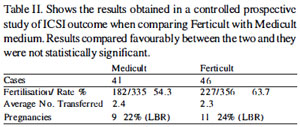
Table II. Shows the results obtained in a controlled prospective study of ICSI outcome when comparing Ferticult with Medicult medium. Results compared favourably between the two and they were not statistically significant.
The availability of pharmaceutical grade medium in recent years now means that the manufacture of home brew media is only justifiable ifbetter results are obtainable. Karamegalos and Bolton (1999) and Le and Carvalho (199) both confirmed that lhe practical benefits of an 'off the shelf' medi um should lead to an end to use of 'in house media'. The development from B2 in the early 80s to· the widespread availability ofmedia such as Ferticult and Medicult justify the move to commercial products manufactured under the rigours of pharmaceutical good manufacturing practice (GMP). The results shown here show there is no ditlerence between commercial media made according to GMP. Individual fertility laboratories now have a wide range ofchoices. Thenext challenge now must be the development of effective media for blastocyst production. It is likely that the next generation of media will also eventually reach parity with regards to their success.