JBRA Assist. Reprod. 2002;06(02):67-70
ARTIGO ORIGINAL
doi: 10.5935/1518-0557.2002.6.2.03
Culturing 8-cell stage embryos helps in discriminating good from poor viability
Embriões de 8 células sofrem descriminação dos bons para viabilidade pobre
PhD FI BMS
Abstract
The rationale for this study was determinate whether the attainment of 8 cells alone at transfer is advantageous. In this study there were 105 consecutive IVF/ICSI patients who recruited prospectively, at transfer embryos were assessed purely on lhe basis of whether they had reached 8-cell or not. (Group A= patients with at least one 8-cell transfered and group B= patients with no embryos having reached this stage). The average ages for IVF and ICSI were group A: 35.5 and group B: 35.6 years. On the results group A outcomes better than those in Group B, were significantly better, when at least one 8-cell was lrans ferred. (p<0.05). These results demonstrate that the 8-cell stage provides na adequate means of discriminaling the viable embryos
Key words: IVF, ICSI, blastocysts
Resumo
O objetivo deste estudo foi determinar se existe vantagem em transferir somente embriões com 8 células
Foram estudados prospectiva e randomizadamente 105 casos de FIV/ICSI, no momento da transferência de embriões onde transferiu-se puramente embriões de 8 células e transferências mistas (Grupo A= transferência puramente de embriões de 8 células e grupo B= embriões com 8 célul as ou não). A média das idades das pacientes foram de grupo A: 35.5 e Grupo B: 35.6 anos. Os resultados de grupo A mostraram que realmente transferir somente embriões de 8 células é significantemente melhor.
Unitermos: ICSI, FIV, blastocisto
Introduction
Since Steptoe and Edwards produced the first IVF baby, embryos have been routinely transferred at the four cell stage. More recently, with the appearance and routine use of commercially available culture, there have been reports of viable blastocysts attaining a relatively high rate of success when lhey are lransferred into the uterus on day 5 of 6 of culture (Behr et al., 1999; Gardner and Lane, 1998). These early reports are promising. Here in the UK, blastocyst transfer is still in its in fancy (see Butterworth, 2001) with few centres having trieel. The sequential media approach seems to have resulted in higher numbers of blastocysts, but more importantly in blastocysts that are more viable, as evidenced by the high implantation rates achieved (Behr et al. 1999; Gardner and Lane, 1998). Moreover, these authors argue that blastocyst morphology is a simple, more easily used, indi rect assessment of viability to select embryos for transfer.
Whilst the possibility of blastocyst transfer is justifiably compelling, there is another marker which might be used with potenlial advantage. Gapjunctions allow neighboring cells to pass small molecules and metabolites directly between lhem, and are generally accepted to be essential emring preimplantation development (Fleming et al., 2000 and Kieleler and Winterhager, 2001). Gap junctional communication is established early in mammalian development; in the mouse, occurring simultaneously with compaction at the 8-cell stage (Lee et al., 1987). Viable mouse embryos compact at the 8-cell stage (Buehr et al., 1987; Lee, 1987; Lee et al." 1987). When mouse embryos fail to compact properly and gap junction communication becomes elisrupteel, viability of these embryos is compromised (Becker et al., 1995 ; Buehr et al., 1987, Lee, 1987; Lee et al., 1987).
Human embryos compact poorly (Lee, 1987) or perhaps at rather a later stage (16-32 cell) than in mice (Dale et al., 1991). The "problem" with human IVF embryos derived from infertile couples, seems to lie in the way they appear to mimic the morphological appearance (featllring poor and incomplete compaction) exhibited when DDK female mice are crossed with males from a elifferent species (Buehr et al., 1987; Lee, 1987). The problem in such cross-bred DDK mouse is specifically one of an interaction between a paternal genomic contribution (ie sperm related) and the DDK cytoplasm (Babinet et al., 1990; Mann, 1986; Wakasugi, 1974). There seems to be an abberant interaction between cytoplasm and a male component, occurring post fertilisation and prior to first cleavage. Lee (1987) argued that gap junction incompetence might play a role in human infertili ty. Results published by Dale et al., (1991) indicate that this might well be the case, although they argued that lhe fact Ihat "spare" human embryos failed to display effective gap junction communieation at the 8-cell stage rellected comparative embryological di llerences rather than a demonstralion of human embryo inviability. Subsequent reports by Hardy et al., (1996) suggested the former to be true rather than the lalter. Once again the embryo morphology reported by these authors indicated simi larity with lhe gap junction incompetent embryos of DDK mice (Buehr et al., 1987; Lee, 1987).
Human embryos display some of the morphological in felicities displayed by gap junction incompetent mouse embryos (Lee, 1987). On the basis that morphologically competent 8-cell human embryos may exhibit characteristics exemplary of viability, we have looked at determining whether a day 3 transfer system might yield equally successful discrimination for embryo viability as the day five scenario. The 8-cell and morula (8-32 cells) slages are likely important developmental landmarks; this stuely has therefore examined the difference in treatment outcome, when elay three (after egg collection) embryo transfer has been carried out. Patients with at least one 8-cell transfered were placed in Group A and lhose with no embryos having reached this stage were assigned to Group B. In this preliminary study, no attempt was made to determine the morphology of the embryos transferred. The rationale for lhis stuely was to determine whether the attainment of 8-cells alone at trans fer is advantageous.
In doing this study, we also embarked on the first steps towarels establishing a blastocyst programmc.
Materiais and Methods
Media
Ferticult (Fertipro, Belgium) and G3 (Fertipro, Belgium) commercially available meelia were used to culture lhe embryos. Ferticult was used for the first two days and G3 for the 3rd elay of culture.
Patients
For the study 105 consecutivc IVF and lCSI patients were recruited prospeetively, at trans fer embryos were assessed purely on the basis of whether they had reached 8-cell of not. Patients with at least one 8-cell transfered were placed in Group A and those with no embryos having reached this stage were assigned to Group B and the outcomes logged prospectively. The average ages for IVF and ICSl were as follows: Group A, 35.5 years; Group B, 35.6.
Sperm preparation
Sperm were prepared using Percoll substitute provieled by Fertipro (Sil-Select, Belgium) by means of a discontinuous gradient of 45 and 90%, centrifuging for 20 minutes at 600g. Pellets were retrieved and washed in the appropriate medium and then resuspended in fresh medium at concentrations of about I million per ml.
IVF procedures
Ovarian stimulation was done using Buserd in (Suprefact, Hoechst) in conjunction with Gonal-F (Serono, UK). Egg collection was carried out by transvaginally directed ultrasound. Oocytes were collected and washed, after which they were placed in Ferticult medium (Fertipro, Belgium). The routine protocol for IVF has been previously published Lee and Carvalho (1999). Insemination was carried out using 50-100000 sperm per ml. Pronuclei check was done 18 to 24 hours later after whieh embryos were placed in new dishes containing fresh medium (equilibrated for 24 hours in the incubator before use (using same medium as the initial culture). Embryos were pl aced in G3 (Fertipro, Belgium) for the final 24 hours 01" culture. Seventy two hours after egg collection, embryos were checked, aner which three embryos (where available) were chosen for embryo transfer.
ICSI
Eggs were treated with 80 IU/ml Hyal uronidase (Meelicult, Denmark; Microm, Oxford ; Scandinavian IVF Science, Huntcr Scientific, Essex) for a maximum of two minutes. The cumulus and corona were then removed by repeated passage through a Cook micro-pipetter and 140 mieron pipettes (Cook, Herts). The eggs were then washed well in fresh meelium and thcn placed into dishes for ICSI. The eggs werc plaeed in 20 microlitre (droplets of culture Iledium covered in mineral oil) in Falcon 1006 dishes. Dishes were filled with 6-8 eggs at a time and also contained two elroplets of polyvinylpyrrolieline (PVP) to act as reservoirs for the sperm.
Results
Results of 3 day culture
Results shown in Table 1 show that live birth rates (Group A outcomes better than those in Group B) were significantly better, when at least one 8-cell was transferred.
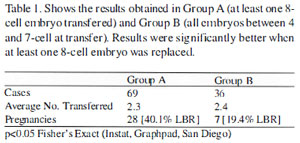
Table I. Shows the results obtained in Group A (at least one 8-cell embryo transfered) and Group B (all embryos between 4 and 7-cell al transfer). Results were significantly better which at least one 8-cell embryo was replaced.
Discussion
These results demonstrate lhat the 8-cell stage provides an aelequate Ileans of discriminating the viable embryos from the less viable ones. A significant portion (up to I in 3) of couples included in this study did not produce any 8-cell embryos for transfer and these patients fared less well. The attainment 01" 8-cells appears to be a reasonable marker for viability, but how so is not yet clear, but may in some way be related to compaetion.
As outlined in the introduction, embryos Ilust attain at least 8- cells before compaction may occur. Lee (1987) has previously reported observing that compaction was generally poor in human embryos kept in culture.
In mouse embryos compaction at the 8-cell stage has been mooted as being a major markerfor embryo viabili ty (Buehr et al., 1987; Lee, 1987; Lee et al, 1987), in fact they also raise the issue of inviabili ty (Buehr et al., 1987; Lee, 1987). When DDK females are mated with males of other strains, they are mostly in fertile pairings. This reduction in fertility is due to death of FI embryos that occurs before implantation (Babinet et al., 1990; Buehr et al., 1987; Mann, 1986; Wakasugi, 1974). The problem is defined by poor gap junction communication and characterised by morphologically poor compaction (Buehr et al., 1987; Lee, 1987). Indeed Mann (1986) showed that the gap junction incompetent DDK embryos l acked a cytosolic component which condemned them to inviability, which was overcome by pronuclear transplantation into enucleated viable embryos of non DDK origin (Babinet et al., 1990). The problem is caused by lhe Om gene on chromosome II, which in DDK eggs results in the cytosolic appearance of an RNA which intentcts detrimentally with the genome of the male pro-nucleus bringing about a lethal condition (Baldacci et al., 1992, 1996).
Whether gap junctions and compaction are necessary as simultaneous events remains to be decided, especially since results with those of the Cx43 knockout mice (De Sousa et al., 1997; Houghton et al., 1999) when intercellular communication is severely reduced by the loss of Cx43, there is no apparent effect on either compaction or blastocyst formation. In the human embryo, the presence and activity of gap junctions have been shown from the early blastocyst stage (Dale et al., 1991). Abnormal low levels of gap junction gene or protein expression may correlate with loss of human embryo viability (Hardy et al., 1996), providing support for the idea that gap junction funclion is associated with embryo viability. Dale et al. (1991) results may not truly retlect the state of play regarding the role of early compaction in human embryo development, since their observations may be in tluenced by the same factors found in in vitro generated bovine embryos, which have been shown to have poorer gap junction communication and delays in compaction when compared with in vivo derived embryos (Boni et al., 1999; Wrenzycki et al., 1996; Niemann and Wrenzycki, 2000).
It is interesting to note that compaction complications in mouse embryos involves a cytosolic factor (Babinet et al., 1990; Baldacci et al., 1992, 1996). and it has not escaped notice that Levron et al. (1996) and Cohen et al. (1997) showed that cytoplasmic transfer from donor eggs may restore developmental potential lo eggs with putative cytoplasmic deficiencies.
These results show that the attainment of the 8-cell stage three days after egg collection is a useful measure of embryo viability, perhaps reflecting the importance of compaction as an "essential" developmental phenomenon; additionally showing that adopting extended culture within an established IVF laboratory, using sequential culture media from Fertipro (G3; developed for blastocyst culture) did not make the laboratory logistics of carrying out extended culture prohibitive. In future, in addition to a move to blastocyst culture and transfer, it is of further interest to determine the value of using compaction as a marker for embryo viability. This preliminary study indicates that future examination of human embryo compaction as a means of determining viability is warranted.
Butterworth S. - Blastoeyst culture: myth of magic? Hum Fellility 4: 109-116, 2001.