JBRA Assist. Reprod. 2002;06(03):105-108
ARTIGO ORIGINAL
doi: 10.5935/1518-0557.2002.6.3.04
Efficacy of freezing all embryos in patients with risk of ovarian hyperstimulation syndrome (OHS) in an ICSI programme
Eficácia do congelamento de embriões em pacientes com risco de sínd rome de hiperestimulação ovariana (SHO) no programa de ICSI
1Center for Human Reproduction, Sinhá Junqueira Maternity Foundation, Ribeirão Preto, SP, Brazil
2Departament of Obstetrics and Gynecology, University of Ribeirão Preto (UNAERP), Ribeirão Preto, S P, Brazil
Abstract
Objective: Ovarian hyperstimulation syndrome (OHS) is a severe iatrogenic complication of ovulation which has a very serious impact on the patient's health, The cryopreservation of supernumerary human embryos has been essential and a routine part of ovarian stimulation ICSI programme to prevent multiple pregnancies. However, to cryopreserve ali embryos can be a policy to prevent patients with risk of OHS. The objective of this study was to evaluate and report the efficacy of freezing ali embryos in patients with OHSS risk.
Study Design: A total of 36 patients who were submitted to an ovarian stimulation cycle for ICSI and presented an ovarian diameter = 50cm3 at the day of human chorionic gonadotrophin (hCG) administration and/or were collected = 25 inmature and mature oocytes were considerate as patients with OHS risk and had ali their embryos cryopreserved. Cryopreservation of ali cleavage stage embryos was carried out using slow method with 1.2 propanediol protocol in an CL 863 Cryologic apparatus. Following the thawing process the embryos were inspected separately in terms of survival (at least one blastomere intact) and cleavage (after 24 hours the division of at least one of the blastomere). A total of 45 tranfers were carried out in two hormonal schemes i.e natural cycle and substitutive cycle.
Results: All patients (36) had no severe OHSS after oocyte retrieval and did not require hospitalization. The mean age of the patients was 30.2 ± 4.6 years. The mean of retrieved oocytes was 26. 1 ± 9. 1 and 481 embryos were frozen. A total of 57 thawed cycles were performed and 85.7% of embryos presented at least one blastomere intacto The frequency of embryo cleavage was 81.1 % ± 24.4 and the mean number of embryo cleavage transferred was 2.6 ± 0.8. The clinical pregnancy rate per thawing cycle was 43 .8% (25/57). The clinical pregnancy rate per embryo transfer was 45.4%(25/55). The rate ofembryo implantation was 22.5%.
Conclusion: This study demonstrates that to cryopreserve ali embryos is an efficacy proceeding to prevent OHS in high risk patient.
Key words: ovarian hyperstimulation syndrome, OHS, ICSI, embryo cryopreservation
Resumo
A Síndrome de hiperestimulação ovariana (SHO) é uma complicação iatrogênica severa da ovulação que causa são que causa sérios impactos na saúde da paciente. A criopreservação de embriões humanos excedentes tem sido essencial e faz parte da rotina no programa de ICSI para a prevenção de gestações múltiplas. Entretanto a criopreservação de todos pode ser uma conduta para prevenir pacientes com risco de SHO.
Objetivo: O objetivo deste estudo foi avaliar e relatar a eticácia do congelamento de todos os embriões em pacientes com risco de SHO.
Material e Métodos: Um total de 36 pacientes que foram submetidos à estimulação ovariana e apresentaram medida ovariana3 50m3) no dia da administração da gonadotrotina coriônica (hCG) e/ou foram coletados ≥ 25 oócitos maduros e imaturos, foram incluídas neste estudo e consideradas como pacientes com risco de SHO. Todos seu embriões forma congelados. A criopreservação de todos os embriões foi realizada através método lento com protocolo 1 .2 propanodiol (embriões no estágio de 4 células) em uma máquina de congelamento Cryologic CL863. Após o processo de descongelamento os embriões foram avaliados separadamente em relação a sobrevida (presença de no mínimo I blastômero intacto) e clivagem (divisão de no mínimo I blastômero após 24 horas em cultura) Foram realizadas um total de 45 transterências em dois esquemas de estimulação hormonal: ciclo natural e ciclo substitutivo. Todas as pacientes não apresentaram SHO severa depois da coleta e não necessitaram de hospitalização.
Resultados: A média da idade das pacientes foi 30.2 ± 4.6 anos. A média de oócitos coletados foi de 26. 1 ± 9. 1 e 481 embriões foram congelados. Um total de 57 ciclos de descongelamento foram realizados e 85,7% dos embriões apresentaram no mínimo um blastômero intacto após o descongelamento. A freqüência de embriões clivados foi de 81,1 % ± 24.4 e a média de embriões transferidos foi de 2.6 ± 0.8. A taxa gravidez clínica por descongelamento foi de 43.8% (25/57). A taxa de gravidez clínica por transferência foi de 45,4% (25/55) e a taxa de implantação foi de 22.5%.
Conclusão: Este estudo demonstra que a criopreservação de todos os embriões é um pmcedimento eticaz na preservação da SHO em pacientes de alto risco.
Unitermos: síndrome de hiperestimulação ovariana, SHO, ICSI, criopreservação de embriões.
Introduction
The most significant complications of infertility therapies that used controlled ovarian hyperestimulation are multiple pregnancy and ovarian hyperestimulation syndrome (OHS). Severe OHS may be associated with massive ovarian enlargement, intravascular volume depletion, ascites, pleural effusions, and electrolyte and coagulation disturbances (Forman et al., 1988). Even though the incidence of the severe form is low (0.5-2%), OHSS remains one of the major sources of morbity and mortality in patients undergoing artificial reproductive technologies.
Furthermore, other studies have clearly shown that the incidence and the duration of the syndrome increase in conceptional cycles as a consequence of prolonged exposure to endogenous human chorionic gonadotrophin (hCG) (Gianaroli et al., 1996) In order to reduce the risk of OHS, several approaches have been proposed: reduction of ovulatory doses of hCG (Schenker 1993); avoidance of luteal phase support with hCG, Araujo et al. (1995); prolonged coasting, (Sher et al., 1993); albumin administration at the time of egg retrieval (Ash et al., 1993). Unfortunately, none of these methods has been demonstrated to have constant efficacy in preventing the syndrome except for the cancellation of the risk cycles before hCG administration. For these reasons, another approach has been proposed, consisting of elective cryopreservation of ali embryos and subsequent transfer of them in non-stimulated cycles (Amso et al., 1990).
The controversial results reported by recent studies on this topic (Awonuga et al., 1996 & Qeenan, et al., 1997) may reflect the different techniques and protocols used, or the different cut-of criteria applied to patients selected at risk of OHS. The purpose of this retrospective study was to analyse outcomes for patients when ali embryos were cryopreserved after the stimulated cycle for ICSI because of the risk of OHSS.
Material and Methods
A total of 36 patients who were submitted to an ovarian stimulation cycle for ICSI and presented an ovarian diameter = 50 cm3 on the day of HCG administration and were submitted to collection of = 25 oocytes were considered as patients at risk for OHSS and had ali their embryos cryopreserved. The mean age of the patients was 30.2 ± 4.8 years. ln the previous history of the patients 18 of them (50%) had elinical picture or ultrasonography suggestive of the polycystic ovarian syndrome (PCOS), 2 patients presented OHS antecedent and the body mass index was 23.8 ± 3.2 (Table I).
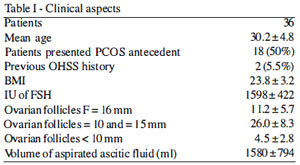
Table I. Clinical aspects
Ovarian stimulation and ICSI procedure:
Ovarian stimulation before the ICSI procedure consisted of blockade of the 2nd phase with nafarelin acetate at the dose of 400µg/day (Synarel, Searle). After 14 days of treatment with the analogue and the establishment of blockade, administration of recombinant FSH was started at a fixed dose of 150 or 300 IU for a period of 7 days. On the eight day of ovarian stimulation, we started monitoring follicular development only by vaginal ultrasound and the doses of FSH were adapted to lhe ovariam response. When at least 3 follieles measuring > 17 mm in diameter were observed, hCG was administered at the dose of 5000 IU.
Oocytes were collected from the follieles by ultrasound-guided transvaginal puncture 34 to 36 hours after hCG injection. After identification, the oocytes were classified according to maturity. The cumulus corona complex was removed by exposure to a type 4 hyaluronidase solution (H-4272, Sigma Chemical Co., USA) at the concentration of 40 IU/ml. The denuded oocytes were incubated in IVF-50 medium (IVF Science Scandinavia, Sweden) until the time for ICSI. For spenn separation from seminal fluid a discontinuous gradient of Sperm-Prep 100 TM was used (IVF Science Scandinavia, Sweden) applied to the 40% and 90% fractions. The ICSI procedure was performed by the method of Svalander et al.( 1995). Ali the obtained embryos were cryopreserved on the second day.
Slow freezing
For the freezing process we used the Freeze-kit I (IVF Science Scandinavia, Sweden), consisting of the following solutions: PBS, l .5 M propanodiol (PROH) and 1 .5 M PROH + 0. 1 M sucrose. The solutions were then distributed on Nunc culture plates and allowed to stabilize at room temperature for 15 minutes. Cryopreservation was performed with a cryologic CL-863 apparatus. Excess embryos were first washed in PBS solution and then transferred to 1 .5 M PROH for LO min, and then transferred to 1 .5 M PROH solution with sucrose and immediately placed in straws. The straws were transferred to a cryochamber stabilized at a temperature of 240C and temperature was then reduced at the rate of 20C per minute until -60C, when manual seeding was performed. The temperature was then reduced by 0.30C per minute until -350C, followed by a free fali to - 1500C, after which the straws were transferred to liquid nitrogen.
For the thawing process, the Thaw-kit I of IVF Science Scandinavia (Sweden) was used. The kit consists of four solutions: 1 .0 M PROH plus 0.2 M sucrose, 0.5 M PROH plus 0.2 M sucrose, 0.2 M sucrose, and PBS. The solutions were stabilized at room temperature for at least 15 minutes and the straws were stabilized at room temperature for 30 s. The embryos were successively added to the four solutions (1.0 M PROH/0.2 M sucrose, 5 min; 0.5 M PROH/0.2 M sucrose, 5 min; 0.2 M sucrose, 10 min; PBS, 5 min). The embryos were then transferred to PBS stabilized at 37ºC in the presence of 5% CO2 for 5 min, and tinally incubated in G 1.2 culture medium (IVF Science Scandinavia, Sweden) for 24 hours. Transfer was performed after determination of embryo eleavage, which was considered to be present when the division of at least one of the blastomeres was observed after 24 hours of culture. (Mauri et al., 2001).
Replacement cycle
Two hormonal schemes were used for the transfer of thawed embryos, i.e. the natural cycle and a substitutive cycle. In the natural cycle, follicular development was monitored by serial vaginal ultrasonography starting on the 10th day of the cycle. A 10000 IU dose of hCG was administered when the follicle presented a diameter > 17 mm, and thawing was routinely perfonned on the fourth day after hCG (day of hCG injection = day I) and embryo transfer on the fifth day after hCG.
In the substitutive cycle, estradiol valerate (Postoval, Wyeth, São Paulo, Brazil) was administered from the first to the 13th day of the cycle at a daily dose of 4-6 mg. Progesterone was introduced on the 14th day at the dose of 400 mg/day by the vaginal route, as long as endometrial thickness was > 6 mm (Oliveira et al., 1997). Thawing was performed on the fourth day of progesterone treatment and transfer on the fifth day. For statiscal analysis, independent Student t-test and chisquared were used where appropriate.
Results
The total number of FSH international unit (IU) used was 1598 ± 422. On the day of hCG administration the patients presented the following ovarian folliele distribution by ultrasonography FO = 16 mm=11 .2± 5.7; FO = IO mm and = 15 mm= 26.0 ±8.3 and FO < I O mm 4.5 ± 2.8 (Table I).
The mean number of retrieved oocytes was 26. 1 ± 9. 1, which 18.1 ± 8.4 were metaphase TI, 4.3 ± 4.0 were metaphase I e 2.7 ± 2.2 were germinal vesicle of stage ofmaturity and a total of 481 embryos was frozen (Table II). None of the 36 patients had severe OHSS after oocyte retrieval or required hospitalization. However, 5 patients (13 .8%) had the necessity of transvaginal ultrasonographic aspiration to the drain the ascitic tluid to make better abdominal and respiratory discomfort, the aspiration was made without anaesthetic at outpatient department where the mean of 1598 ± 422ml was aspirated.
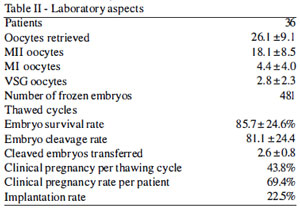
Table II. Laboratory aspects
A total of 57 thawed cycles were performed and 85.7% of the embryos presented at least one intact blastomere. The frequency ofembryo cleavage was 81.1 % ± 24.6 and the mean number of cleaved embryo transferred was 2.6±0.8. The clinical pregnancy rate per thawing cycle was 43.8% (25/57). The clinical pregnancy rate perembryo transfer was 45.4%(25/55). The rate of embryo implantation was 22.5% (Table II).
Discussion
Severe OHS remains the mostserious of the potential complications arising in patients treated with gonadotrophins for ovarian stimulation. It has been recognized that the incidence of this complication is increased with the use of GnRH-a protocols for ovarian stimulation (Forman et al., 1988), presumably as a result of a greater degree of stimulation.
Because severe OHSS is very rare in the absence of a source of hCG in the luteal phase (pregnancy or exogenous administration), a number of maneuvers that minimize hCG exposure can be considered in attempting to reduce the risk of OHS occurring.
Ferraretti et al. (1999) revealed that the incidence of the severity and the duration of the syndrome was strictly related to the surge of pregnancy. In cycles where no conception occurred the incidence of OHS was 0.3% with a mean duration of 6.2 ± 1 .7 days, whereas in pregnant cycles 3. 1 % had OHSS lasting 16.4 ± 3 days. Recent studies have proposed the elective cryopreservation of ali generated embryos from patients considered at risk ofdeveloping OHS, but the results achieved were contradictory.
Some investigators suggested that this procedure reduce the incidence of severe OHSS and does not intluence signiticantly the pregnancy rate. (Pattinson et al. 1995) In another study, Tiitnnen et al. (1995) studied twenty-three women that were considered to have an increased risk of developing OHSS. They were characterised by more than 20 retrieved oocytes and/or by serum oestradiol levels exceeding 10,000 pmol/l on the day of hCG. One out of the 23 patients developed a moderate degree OHS, while the others had only mild symptoms. Among the 23 patients there have been 15 clinical pregnancies after transter of two to three frozen-thawed embryos in natural cycles, with a 32.6% pregnancy rate. More recently, Ferraretti et al 13 in a prospective randomized study, analyzed 125 patients at risk of OHS (blood oestradiol concentration = 1500 pglml on the day of HCG administration and = 15 oocytes were collected). The patients were matched in two groups: group A, control group (n=67), had fresh embryo transters; group B (n=58) had cryopreservation of all obtained pronucleate embryos. There were no significant differences in terms of pregnancies per patient (46.3 versus 48.3%) and live birth rates (38.8 versus 39.6%). No cases of OHS occurred in group B, while four patients developed the syndrome in group A.
Others researches argued that the elective cryopreservation of ali embryos does not potentially prevent the development of OHS, but reduces the pregnancy and live birth rates. (Awonuga et al., 1996). The authors analyzed 117 treatment cycles in which the serum E2 concentration on the day of HCG administration was > 10,000 pM and in whom = 15 oocytes were retrieved. The patients were divided in two groups: group A (n=65) patients who had elective cryopreservation of ali embryos and group B (n= 52) patients who had fresh embryo transfer. The clinical pregnancy (35 vs 17%; p<0.03) and the live birth (27 vs 12%; p<0.05) rates in patients receiving fresh embryo transfer was significantly higher than in those who had elective cryopreservation of ali embryos. The incidence of moderate and severe OHSS was similar in both groups (3.8 and 6.2%).
In the other hand, an additional study Queenan et al. (1997) has been reported that despite the excellent pregnancy rate achieved with frozen-thawed embryos, the onset of OHSS is hot avoided. In this paper the authors monitored, for up to 2 weeks post-retrieval, 15 patients at risk of OHS (oestradiol = 4500 pglml on the day of HCG and =25 folicles of intermediate or large size)and have ali embryos cryopreserved. Two patients (13%) developed moderate OHS needing both hospitalization and vaginal aspiration of ascitic tluid. Two other patients (13%) developed moderate OHS requiring an ascitic tluid vaginal aspiration in the office setting, with dramatic improvement of the condition. Subsequent transfer of frozenthawed embryos yielded a clinical pregnancy rate of 58% per transfer. It was concluded that OHS was reduced, but not did not eliminate the patients risk.
These controversies could be explained with the difterent freezing procedures adopted and the different criteria used to detine which patient is at risk and who is not. For OHS.
The population studied showed a high incidence of patients with PCOS (50%) indicating that a special care must be take at the moment of their stimulation regimen choice. Moreover, patients ovarian responses presented a high number of follicle between 10 and 15 mm (26.0 ± 8.3) showing the follicle asynchrony.
In our study, the patients detined as patients with risk ofOHSS were patients who presented an ovarian diameter = 50 cm3 on the day of hCG administration and/or = 25 oocytes were collected. None of the 36 patients had severe OHSS after oocyte retrieval or required hospitalization.
However, 5 patients (13.8%) had the necessity of transvaginal ultrasonographic aspiration to the drain the ascitic fluid to make better abdominal and respiratory disconfort. These proceding was done at outpatient department.
The clinical pregnancy rate perthawing cycle was 43.8% (25/57). The clinical pregnancy rate perembryo transfer was 45.5%(25/55). The rate of embryo implantation was 22.5%. This study demonstrates that to cryopreserve ali embryos is an effective procedure to prevent OHS in high risk patient and excellent pregnancy rate were achieved with frozen-thawed embryos.