JBRA Assist. Reprod. 2016;20 (1):23-26
ORIGINAL ARTICLE
doi: 10.5935/1518-0557.20160006
A prospective randomized study comparing two commercially available types of human embryo culture media: G1-PLUS™/G2-PLUS™ sequential medium (Vitrolife) and the GL BLAST™ sole medium (Ingamed)
1Universidade Positivo, Setor de Ciências Biológicas e da Saúde, Curitiba, Paraná, Brazil.
2Feliccitá Instituto de Fertilidade, Curitiba, Paraná, Brazil.
3Universidade de Brasília, Departamento de Genética e Morfologia, Brasília, Federal District, Brazil.
CONFLICT OF INTERESTS
No conflict of interest have been declared.
ABSTRACT
Objective:
To check the efficacy of two types of commercially available embryo
culture medium: G1-PLUS™/G2-PLUS™ sequential (Vitrolife, Gothenburg,
Sweden) and GV BLAST™ sole (Ingamed, Maringá, Brazil) with regards to
fertilization, cleavage, blastocyst and pregnancy rates.
Methods:
Prospective and randomized study conducted from March to July 2015,
using the medical records of 60 patients submitted to Intracytoplasmic
Sperm Injection techniques (ICSI). Data regarding the age of patients,
together with fertilization, cleavage, blastocyst and pregnancy rates,
were collected and compared in relation to the: G1-PLUS™/G2-PLUS™
sequential and GV BLAST™ sole mediums. The data were tabulated and
compared using the Pearson’s Chi-Square test (95% CI).
Results:
There was no significant difference when comparing patients divided
into higher and lower fertility age. No significant statistical
difference was noted between the fertilization rates (P=0.59), cleavage (P=0.91), evolution to blastocyst (P=0.33) and total pregnancy (P=0.83) when comparing the embryos cultured in the different media analysed.
Conclusion:
We conclude that the G1-PLUS™/G2-PLUS™ sequential and GV BLAST™ sole
mediums are equally effective with regards to fertilization, cleavage,
blastocyst development and total pregnancy rates.
Keywords: In vitro fertilization, Embryonic culture medium, ICSI, Pregnancy rate.
INTRODUCTION
Highly complex procedures employed in Intracytoplasmic Sperm Injection
techniques (ICSI) require knowledge of human embryo physiological
needs, from zygote through to the blastocyst formation. Using the
knowledge acquired from embryonic manipulation, it was possible to
create artificial embryo culture media, based on the compositions of
tubal and uterine secretions (Cossiello, 2009).
These mediums influence both embryo quality and pregnancy rates, and
may differ according to the nature or concentration of their components
(Cossiello, 2009; Almodin et al., 2001). Various culture mediums have been compared and have presented different results relating to in vitro fertilization success (table 1).
This paper aims at comparing the efficacy of two types of human embryo
culture medium: G1-PLUS™/G2-PLUS™ sequential (Vitrolife, Gothenburg,
Sweden) and the GV BLAST™ sole (Ingamed, Maringá, Brazil) through a
prospective, randomized study comparing fertilization, cleavage,
blastocyst and pregnancy rates.
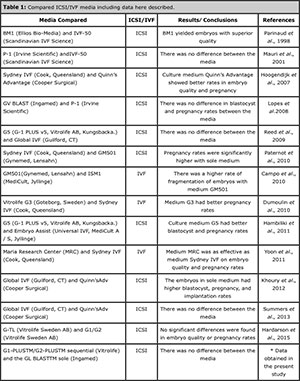
Table 1: Compared ICSI/IVF media including data here described.
MATERIALS AND METHODS
Experimental groups
A prospective, randomized study was carried out from March to July 2015
in a clinic of assisted human reproduction in Curitiba/PR. Data from 60
patients who were submitted to the Intracytoplasmic Sperm Injection
(ICSI) technique in fresh cycles, was tabulated and compared. Patients
were randomly divided into Group 1 (n=34) and Group 2 (n=26). Group 1
patient embryos were cultivated with G1-PLUS™/G2-PLUS™ sequential
(Vitrolife) medium, whereas Group 2 patient embryos were cultivated in
GV BLAST™ sole (Ingamed) medium. Comparisons of the groups regarding:
patient age, rates of normal fertilization, embryo cleavage, blastocyst
development and pregnancy were conducted.
Culture media
G1-PLUS™ and G2
PLUS™ are sequential embryonic media. G1 PLUS™ provides carbohydrates,
amino acids and hyaluronan to support the first stages of development
(until D3), while the G2 PLUS™ medium contains a quantity of amino
acids and hyaluronan for cultivation until the blastocyst. In addition,
both mediums contain human serum albumin. The GV BLAST™ medium is a
bicarbonate buffering system, made to promote early embryonic
development to the blastocyst stage. It consists of a single culture
medium, without any protein components. The general protocols of
assisted human reproduction laboratories include protein supplements
when working with the medium. Current recommendations are to employ 10%
Ingamed serum, and not to use human albumin.
Ovulation induction, ICSI, embryo cultivation and pregnancy verification
The hormonal stimulation cycle was initiated following clinical,
biochemical and imaging examinations in order to obtain fresh oocytes (Dzik et al., 2010).
Freshly collected oocytes were denuded, and classified according to
their maturity. Only oocytes in metaphase II were submitted to ICSI, 3
to 4 hours after follicular aspiration (Dzik et al., 2010).
Once injected, oocytes were randomly divided into Group 1
(G1-PLUS™/G2-PLUS™) and Group 2 (GV BLAST™). The oocytes injected in
Group 1 were grown in G1-PLUS™ medium until Day 3 of development. The
embryos that were not transferred until Day 3 were cultured in the
G2-PLUS™ medium until the fifth day. Those from Group 2 were cultured
in the GV BLAST™ medium until the third day of development. Similarly,
embryos that were not transferred until the third day had their medium
renewed and were grown until the fifth day.
Oocyte fertilization
was checked between 16 and 18 hours post-ICSI. Embryos were evaluated
on the second (D2) and third (D3) days of culture based on the number
of cleaved cells, which corresponds to the day of development. The
cleavage of the embryos was categorized as per Ben-Yosef; 2004.
The classification was divided into three groups: fast cleaving (> 4
cells on D2 or > 8 cells on D3); normal cleaving (2-4 cells on D2 or
6-8 cells on D3) or delayed cleaving (< 2 cells on D2 or < 6
cells on D3).
Embryos were transferred on the second, third or
fifth day of embryonic culture according to the age of the patient, the
number of mature oocytes obtained and embryonic quality (Dzik et al., 2010).
After 12 to 14 days of embryo transfer, pregnancy was evaluated by
quantitative Beta hCG examination (testing for the beta fraction of
chorionic gonadotropin) (Basirat et al., 2010). Pregnancy rates were assessed according to the day of embryo transfer: D2, D3 and D5.
Statistical analysis
The data were tabulated and statistical comparison between groups
performed using the Pearson’s Chi-Square test (Social Science
Statistics:
http://www.socscistatistics.com/tests/chisquare/Default2.aspx).
Analyses resulting in a P <0.05 were considered statistically
significant.
Ethics Committee Approval
This
project received approval from the Research Ethics Committee of
Universidade Positivo, under number 45767215.7.0000.0093.
RESULTS
In order to ensure age
homogeneity in the sample, which is important to account for the effect
of maternal age on oocyte quality, the patients in both groups were
divided into age groups: 26-30; 31-35; 36-40; 40-45 and 45-50.
Statistical analyses revealed equivalent age distribution in both
groups (P=0.40).
Of the total 311 mature oocytes subjected to ICSI, 171 (55%) were from
Group 1, while 140 (45%) were from Group 2. According to table 2, there was no significant difference between the groups with regards to: fertilization rate (P=0.59); embryo cleavage rate (P=0.91); the rate of embryos that developed to blastocyst (P=0.33), and to the pregnancy rate (P=0.83).
We also found no significant difference when comparing media at the
embryonic stage according to the number of cells in each day (P=0.69), in accordance with table 3.
The pregnancy rates were similar on all days of embryo transfer: on D2 (P=0.07), D3 (P=0.08) and D5 (P=0.04) according to table 4.
Regarding the overall pregnancy rate, 41.17% of the women from Group 1
became pregnant, while 38.46% in Group 2 achieved the same goal which
was determined to be statistically equivalent.
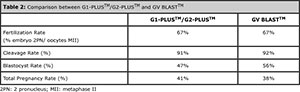
Table 2: Comparison between G1-PLUS™/G2-PLUS™ and GV BLAST™
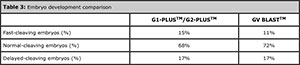
Table 3: Embryo development comparison
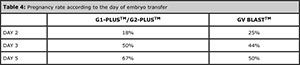
Table 4: Pregnancy rate according to the day of embryo transfer
DISCUSSION
Since different human embryonic cultivation media are commercialized,
it is important that they are compared in terms of their efficacy,
especially those from new market entry companies, which offer products
to compete with those deemed to be international.
In a study of 182 patients, Mauri et al., 2001
compared the P-1 medium (Irvine Scientific) and the IVF-50 medium
(Scandinavian IVF Science) for fertilization, cleavage, transfer,
abortion and pregnancy rates and found no difference between the media.
However, other studies have reported the advantages and disadvanges of
tested media (Ben-Yosef et al., 2004),
comparing the P-1 (Irvine Scientific) and IVF (COOK) media. In this
case, it was concluded that the P-1 medium afforded advantages
regarding implantation and embryo development rates. The supporting
data was obtained from the average embryo cell number counts on each
developmental day in comparison with what is expected.
Embryos in
normal-cleaving and fast-cleaving rates are indicative of good quality
culture as they have greater potential for implantation and pregnancy (Ziebe et al., 1997; Giorgetti et al., 1995).
There are no previous reports of studies comparing the media used in
our study with any other commercially available medium. We observed no
significant difference in the efficacy of the tested media regarding
the average embryo cell number on each day.
Hambiliki et al., 2011,
compared the G-IVF ™ v5 PLUS/ G-1™ v5 PLUS media and the Universal IVF
medium/EmbryoAssist ™ for embryo morphology and development on D2 and
D3. The study showed an increased fertility rate in the G-IVF ™ v5
PLUS/ G-1™ v5 PLUS medium, but there was no difference in polyploidy
and embryo quality. Lopes et al., 2008 compared the GV BLAST™ (Ingamed) medium and the HTF/P1P-1 medium (Irvine Scientific).
The results showed similarity between mediums in fertilization,
cleavage and pregnancy rates. In the present study, we also used the GV
BLAST™ medium, and similarly there was no change in embryo quality in
comparison with the G1-PLUS™/G2-PLUS™ medium. We did not observe any
statistical difference in relation to the comparison of overall
pregnancy rates.
Mantikou et al., 2013,
in his systematic review, evaluated 20 different methods of cultivation
from 11 different companies and concluded that it is still uncertain as
to which is the best medium to cultivate embryos to improve pregnancy
rates for in vitro fertilization. As observed in the
previously mentioned studies, there remains uncertainty as to which
culture medium facilitates the highest pregnancy rate.
Although the
compared mediums have different components and are from separate
companies, the result indicates that both the G1-PLUS™/G2-PLUS™
sequential medium and the GV BLAST™ sole medium are equally effective
in relation to fertilization, cleavage, blastocyst formation and
pregnancy rates.
REFERENCES
Almodin
CG, Minguetti-Câmara VC, Pereira LAC. [Embryo Culture to Blastocyst
Stage: Comparison Using Sequential Medium and Coculture]. Rev Bras
Ginecol Obstet. 2001; 23:589-95.
Crossref
Basirat
Z, Bijani A. Serum beta human chorionic gonadotropin levels at 16 days
following embryo transfer in intra cytoplasmic sperm injection cycles
to predict pregnancy outcome. Saudi Med J. 2010;31:1015-20.
Medline
Ben-Yosef
D, Amit A, Azem F, Schwartz T, Cohen T, Mei-Raz N, Carmon A, Lessing
JB, Yaron Y. Prospective Randomized Comparison of Two Embryo Culture
Systems: P1 Medium by Irvine Scientific and The Cook IVF Medium. J
Assist Reprod Genet. 2004; 21:291-5.
Medline Crossref
Campo
R, Binda MM, Van Kerkhoven G, Frederickx V, Serneels A, Roziers P,
Lopes AS, Gordts S, Puttemans P, Gordts S. Critical reappraisal of
embryo quality as a predictive parameter for pregnancy outcome: a pilot
study. Facts Views Vis Obgyn. 2010;2:289-95.
Medline
Dumoulin
JC, Land JA, Van Montfoort AP, Nelissen EC, Coonen E, Derhaag JG,
Schreurs IL, Dunselman GA, Kester AD, Geraedts JP, Evers JL. Effect of
in vitro culture of human embryos on birthweight of newborns. Hum
Reprod. 2010;25:605-12.
Medline Crossref
Giorgetti
C, Terriou P, Auquier P, Hans E, Spach JL, Salzmann J, Roulier R.
Implantation: Embryo score to predict implantation after in-vitro
fertilization: based on 957 single embryo transfers. Hum Reprod.
1995;10:2427-31.
Medline Crossref
Hambiliki
F, Sandell P, Yaldir F, Stavreus-Evers A. A prospective randomized
sibling-oocyte study of two media systems for culturing cleavage-stage
embryos—impact on fertilization rate. J Assist Reprod Genet.
2011;28:335-41.
Medline Crossref
Hardarson
T, Bungum M, Conaghan J, Meintjes M, Chantilis SJ, Molnar L, Gunnarsson
K, Wikland M. No inferiority, randomized, controlled trial comparing
embryo development using media developed for sequential or undisturbed
culture in a time-lapse setup. Fertil Steril. 2015;104:1452-9.
Medline Crossref
Hoogendijk
CF, Kruger TF, Beer ML, Siebert TIS. A study of two sequential culture
media – impact on embryo quality and pregnancy rates. S Afr J Obstet
Gynaecol. 2007; 13:52-8.
Link
Khoury
C, Coffler M, Potter D, Frederick J, Batagglia D. Improved blastocyst
development using a single step medium versus a sequential medium.
Fertil Steril. 2012; 97:S4-S5.
Crossref
Lopes
V M, Pereira TR, Lopes JR. C; Café, T. C; Almodin, C. G; Câmara, V. C.
M. [A comparison between GV and HTF/P1 media in IVF]. JBRA Assist
Reprod. 2008; 12:11-4.
Link
Mantikou
E, Youssef MA, van Wely M, van der Veen F, Al-Inany HG, Repping S,
Mastenbroek S. Embryo culture media and IVF/ICSI succes rates: a
systematic review. Hum Reprod Update. 2013;19:210-20.
Medline Crossref
Mauri
AL, Petersen CG, Baruffi RL, Franco JG Jr. A Prospective, Randomized
Comparison of Two Commercial Media for ICSI and Embryo Culture. J
Assist Reprod Genet. 2001;18:378-81.
Medline Crossref
Parinaud
J, Veiga A, Vieitez G, Busquets A, Milhet P, Calderon G, Richoilley G,
Barri P. Randomized comparison of three media used for embryo culture
after intracytoplasmic sperm injection. Hum Reprod. 1998;13:212-7.
Medline Crossref
Paternot
G, Debrock S, D’Hooghe TM, Spiessens C. Early embryo development in a
sequential versus single médium: a randomized study. Reprod Biol
Endocrinol. 2010;8:83.
Medline Crossref
Reed
ML, Hamic A, Thompson DJ, Caperton CL. Continuous uninterrupted single
medium culture without medium renewal versus sequential media culture:
a sibling embryo study. Fertil Steril. 2009;92:1783-6.
Medline Crossref
Summers
MC, Bird S, Mirzai FM, Thornhill A, Biggers JD. Human preimplantation
embryo development in vitro: a morphological assessment of sibling
zygotes cultured in a single medium or in sequential media. Hum Fertil.
2013;16:278-85.
Medline Crossref
Yoon
J, Yoon HJ, Juhn KM, Ko JK, Yoon SH, Ko Y, Lim JH. Application of two
different synthetic sequential media for the human IVF-ET program: a
prospective, randomized, and comparative study. Clin Exp Reprod Med.
2011;38:186-92.
Medline Crossref
Ziebe
S, Petersen K, Lindenberg S, Andersen AG, Gabrielsen A, Andersen AN.
Embryo morphology or cleavage stage: how to select the best embryos for
transfer after in-vitro fertilization. Hum Reprod. 1997;12:1545-9.
Medline Crossref