JBRA Assist. Reprod. 2023;27(2):247-253
ORIGINAL ARTICLE
doi: 10.5935/1518-0557.20220052
Histological and molecular evaluation of Mentha arvensis extract on a polycystic ovary syndrome rat model
1Department of Clinical Biochemistry, School of Medicine, Tehran University of Medical Sciences, Tehran, Iran
2Department of Clinical Biochemistry, Islamic Azad University, Shahr-e-Qods Branch, Qods, Tehran, Iran
3Department of Biology, Zarghan Branch, Islamic Azad University, Zarghan, Iran
4Clinical Neurology Research Center, Shiraz University of Medical Sciences, Shiraz, Iran
5Persian BayanGene Research and Training Center, Shiraz University of Medical Sciences, Shiraz, Iran
6Department of immunology, College of Veterinary Medicine, Science and Research Branch, Islamic Azad University, Tehran, Iran
7Department of Biology, East Tehran Branch, Islamic Azad University, Tehran, Iran
8Reprodutive Biology Department, School of Advanced Medical Sciences and Technologies, Shiraz University of Medical Sciences, Shiraz, Iran
9Department of Immunology, Shiraz University of Medical Sciences, Shiraz, Iran
CONFLICTS OF INTEREST
The authors declare that no conflicting financial interests exist.
ABSTRACT
Objective: This study aimed to investigate the impact of Mentha arvensis on a rat model of polycystic ovary syndrome (PCOS).
Methods: The PCOS rat model was made by the daily subcutaneous injection of testosterone enanthate (250mg/kg) for 21 days. Thirty rats were divided into five groups, including a healthy control group and four PCOS groups treated with various concentrations of hydroalcoholic extract of Mentha arvensis (0, 50, 100 and 200mg/kg). LH and FSH were measured in the blood. The ovaries were used for histological investigation, Cyp17 and Ptgs2 genes expression and total antioxidant capacity.
Results: Our results indicated that the level of LH and FSH hormones in treated PCOS rats with various concentrations of M. arvensis were reduced in comparison with the untreated PCOS group (p<0.01). Mentha arvensis in the highest concentration (200mg/kg) decreased the number of cysts in this group in comparison with the untreated PCOS group (p<0.01). The expression of Cyp17 and Ptgs2 genes in the treated group with the highest concentration of hydroalcoholic extract were decreased in comparison with the untreated PCOS group (p<0.05). Moreover, the antioxidant capacity in the rats receiving Mentha arvensis hydroalcoholic extract was significantly increased in comparison with that from the untreated PCOS rats (p<0.05).
Conclusions: For the first time, Mentha arvensis hydroalcoholic extract proved to reduce some polycystic ovary syndrome symptoms. In the present experiment, a dose of 200mg/kg of Mentha arvensis hydroalcoholic extract was regarded as the most efficient dose.
Keywords: polycystic ovary syndrome,Mentha,CYP17,Ptgs2
INTRODUCTION
Polycystic ovary syndrome (PCOS), one of the most common endocrine system disorders, affects women during their reproductive age (McCartney & Marshall, 2016). This disease was described in 1935 by Stein and Leventhal, that is why it is also named Stein-Leventhal syndrome (Leventhal, 1958). In this disease, approximately 10 small cysts with diameters from 2 to 8 mm are formed in one or both ovaries; or the ovarian volume in at least one ovary is more than 10 ml (Jonard et al., 2003). In healthy women, immature oocytes are matured under the effect of Follicle-stimulating hormone (FSH) and ovulation, as well as final maturation is induced by Luteinizing Hormone (LH). While, in women with PCOS, gonadotropin-releasing hormone (GnRH) is increased, and subsequently LH is promoted in comparison with FSH in circulation (Banaszewska et al., 2003).
Since androgen hormones are greatly produced in PCOS, the expression of involved genes is changed in the production of endogenous hormones. One of these genes is the Cytochrome P450-C17 gene (Cyp17), which encodes the cytochrome P40 enzyme. It is involved in the production of 17-hydroxypregnenolone and 17-hydroxyprogesterone from pregnenolone and progesterone, respectively (Gilep et al., 2011). Ptgs2 or Cox2 gene are important in ovulation. They are involved in the production of prostaglandin as an inflammatory dilator in the ovary (Fox et al., 2019).
Multiple studies have indicated that oxidative stress, a mismatch between oxidation and antioxidation, is one of the causes of PCOS and PCOS-related symptoms, such as insulin resistance, hyperandrogenic and chronic inflammation (Zuo et al., 2016). In view of the fact that epidemiological findings showed a high prevalence of PCOS worldwide (Yildiz et al., 2012), PCOS increases the risk of many diseases, such as infertility (Hart, 2008), cancer (Balen, 2001), type II diabetes mellitus (Elting et al., 2001), obesity (Elting et al., 2001) and heart disease (Dokras, 2013) in these women. Thus, this disease affects all aspects of a woman’s mental and physical health, and subsequently it will have negative mental and economic impacts on family health.
Regarding the side effects of chemical drugs on PCOS treatment, identification and production of alternative drugs are conducive to improve PCOS and its symptoms. Medicinal plants were applied for treating a high range of gynecological diseases, including menopausal and menstrual symptoms. Mentha arvensis is a species of the Lamiaceae family of plants, which can grow in temperate wet climates and even in humid places with steppe climates (Ferreira et al., 2012). Various species of the Lamiaceae family have been used to treat various women’s health problems, like dysmenorrhea (Bafor et al., 2021; Uritu et al., 2018), amenorrhea (Elahi et al., 2016; Moini Jazani et al., 2018) and PCOS (Abasian et al., 2018; Goswami et al., 2012). But no study has been conducted to investigate the effects of M. arvensis on PCOS. Regarding the high prevalence of PCOS and complications, and failure of chemical treatments in these patients, we investigated the impact of M. arvensis hydroalcoholic extract on LH and FSH hormones in blood, as well as the expression of Cyp17 and Ptgs2 genes and antioxidant capacity of ovary in a PCOS rat model.
MATERIALS AND METHODS
Plant collection and extraction
For this experimental study, M. arvensis was collected from the province ofFars, Iran. It was identified by a botanist; it was given a voucher number and it was deposited in the Shiraz School of Pharmacy Herbarium.The plant was dried with all its organs, and it was grinded. To provide hydroethanolic extract, 100 g of dried plant was soaked in 700 ml 80% ethanol and the mixture was shaken for 48 hours, and it was repeated twice. The solution was filtered and the extracts were condensed by a rotary device at 40-50°C for two days. The provided powder was stored at 4°C until the assays were performed.
Animals
Thirty female wistar rats (6-7 weeks old), weighting 195±4.1 were provided by the Pasture Iran institute animal house. The animals were randomly divided into five groups of six rats each, including a healthy control group, untreated PCOS group (PCOS), PCOS rats treated with 50 mg/kg (T50 mg/kg), 100 mg/kg (T100 mg/kg) and 200 mg/kg (T200 mg/kg) hydroalcoholic extract of M. arvensis. The rats were maintained into 23±3°C with free access to food and water in 12 h light: 12 h dark cycles.Furthermore, the treatment groups of 50, 100 and 200 mg/kg of extract powder mixed with water for 4 weeks were fed by gavage at a volume of 0.5 ml. The weight of all rats was measured before the treatment, after PCOS induction and the last day of experiment. All animal care and procedures in this study were approved by the Ethics committee of the Islamic Azad University, Shahr-e-Qods Branch (No. IAUSG 1926).
Polycystic ovary syndrome rat model
Rats in the PCOS group, were daily administered 250 mg/kg of testosterone enanthate (Aburaihan Pharmaceutical Co., Iran) by subcutaneous injection in the neck for 3 weeks. After that, ovarian tissue and the number of follicles were examined to confirm the PCOS induction.
Measurement of LH and FSH hormone levels
After four weeks of M. arvensis extract treatment, blood samples were harvested from the rats’ hearts. To prepare the serum, blood samples were centrifuged at 2500rpm for 10 minutes and levels of LH and FSH hormones (ZellBio GmbH, Germany) were assessed using the ELISA technique, based on instructions from the manufacturer, by ELISA Reader at a wavelength of 450nm.
Ovarian morphology
In the end of the experiment, the ovaries of all groups were stained for histological assessment by hematoxylin and eosin (H&E). Briefly, after dissecting the ovaries, the samples were fixed in formaldehyde. Then, the routine paraffin embedding was done. The ovary tissues were cut using a rotary microtome at a thickness of 5 μm. The samples were stained with H&E and examined under a light microscope (Nikon ECLIPSE E200, Japan).
Total antioxidant capacity (TAC) in ovarian tissues
The ovaries were removed and homogenized in PBS buffer, and then centrifuged at 12,000 rpm for 15 minutes at 4°C. After that, the supernatant was transferred into a new tube and TAC was measured using the Kiazist TAC kit (Kiazist, Iran) according to instructions from the manufacturer. Absorbance was read at 450 nm wavelength.
The assessment of Cyp17 and Ptgs2 gene expression
Real time RT-PCR was used to evaluate the expression of Cyp17 and Ptgs2 (Cox2) genes in ovarian tissue samples. To extract RNA, we used the RiboEX kit (GeneAll, Seoul, South Korea), according to instructions of manufacturer. A nanodrop device was used to determine the amount and purity of the extracted RNA. In the next step, cDNA was synthesized using a HyperScript™ first strand cDNA synthesis kit. Real-time RT-PCR was performed using an Applied Biosystems StepOnePlus™ (Applied Biosystems™, Foster City, CA, USA) in a final volume of 25 μL containing of 1 μl of the cDNA template, 12.5 μL of RealQ Plus 2x Master Mix Green (Amplicon, Denmark), and 1 μL (10 pmol/μl) of each specific primer (Table 1). Glyceraldehyde-3-phosphate dehydrogenase was used as a reference gene. The samples were analyzed using the 2-∆∆Ct method.
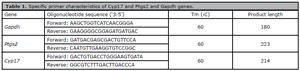
Table 1. Specific primer characteristics of Cyp17 and Ptgs2 and Gapdh genes.
Statistical analysis
Data analysis was performed by GraphPad Prism version 6 (GraphPad Software). One-way ANOVA test was applied to check data significance. Tukey’s multiple comparison was used as a posthoc to compare the groups. All results were presented as mean ± standard error (mean±SEM). We considered a significance level of 0.05. we used five replicates per group for each assessment.
RESULTS
Body weight
The rats’ weights were measured before starting the study, after creating the PCOS model and on the last day of the study (Table 2). In the last day of the experiment, the body weight in the PCOS group was higher than among controls and the T50, T100 and T200 groups (p<0.05). After 21 days of treatment with hydroalcoholic extract of M. arvensis, body weight of rats in the T50, T100 and T200 groups reached the levels of the control group.
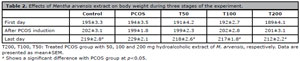
Table 2. Effects of Mentha arvensis extract on body weight during three stages of the experiment.
LH and FSH hormones
The levels of LH and FSH hormones in the serum of rat groups are presented in Fig. 1. LH and FSH levels in untreated PCOS and T50 groups significantly increased in comparison with the healthy controls, the T100 and T200 groups (p<0.01). It was also found that the levels of LH and FSH in the PCOS group were higher than theT50 group (p<0.01). On the other hand, levels of LH and FSH hormones in the T100 and T200 groups reached the values of the control group (Fig. 1).
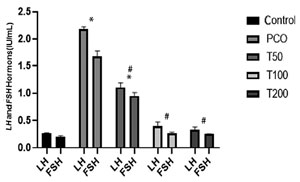
Figure 1. The changes in LH and FSH hormones in the rat groups: LH and FSH hormones (IU/mL) in the healthy control group, untreated PCOS group (PCOS), treated groups with 50 mg (T50), 100 mg (T100) and 200 mg (T200) hydroalcoholic extract of M. arvensis. * Shows a significant difference with the control group at p<0.001, and # Shows a significant difference vis-à-vis the PCOS group at p<0.01.
Ovarian morphology
Ovarian tissues of controls, PCOS and treated group (with 200 mg/kg hydroalcoholic extract of M. arvensis) were assessed using hematoxylin and eosin staining (Fig. 2) with a magnification of 400s. As indicated in Fig. 2 in the control group, healthy follicles were visible with black arrows and in the PCOS group cysts were indicated with red arrows. In the T200 group, healthy follicles are represented by a black arrow.
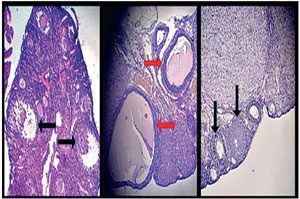
Figure 2. Ovarian cross section photomicrograph (H&E) of control, PCOS and treated groups with 200 mg/kg hydroalcoholic extract of M. arvensis (T200 mg/Kg) with 400x magnification. Red arrows show the cysts in the PCOS group (middle image), and the black arrows represent a healthy follicle in the ovaries of control group (left image) and T200 group (right image) animals.
Number of follicles
We counted the number of follicles in the ovaries from three rats of each group. Results showed that the number of ovarian follicles in the PCOS group (5±1.3) was lower than that in healthy rats (23±1.4. p<0.01). This number was increased in PCOS rats treated with M. arvensis hydroalcoholic extract (p<0.01); and the highest number of follicles was observed in the T200 group (21±2.6), which was not significantly different from the number of follicles among healthy controls Table 3.

Table 3. The number of follicles in the ovaries after treating the PCOS rats with different concentration of hydroalcoholic extract of M. arvensis.
Total antioxidant capacity of ovarian tissue
This finding indicated that the total antioxidant capacity in the PCOS group was significantly lower than the PCOS-treated groups with different concentrations of M. arvensis extract (T50, T100 and T200, p<0.05). There were no significant differences among the treated groups (Fig. 3).
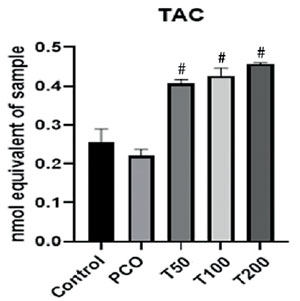
Figure 3. Total antioxidant capacity of ovarian tissues. Total antioxidant capacity was measured in the control, untreated PCOS (PCOS), treated PCOS group with 50 mg (T50), 100 mg (T100) and 200 mg (T200) hydroalcoholic extract of M. arvensis. # Shows a significant difference in the PCOS group at p<0.05.
Cyp17 and Ptgs2 gene expression in the ovaries
Real time RT-PCR results indicated that the Cyp17 and Ptgs2 gene expressions in ovarian samples of PCOS and T50 groups were significantly enhanced in comparison with the control group (Fig. 4, p<0.01). Furthermore, expressions of these genes were significantly reduced in the T100 and T200 treated groups in comparison with the PCOS group (p<0.05).
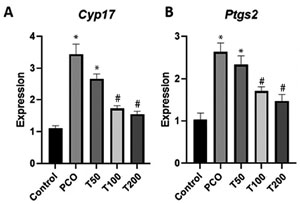
Figure 4. The expressions of Cyp17 and Ptgs2 genes in ovarian tissue. Expression of Cyp17 (4A) and Ptgs2 (4B) genes in ovarian tissue of healthy controls, untreated PCOS (PCOS), treated group with 50 mg (T50), 100 mg (T100) and 200 mg (T200) hydroalcoholic extract of M. arvensis. * Shows a significant difference vis-a-vis control group at p<0.01, and # Shows a significant difference with PCOS and T50 groups at p<0.01.
DISCUSSION
PCOS is a common metabolic disorder in women of childbearing age, which affects all aspects of a woman’s life. The criteria for diagnosis of this disease are LH and FSH hormone level as well as ovarian histological changes and weight gain of patients. In this study, we approved creating a rat model using features like rat weight, LH and FSH hormones and ovarian tissue changes.
In the present study we found that hydroalcoholic extract of M. arvensis in all concentrations inhibited weight gain in the PCOS rats; although the concentration of 200 mg/kg had the highest impact on body weight improvement. Alizadeh et al. (2020) evaluated the effects of hydroalcoholic extract of Stachys sylvatica from Lamiacea family on the inhibition of obesity in the PCOS rat model. Their study indicated that the extract improved obesity in PCOS rats.
In healthy women, the level of the two hormones FSH and LH were almost the same (Swaroop et al., 2015); but in PCOS women the LH level was increased. The results of our study showed an increase in LH in the PCOS group. The groups treated with 100 and 200 mg/kg of hydroalcoholic extract of M. arvensis significantly decreased the LH and FSH to their levels in healthy rats. Mentha species, like M. arvensis have high amounts of phenolic compounds as secondary metabolites (Benabdallah et al., 2016; Gharib & da Silva, 2013), and the most significant phenolic compounds in these species are flavonoids (Haj-Husein et al., 2016). Some flavonoids can activate GABA by binding to its receptor (Ciechanowska et al., 2009). Gonadotropins stimulate the secretion of LH and FSH hormones from the pituitary gland. On the other hand, gonadotropin secretion is prevented by GABA neurotransmitter (Ciechanowska et al., 2009). Thus, by binding the flavonoids to GABA receptors, GABA prevents the GnRH secretion and subsequently, the level of LH secretion will be reduced (Herbison & Dyer, 1991). At variance with those results, Alizadeh et al. (2020) study indicated that Stachys sylvatica hydroalcoholic extract significantly reduced the levels of FSH and LH in treated rats. Also, Grant’s (2010) study showed that spearmint (Lamiacea family) significantly increased LH and FSH in women with PCOS. The results of another study indicated that Marjoram (Lamiacea family) as tea, had no change in the level of LH hormone in women with PCOS (Haj-Husein et al., 2016). These differences in the studies could be attributed to variances in the PCOS induction drug, the investigated subject, and the type of plant extract used.
This study showed a significant increase in the number of cystic follicles in the PCOS group in comparison with the healthy control group. The number of ovarian cysts was reduced after treatment with M. arvensis hydroalcoholic extract. These findings are consistent with the results of some other species of Lamiacea family and other herbal extracts in the treatment of PCOS (Alizadeh et al., 2020; Amoura et al., 2015; Sadeghi Ataabadi et al., 2017).
Our findings indicated an important increase in the antioxidant capacity of the ovary of PCOS rats treated with M. arvensis hydroalcoholic extract. The research of Sadeghi Ataabadi et al. (2017) indicated that Mentha spicata extract in PCOS rats decreased ovarian cysts and increased ovarian antioxidant capacity. Increasing oxidative stress by an imbalance between antioxidants and oxidants, which can disrupt the folliculogenesis in PCOS patients and consumption of antioxidant substances can be efficient in the treatment of PCOS (Zhang et al., 2008). Multiple studies showed that the increase in antioxidant capacity of Mentha species such as arvensis is due to its phenolic compounds (Benabdallah et al., 2016; Dar et al., 2014).
In this study, the expression of Cyp17 in ovarian tissue of PCOS rats was considerably high. In agreement with this finding, many studies revealed that the expression of Cyp17 in PCOS ovarian tissue of humans and rats was greatly expressed compared to healthy ovarian tissue (Li et al., 2013; Nelson et al., 1999; Wickenheisser et al., 2005). This study for the first time presented that M. arvensis hydroalcoholic extract considerably decreased the expression of Cyp17 in PCOS rats. Increasing Cyp17 production increases androgen production. Subsequently, misplaced androgen production plays a pivotal role in the PCOS etiology (Rosenfield & Ehrmann, 2016). Hence, reduction of PCOS symptoms in treated rats with M. arvensis extract can be due to the influence of this plant on downregulation of the Cyp17 expression and subsequently, reduction of androgen production.
The expression of Ptgs2 gene as a follicular phase marker was considerably high in the ovarian tissue of PCOS rats. Several studies reported high expression of this gene in PCOS patients (Liu et al., 2016; Schmidt et al., 2014). One of the mechanisms of pathogenesis suggested that gene expression of zinc finger gene 217 (Znf217) was decreased in PCOS rats and women. This gene increases the expression of inflammatory genes, such as Ptgs2 and Prostaglandin E2 (Pge2) (Zhai et al., 2020).
CONCLUSION
This study confirmed that M. arvensis hydroalcoholic extract can be useful as a treatment for PCOS patients by improving follicularization and regulating LH and FSH secretion. It seems that the antioxidant features of arvensis extract are beneficial in reducing the symptoms of this disease, and it is suggested that different extract compounds, especially phenolic compounds, play an important role in this activity.
Bafor EE, Kalu CH, Omoruyi O, Elvis-Offiah UB, Edrada-Ebel R. Thyme (Thymus vulgaris[Lamiaceae]) Leaves Inhibit Contraction of the Nonpregnant Mouse Uterus. J Med Food. 2021;24:541-50. PMID: 32758061 DOI: 10.1089/jmf.2020.0076 Medline
Balen A. Polycystic ovary syndrome and cancer. Hum Reprod Update. 2001;7:522-5. PMID: 11727859 DOI: 10.1093/humupd/7.6.522 Medline
Banaszewska B, Spaczyński RZ, Pelesz M, Pawelczyk L. Incidence of elevated LH/FSH ratio in polycystic ovary syndrome women with normo- and hyperinsulinemia. Rocz Akad Med Bialymst. 2003;48:131-4. PMID: 14737959 Medline
Ciechanowska M, Lapot M, Malewski T, Mateusiak K, Misztal T, Przekop F. Effects of GABA(A) receptor modulation on the expression of GnRH gene and GnRH receptor (GnRH-R) gene in the hypothalamus and GnRH-R gene in the anterior pituitary gland of follicular-phase ewes. Anim Reprod Sci. 2009;111:235-48. PMID: 18434046 DOI: 10.1016/j.anireprosci.2008.03.006 Medline
Dokras A. Cardiovascular disease risk in women with PCOS. Steroids. 2013;78:773-6. PMID: 23624351 DOI: 10.1016/j.steroids.2013.04.009 Medline
Elting MW, Korsen TJ, Bezemer PD, Schoemaker J. Prevalence of diabetes mellitus, hypertension and cardiac complaints in a follow-up study of a Dutch PCOS population. Hum Reprod. 2001;16:556-60. PMID: 11228228 DOI: 10.1093/humrep/16.3.556 Medline
Gilep AA, Sushko TA, Usanov SA. At the crossroads of steroid hormone biosynthesis: the role, substrate specificity and evolutionary development of CYP17. Biochim Biophys Acta. 2011;1814:200-9. PMID: 20619364 DOI: 10.1016/j.bbapap.2010.06.021 Medline
Grant P. Spearmint herbal tea has significant anti-androgen effects in polycystic ovarian syndrome. A randomized controlled trial. Phytother Res. 2010;24:186-8. PMID: 19585478 DOI: 10.1002/ptr.2900 Medline
Haj-Husein I, Tukan S, Alkazaleh F. The effect of marjoram (Origanum majorana) tea on the hormonal profile of women with polycystic ovary syndrome: a randomised controlled pilot study. J Hum Nutr Diet. 2016;29:105-11. PMID: 25662759 DOI: 10.1111/jhn.12290 Medline
Hart R. PCOS and infertility. Panminerva Med. 2008;50:305-14. PMID: 19078871 Medline
Herbison AE, Dyer RG. Effect on luteinizing hormone secretion of GABA receptor modulation in the medial preoptic area at the time of proestrous luteinizing hormone surge. Neuroendocrinology. 1991;53:317-20. PMID: 1645854 DOI: 10.1159/000125735 Medline
Jonard S, Robert Y, Cortet-Rudelli C, Pigny P, Decanter C, Dewailly D. Ultrasound examination of polycystic ovaries: is it worth counting the follicles? Hum Reprod. 2003;18:598-603. PMID: 12615832 DOI: 10.1093/humrep/deg115 Medline
Leventhal ML. The Stein-Leventhal syndrome. Am J Obstet Gynecol. 1958;76:825-38. PMID: 13583027 DOI: 10.1016/0002-9378(58)90019-X Medline
Li H, Chen Y, Yan LY, Qiao J. Increased expression of P450scc and CYP17 in development of endogenous hyperandrogenism in a rat model of PCOS. Endocrine. 2013;43:184-90. PMID: 22798247 DOI: 10.1007/s12020-012-9739-3 Medline
Liu Q, Li Y, Feng Y, Liu C, Ma J, Li Y, Xiang H, Ji Y, Cao Y, Tong X, Xue Z. Single-cell analysis of differences in transcriptomic profiles of oocytes and cumulus cells at GV, MI, MII stages from PCOS patients. Sci Rep. 2016;6:39638. PMID: 28004769 DOI: 10.1038/srep39638 Medline
McCartney CR, Marshall JC. CLINICAL PRACTICE. Polycystic Ovary Syndrome. N Engl J Med. 2016;375:54-64. PMID: 27406348 DOI: 10.1056/NEJMcp1514916 Medline
Moini Jazani A, Hamdi K, Tansaz M, Nazemiyeh H, Sadeghi Bazargani H, Fazljou SMB, Nasimi Doost Azgomi R. Herbal Medicine for Oligomenorrhea and Amenorrhea: A Systematic Review of Ancient and Conventional Medicine. Biomed Res Int. 2018;2018:3052768. PMID: 29744355 DOI: 10.1155/2018/3052768 Medline
Nelson VL, Legro RS, Strauss JF 3rd, McAllister JM. Augmented androgen production is a stable steroidogenic phenotype of propagated theca cells from polycystic ovaries. Mol Endocrinol. 1999;13:946-57. PMID: 10379893 DOI: 10.1210/mend.13.6.0311 Medline
Rosenfield RL, Ehrmann DA. The Pathogenesis of Polycystic Ovary Syndrome (PCOS): The Hypothesis of PCOS as Functional Ovarian Hyperandrogenism Revisited. Endocr Rev. 2016;37:467-520. PMID: 27459230 DOI: 10.1210/er.2015-1104 Medline
Sadeghi Ataabadi M, Alaee S, Bagheri MJ, Bahmanpoor S. Role of Essential Oil of Mentha Spicata (Spearmint) in Addressing Reverse Hormonal and Folliculogenesis Disturbances in a Polycystic Ovarian Syndrome in a Rat Model. Adv Pharm Bull. 2017;7:651-4. PMID: 29399556 DOI: 10.15171/apb.2017.078 Medline
Schmidt J, Weijdegård B, Mikkelsen AL, Lindenberg S, Nilsson L, Brännström M. Differential expression of inflammation-related genes in the ovarian stroma and granulosa cells of PCOS women. Mol Hum Reprod. 2014;20:49-58. PMID: 23900753 DOI: 10.1093/molehr/gat051 Medline
Swaroop A, Jaipuriar AS, Gupta SK, Bagchi M, Kumar P, Preuss HG, Bagchi D. Efficacy of a Novel Fenugreek Seed Extract (Trigonella foenum-graecum, Furocyst) in Polycystic Ovary Syndrome (PCOS). Int J Med Sci. 2015;12:825-31. PMID: 26516311 DOI: 10.7150/ijms.13024 Medline
Uritu CM, Mihai CT, Stanciu GD, Dodi G, Alexa-Stratulat T, Luca A, Leon-Constantin MM, Stefanescu R, Bild V, Melnic S, Tamba BI. Medicinal Plants of the Family Lamiaceae in Pain Therapy: A Review. Pain Res Manag. 2018;2018:7801543. PMID: 29854039 DOI: 10.1155/2018/7801543 Medline
Wickenheisser JK, Nelson-Degrave VL, McAllister JM. Dysregulation of cytochrome P450 17alpha-hydroxylase messenger ribonucleic acid stability in theca cells isolated from women with polycystic ovary syndrome. J Clin Endocrinol Metab. 2005;90:1720-7. PMID: 15598676 DOI: 10.1210/jc.2004-1860 Medline
Yildiz BO, Bozdag G, Yapici Z, Esinler I, Yarali H. Prevalence, phenotype and cardiometabolic risk of polycystic ovary syndrome under different diagnostic criteria. Hum Reprod. 2012;27:3067-73. PMID: 22777527 DOI: 10.1093/humrep/des232 Medline
Zhai J, Li S, Cheng X, Chen ZJ, Li W, Du Y. A candidate pathogenic gene, zinc finger gene 217 (ZNF217), may contribute to polycystic ovary syndrome through prostaglandin E2. Acta Obstet Gynecol Scand. 2020;99:119-26. PMID: 31454071 DOI: 10.1111/aogs.13719 Medline
Zhang D, Luo WY, Liao H, Wang CF, Sun Y. [The effects of oxidative stress to PCOS]. Sichuan Da Xue Xue Bao Yi Xue Ban. 2008;39:421-3. Chinese. PMID: 18575330 Medline
Zuo T, Zhu M, Xu W. Roles of Oxidative Stress in Polycystic Ovary Syndrome and Cancers. Oxid Med Cell Longev. 2016;2016:8589318. PMID: 26770659 DOI: 10.1155/2016/8589318 Medline