JBRA Assist. Reprod. 2024;28(2):295-298
ORIGINAL ARTICLE
doi: 10.5935/1518-0557.20240004
High ovarian responders have the highest risk of premature progesterone rise
1Reproductive Endocrinology Specialist, Centro Médico Nacional 20 de Noviembre, Mexico City, Mexico
2Associate Professor, Obstetrics and Gynecology Department, Escuela Superior de Medicina, Instituto Politécnico Nacional, Mexico City, Mexico
3Reproductive Endocrinology Fellow at Reproductive Endocrinology Department, Centro Médico Nacional 20 de Noviembre, Mexico City, Mexico
4Minimally Invasive Gynecological Surgery Department, Centro Médico Nacional 20 de Noviembre, Mexico City, Mexico
5Reproductive Endocrinology Professor at Universidad Nacional Autónoma de México
6Reproductive Endocrinology Specialist, Reproductive Endocrinology Department, Centro Médico Nacional 20 de Noviembre, Mexico City, Mexico
7Centre for Reproductive Medicine, Universitair Ziekenhuis Brussel, Vrije Universiteit Brussel, Brussels, Belgium
8Department of Obstetrics and Gynaecology, School of Medicine, European University Cyprus, Nicosia, Cyprus
9IVF Athens, Athens, Greece
CONFLICT OF INTEREST
PD has been a consultant to Merck Healthcare KGaA (Darmstadt, Germany) from April 2021 till June 2023, and is a Merck employee (Medical Director, Global Medical Affairs Fertility) with Merck Healthcare KGAaA (Darmstadt, Germany) since July 2023. He declares honoraria for lecturing from Merck KGaA, MSD, Organon and Ferring.
ABSTRACT
Objective: Late follicular phase progesterone elevation is a complication that affects approximately 38% of IVF cycles. There is a lack of consensus on the appropriate cut-off levels for progesterone on hCG day. Although premature progesterone rise occurs in all kinds of ovarian responses, there is a knowledge gap regarding the ovarian response with the highest risk of this phenomenon. Our study aims to assess the relative risk of each kind of ovarian response for premature progesterone rise and evaluate the prevalence of premature progesterone rise in each ovarian response.
Methods: A retrospective, cross-sectional, comparative and analytic study was performed at the Reproductive Endocrinology Department in Centro Médico Nacional 20 de Noviembre in Mexico City. All conventional-antagonist cycles were grouped according to their ovarian response and were evaluated from 2015 to 2020. Pearson’s Squared-chi, Cramer’s V, cross-table and the relative risk were calculated.
Results: The prevalence of premature progesterone rise oscillated from 20.8 to 67.9% for low and high ovarian responders, respectively. After calculating the relative risk, high ovarian responders had a 1.38 higher risk for premature progesterone rise than other groups.
Conclusions: High ovarian responders have the highest risk for premature progesterone rise compared to normal and low ovarian responders. High ovarian responders have a 67.9% prevalence of premature progesterone rise.
Keywords: risk, premature, progesterone, ovarian, response
INTRODUCTION
Late follicular phase progesterone elevation is a complex phenomenon affecting 12 to 38% of in-vitro fertilization (IVF) cycles (Drakopoulos et al., 2019). Until today there is a lack of consensus on the optimal cut-off levels for progesterone on hCG day, ranging between 0.8 to 2.0 ng/ml. While the most commonly used cut-off level is 1.5 ng/ml, as suggested by some authors (Bosch et al., 2010). There is also evidence that progesterone levels on hCG day have limited regulation since lower progesterone levels also affect live-birth rates (Arvis et al., 2019).
Diverse authors have addressed the deleterious effects of premature progesterone elevation on endometrial receptivity and its impact on pregnancy rates after a fresh embryo transfer (Van Vaerenbergh et al., 2011; Drakopoulos et al., 2019; Xiong et al., 2020). However, the aetiology of late follicular phase progesterone elevation is still debatable; some authors consider that several mechanisms can interact in the same patient (Cortés-Vazquez et al., 2021; 2022). Some authors have found that ovarian response to stimulation protocols is strongly related to progesterone levels on hCG day (Sonigo et al., 2014). Using data from a large prospective randomized controlled trial, Yding Andersen et al. (2011) demonstrated that late follicular phase progesterone is governed by the number of preovulatory follicles and LH concentrations. To the best of our knowledge, no studies are addressing the risk for premature progesterone rise based on the ovarian response. This retrospective study assesses the relative risk for premature progesterone rise in every ovarian response.
MATERIAL AND METHODS
Study population
We performed a retrospective analytic and comparative study; all IVF/ICSI cycles performed in the Reproductive Endocrinology Department at Centro Médico Nacional 20 de Noviembre from 2015 to 2020 were analysed. Notably, the Ethics Committee (Institutional Board Review) from Centro Médico Nacional 20 de Noviembre approved this study. All conventional/ antagonist ovarian cycles were included. Patients were excluded if they had a double ovarian stimulation cycle, progestin-primed ovarian stimulation, mild ovarian stimulation cycles, incomplete information and fertilitypreserving cycles for oncologic reasons. From all cycles, age, body mass index, estradiol, progesterone on hCG day, stimulation length, number of preovulatory follicles, total FSH dosage and number of oocytes retrieved were recorded. All patients were stimulated as previously described (Cortés-Vazquez et al., 2021).
A convenience-sampling method was performed, and 563 cycles were reviewed and analyzed. All cycles were classified according to their ovarian response. Cycles were classified according to Bologna Criteria to define a poor ovarian response. Group 1 had less or equal to 3 oocytes retrieved, group 2 had 4 to 7 oocytes retrieved, Group 3 had 8 to 14 oocytes, and Group 4 had more than 15 retrieved oocytes. Premature progesterone rise was defined by a serum progesterone value of more than 0.9 ng/ml progesterone level on hCG day.
Statistical analysis
A Kolmogorov-Smirnov test was performed to evaluate the data for normality. Subsequently, a cross table was generated, and a Pearson’s Chi-squared test was performed to compare the risk of premature progesterone rise according to ovarian response. Afterwards, a Cramer’s V test was used to estimate the effect size. Finally, the relative risk was calculated for each kind of ovarian response. Statistical analysis was performed using SPSS version 25 (IBM), and p<.05 was considered statistically significant.
RESULTS
The primary dataset included 563 cycles from 2015 to 2020; after applying inclusion and exclusion criteria, 530 cycles were eligible for analysis. At Table 1, we summarized our population’s characteristics. Statistically significant differences between groups in the number of follicles >14mm, number of retrieved oocytes, progesterone-per-follicle index, oestradiol and progesterone on hCG day were found (Table 2). Although age was significantly different between groups, we assume it is clinically irrelevant. Notably, there was no difference in total FSH dosage among groups, and the high responders had the highest progesterone level on hCG day. We found that the high responders had the most elevated risk for premature progesterone rise (Table 3). Pearson’s Chi-squared test showed a p<.000, and Cramer’s V showed a medium effect size (Tables 4 and 5). The prevalence of elevated progesterone levels on hCG day in high responders was 67.9%, while in other groups ranged from 20.8 to 47.2%. We calculated the relative risk for each group; as shown in Table 6, high-responders had the highest relative risk for premature progesterone rise, with a 1.38 RR. Relative risks according to the type of ovarian response can be found in Table 6.
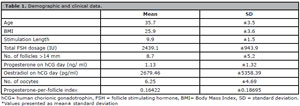
Table 1. Demographic and clinical data.
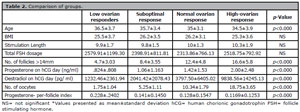
Table 2. Comparison of groups.
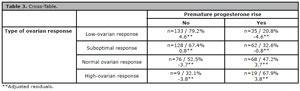
Table 3. Cross-Table.

Table 4. Chi-squared test.
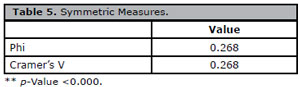
Table 5. Symmetric Measures.
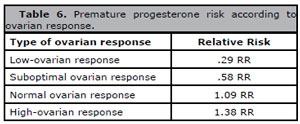
Table 6. Premature progesterone risk according to ovarian response.
DISCUSSION
To the best of our knowledge, this is the first study to assess the relative risk for each ovarian response to develop premature progesterone rise. In our high-responder population, premature progesterone rise prevalence was surprisingly high compared to the 30.2% prevalence reported in other studies (Requena et al., 2014). Racial and ethnic differences between populations could explain this higher prevalence. In a retrospective cohort study, some authors observed that serum progesterone on the hCG day was higher in Latino and Asian women than in white women (Hill et al., 2017). Several authors have shown similar results, particularly that increased follicular development and the number of oocytes retrieved are associated with higher progesterone levels on hCG day (Ubaldi et al., 1995; Yding Andersen et al., 2011; Requena et al., 2014; Racca et al., 2018; Oktem et al., 2019). On the contrary, other authors reached different conclusions, finding that there were no significant differences regarding the number of retrieved oocytes in patients with or without high progesterone levels (Fanchin et al., 1997; Kofinas et al., 2016).
Another finding in our study was that patients with high progesterone levels on hCG day do not have higher gonadotropin consumption compared to normal or lower responders, which is coincident with other publications (Yding Andersen et al., 2011; Lee et al., 2014; Arvis et al., 2019; Oktem et al., 2019). However, other investigators have found an association between elevated preovulatory progesterone levels and higher gonadotropin consumption (Ubaldi et al., 1995; Fanchin et al., 1997; Kofinas et al., 2016; Cao et al., 2020).
Our results are relevant, above all, for patient counselling and treatment individualization. Higher responders have a higher probability of live birth after a freezeonly cycle strategy irrespective of progesterone concentration compared to fresh embryo transfer (Bosdou et al., 2019; Yu et al., 2020). So it would be reasonable to implement a freeze-all policy in high ovarian responders since the risk of ovarian hyperstimulation syndrome (OHSS) would be abolished, along with the premature progesterone rise risk. Stormlund et al. (2019) demonstrated that nearly 60% of patients would prefer a freeze-all strategy where the pregnancy outcome was equal to fresh embryo transfer. Approximately 90% of infertile women would opt for a frozen embryo transfer if ovarian stimulation implies any risk to the mother or child (Stormlund et al., 2019). The freeze-all strategy would also allow physicians to use a more patient-friendly in high-responders, with progestin-primed ovarian stimulation without compromising oocyte or embryo safety, as shown by Zhu et al. (2021); albeit more evidence is needed.
CONCLUSIONS
High responders have the highest risk among all the ovarian responses. Physicians should assess patients about the increased risk of premature progesterone rise and consider implementing a freeze-all policy in high responders.
REFERENCES
Arvis P, Lehert P, Guivarc’h-Levêque A. Both high and low HCG day progesterone concentrations negatively affect live birth rates in IVF/ICSI cycles. Reprod Biomed Online. 2019;39:852-9. PMID: 31570237 DOI: 10.1016/j.rbmo.2019.07.001 Medline
Bosch E, Labarta E, Crespo J, Simón C, Remohí J, Jenkins J, Pellicer A. Circulating progesterone levels and ongoing pregnancy rates in controlled ovarian stimulation cycles for in vitro fertilization: analysis of over 4000 cycles. Hum Reprod. 2010;25:2092-100. PMID: 20539042 DOI: 10.1093/humrep/deq125 Medline
Bosdou JK, Venetis CA, Tarlatzis BC, Grimbizis GF, Kolibianakis EM. Higher probability of live-birth in high, but not normal, responders after first frozen-embryo transfer in a freeze-only cycle strategy compared to fresh-embryo transfer: a meta-analysis. Hum Reprod. 2019;34:491-505. PMID: 30689865 DOI: 10.1093/humrep/dey388 Medline
Cao P, Miao B, Xu Y, Fan Q, Zhang Q, Zhang G, Zhou C, Xu Y. Role of gene polymorphisms related to progesterone elevation in women undergoing long GnRH agonist protocols. Reprod Biomed Online. 2020;40:381-92. PMID: 32204850 DOI: 10.1016/j.rbmo.2019.12.013 Medline
Cortés-Vazquez AC, Rodríguez JMAG, Algara ALC, García JDM. Correlation between biochemical, ultrasonographic and demographic parameters with ovarian response to IVF/ICSI treatments in Mexican women. JBRA Assist Reprod. 2021;25:4-9. PMID: 32489091 DOI: 10.5935/1518-0557.20200040 Medline
Cortés-Vazquez A, Escobosa C, Cortés-Algara AL, Moreno-García JD. Novel insights on premature progesterone elevation: a mini-review. JBRA Assist Reprod. 2022;26:531-7. PMID: 35001522 DOI: 10.5935/1518-0557.20210096 Medline
Drakopoulos P, Racca A, Errázuriz J, De Vos M, Tournaye H, Blockeel C, Pluchino N, Santos-Ribeiro S. The role of progesterone elevation in IVF. Reprod Biol. 2019;19:1-5. PMID: 30777675 DOI: 10.1016/j.repbio.2019.02.003 Medline
Fanchin R, Hourvitz A, Olivennes F, Taieb J, Hazout A, Frydman R. Premature progesterone elevation spares blastulation but not pregnancy rates in in vitro fertilization with coculture. Fertil Steril. 1997;68:648-52. PMID: 9341604 DOI: 10.1016/S0015-0282(97)80464-5 Medline
Hill MJ, Royster GD 4th, Taneja M, Healy MW, Zarek SM, Christy AY, DeCherney AH, Widra E, Devine K. Does elevated progesterone on day of oocyte maturation play a role in the racial disparities in IVF outcomes? Reprod Biomed Online. 2017;34:154-61. PMID: 27887992 DOI: 10.1016/j.rbmo.2016.11.002 Medline
Kofinas JD, Mehr H, Ganguly N, Biley Y, Bochkovsky S, McCulloh D, Grifo J. Is it the egg or the endometrium? Elevated progesterone on day of trigger is not associated with embryo ploidy nor decreased success rates in subsequent embryo transfer cycles. J Assist Reprod Genet. 2016;33:1169-74. PMID: 27262838 DOI: 10.1007/s10815-016-0752-y Medline
Lee VC, Li RH, Chai J, Yeung TW, Yeung WS, Ho PC, Ng EH. Effect of preovulatory progesterone elevation and duration of progesterone elevation on the pregnancy rate of frozen-thawed embryo transfer in natural cycles. Fertil Steril. 2014;101:1288-93. PMID: 24602752 DOI: 10.1016/j.fertnstert.2014.01.040 Medline
Oktem O, Yakin K, Oguz SY, Isiklar A, Balaban B, Urman B. High responders are not exempt from detrimental effects of prematurely rising progesterone levels in fresh embryo transfer cycles. Reprod Biomed Online. 2019;38:206-15. PMID: 30579821 DOI: 10.1016/j.rbmo.2018.11.008 Medline
Racca A, Santos-Ribeiro S, De Munck N, Mackens S, Drakopoulos P, Camus M, Verheyen G, Tournaye H, Blockeel C. Impact of late-follicular phase elevated serum progesterone on cumulative live birth rates: is there a deleterious effect on embryo quality? Hum Reprod. 2018;33:860-8. PMID: 33340402 DOI: 10.1093/humrep/dey031 Medline
Requena A, Cruz M, Bosch E, Meseguer M, García-Velasco JA. High progesterone levels in women with high ovarian response do not affect clinical outcomes: a retrospective cohort study. Reprod Biol Endocrinol. 2014;12:69. PMID: 25064138 DOI: 10.1186/1477-7827-12-69 Medline
Sonigo C, Dray G, Roche C, Cédrin-Durnerin I, Hugues JN. Impact of high serum progesterone during the late follicular phase on IVF outcome. Reprod Biomed Online. 2014;29:177-86. PMID: 24925307 DOI: 10.1016/j.rbmo.2014.03.027 Medline
Stormlund S, Schmidt L, Bogstad J, Løssl K, Prætorius L, Zedeler A, Pinborg A. Patients’ attitudes and preferences towards a freeze-all strategy in ART treatment. Hum Reprod. 2019;34:679-88. PMID: 30811549 DOI: 10.1093/humrep/dez006 Medline
Ubaldi F, Smitz J, Wisanto A, Joris H, Schiettecatte J, Derde MP, Borkham E, Van Steirteghem A, Devroey P. Oocyte and embryo quality as well as pregnancy rate in intracytoplasmic sperm injection are not affected by high follicular phase serum progesterone. Hum Reprod. 1995;10:3091-6. PMID: 8822420 DOI: 10.1093/oxfordjournals.humrep.a135864 Medline
Van Vaerenbergh I, Fatemi HM, Blockeel C, Van Lommel L, In’t Veld P, Schuit F, Kolibianakis EM, Devroey P, Bourgain C. Progesterone rise on HCG day in GnRH antagonist/rFSH stimulated cycles affects endometrial gene expression. Reprod Biomed Online. 2011;22:263-71. PMID: 21273126 DOI: 10.1016/j.rbmo.2010.11.002 Medline
Xiong Y, Hu L, Zhang T, Wang M, Xu H, Li TC, Sun Y, Wang CC. Effects of high progesterone in in-vitro fertilization cycle on DNA methylation and gene expression of adhesion molecules on endometrium during implantation window. J Assist Reprod Genet. 2020;37:33-43. PMID: 31758513 DOI: 10.1007/s10815-019-01623-6 Medline
Yding Andersen C, Bungum L, Nyboe Andersen A, Humaidan P. Preovulatory progesterone concentration associates significantly to follicle number and LH concentration but not to pregnancy rate. Reprod Biomed Online. 2011;23:187-95. PMID: 21665546 DOI: 10.1016/j.rbmo.2011.04.003 Medline
Yu Y, Zhao S, Li Y, Niu Y, Wei D, Zhang S, Chen ZJ, Zhang H, Legro RS. Live birth after a freeze-only strategy versus fresh embryo transfer in three randomized trials considering progesterone concentration. Reprod Biomed Online. 2020;41:395-401. PMID: 32600942 DOI: 10.1016/j.rbmo.2020.04.021 Medline
Zhu J, Zhang J, Yang J, Li D, Wang C, Elizur SE, Zhao K, Kuang Y, Wang Y. A comprehensive evaluation of progestin-primed ovarian stimulation protocol in patients with or without PCOS undergoing in vitro fertilization. Reprod Biol. 2021;21:100540. PMID: 34416405 DOI: 10.1016/j.repbio.2021.100540 Medline