JBRA Assist. Reprod. 2026 2026;00(0):00-00
CASE REPORT
doi: 10.5935/1518-0557.20260086
Successful Combined Therapy for Post-Orgasmic Illness Syndrome: A Case Report
1Department of Urology, Instituto de Medicina Integral Prof. Fernando Figueira (IMIP), Recife, Pernambuco, Brazil
2Universidade Estadual do Ceará (UECE), Fortaleza, Ceará, Brazil
3Hospital Getúlio Vargas, Recife, Pernambuco, Brazil
4Universidade Federal de Pernambuco, Recife, Pernambuco, Brazil
CONFLICT OF INTEREST STATEMENT
The authors declare no conflicts of interest.
ABSTRACT
Post-Orgasmic Illness Syndrome (POIS) is a rare con-dition characterized by flu-like symptoms after ejacula-tion, lasting several days and impairing quality of life. A 62-year-old man developed POIS after percutaneous ep-ididymal sperm aspiration, with symptoms lasting seven days and worsening over six years. Multiple treatments offered minimal relief until combined therapy with tam-sulosin, ebastine, escitalopram, and montelukast achieved complete resolution and restored sexual function. Immune hypersensitivity to seminal or epididymal antigens is a leading hypothesis. The success of α-blockers, antihista-mines, and SSRIs highlights the interplay between im-mune, autonomic, and psychological mechanisms. POIS is a complex, underrecognized disorder. Multimodal therapy addressing both immune and neuropsychological pathways may yield optimal outcomes. Greater awareness and stan-dardized diagnostic and treatment criteria are needed to improve management and research.
Keywords: orgasm, sperm retrieval, hypersensitivity, ejaculation, alpha-adrenergic antagonists
INTRODUCTION
Post-orgasmic illness syndrome (POIS) is a rare condition first described by Waldinger & Schweitzer (2002), characterized by the onset of systemic, flu-like symptoms shortly after orgasm, whether following sexual intercourse, masturbation, or spontaneous ejaculation. Commonly reported symptoms include headache, myalgia, pharyngeal or ocular discomfort, fatigue, feverish sensations, irritability, and cognitive difficulties. These manifestations typically last between 2 and 7 days and recur after subsequent ejaculations (Waldinger et al., 2011). POIS may present as a primary form, with onset during adolescence coinciding with the first ejaculations, or as a secondary form, developing later in adulthood (Abdessater et al., 2019).
Fewer than 60 cases of post-orgasmic illness syndrome have been reported worldwide, and the condition remains underrecognized due to its low prevalence, limited awareness among clinicians, and patients’ reluctance to discuss orgasm-related symptoms (Nguyen et al., 2018). Affected men frequently experience significant emotional distress, impaired quality of life, and sexual avoidance behaviors driven by fear of symptom recurrence, often resulting in interpersonal and psychosocial difficulties.
Several pathophysiological mechanisms have been proposed, including immunological hypersensitivity to seminal fluid, hormonal disturbances, neuroendocrine imbalance, and transient autonomic dysfunction (Abdessater et al., 2019; Nguyen et al., 2018). Although an immune-mediated response remains the leading hypothesis, the exact etiology of POIS remains unclear (Jiang et al., 2015). Given the scarcity of available data and the absence of standardized diagnostic or therapeutic guidelines, the reporting of well-documented cases is essential to improve clinical recognition and inform future research. Here, we describe a case of secondary POIS following repeated epididymal sperm aspiration procedures, highlighting symptom evolution, therapeutic challenges, and potential underlying mechanisms.
CASE DESCRIPTION
The patient was a 62-year-old man who developed reproducible systemic symptoms immediately after orgasm over a 6-year period. Symptoms began within minutes to one hour after ejaculation and occurred after more than 90% of ejaculation events, including intercourse and masturbation, thereby fulfilling one of the key proposed diagnostic criteria for POIS (Waldinger et al., 2011).
The clinical presentation included manifestations with somatic symptoms consisting of fever, sore throat, asthenia, arthralgia, myalgia, headache, and nasal congestion. Neurocognitive symptoms included irritability, mental fatigue, and difficulty concentrating. The patient also described generalized malaise suggestive of transient autonomic involvement. Episodes typically lasted 2 to 3 days and resolved spontaneously in the absence of pharmacologic treatment.
Symptom onset occurred shortly after his first percutaneous epididymal sperm aspiration (PESA) for infertility treatment in 2014, following a prior vasectomy in 1993 and an unsuccessful vasectomy reversal earlier that same year. He subsequently underwent four additional PESA procedures, after which symptoms progressively worsened, supporting a diagnosis of secondary POIS.
His medical history included hypertension, type 2 diabetes mellitus, obstructive sleep apnea, anxiety, insomnia, and brief prior testosterone therapy. Testicular Doppler ultrasound performed on December 20, 2022, demonstrated normal testicular volumes (right: 24.1 mL; left: 18.5 mL), absence of venous reflux bilaterally, and signs of epididymal ectasia. Hormonal evaluation on April 17, 2023, showed total testosterone 394 ng/dL, SHBG 26.3 nmol/L, calculated free testosterone 9.0 ng/dL, LH 3.63 IU/L, FSH 5.86 IU/L, TSH 2.5 mIU/L, free T4 0.87 ng/dL, and vitamin D 48.0 ng/mL.
Given the patient’s comorbidities and the nonspecific nature of several reported symptoms, alternative diagnoses were systematically considered. Infectious and inflammatory conditions potentially associated with post-ejaculatory symptoms, including urinary tract infection, chronic prostatitis/chronic pelvic pain syndrome, and seminal vesiculitis, were not supported by the history, physical examination, or objective evaluation. Endocrine causes, including hypogonadism, thyroid dysfunction, and hyperprolactinemia, were considered less likely because the hormonal assessment described above showed no clinically relevant abnormalities. Ultrasonographic evaluation revealed no relevant structural abnormalities. In addition, the history and clinical assessment did not suggest a primary neurologic disorder or a primary psychiatric condition as a more plausible explanation for the recurrent symptoms consistently triggered by ejaculation.
The patient had previously undergone multiple empirical treatments, including hydroxychloroquine, colchicine, and methotrexate, which resulted in only mild and transient improvement, with recurrence of symptoms. Doxazosin was prescribed for three months without clinical benefit. During acute episodes, he used corticosteroids, antihistamines, and non-steroidal anti-inflammatory drugs, achieving only partial and temporary relief.
Treatment was initiated on December 13, 2022, with escitalopram 10 mg orally once daily, tamsulosin 0.4 mg orally once daily, and ebastine 10 mg orally once daily, all started concomitantly. At the next evaluation on February 6, 2023, the patient reported mild improvement, estimated at approximately 30%. Given the partial response, treatment was escalated with the addition of montelukast 10 mg orally once daily and an increase in tamsulosin dosage to 0.4 mg every 12 hours (0.4 mg twice daily).
By June 2023, the patient reported marked clinical improvement, estimated at approximately 90% reduction in symptoms, and no longer required symptomatic medications after sexual activity. The frequency of sexual intercourse increased from about one episode every 2-3 months prior to treatment to approximately 3-4 episodes per month. The therapeutic regimen was maintained without further modifications, and the patient reported no adverse effects.
Complete remission of POIS symptoms was achieved six months after initiation of combination therapy. At the most recent follow-up, three years later, the patient remained asymptomatic and reported more than 30 ejaculation events without recurrence of symptoms. A detailed chronological timeline of clinical events, symptom evolution, and therapeutic interventions is presented in Table 1.
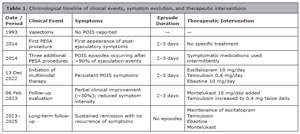
Table 1. Chronological timeline of clinical events, symptom evolution, and therapeutic interventions
DISCUSSION
Post-orgasmic illness syndrome (POIS) is a rare condition first described by Waldinger & Schweitzer (2002). Although formal diagnostic criteria have not yet been established, the medical literature proposes a set of commonly accepted parameters to guide diagnosis (Table 2) (Abdessater et al., 2019; Waldinger et al., 2011). Clinical presentation is heterogeneous; however, patients most frequently report systemic, flu-like manifestations following ejaculation (Figure 1). To date, fewer than 60 cases have been reported worldwide, and the condition remains underrecognized, largely due to limited awareness among physicians (Alanazi et al., 2024; Nguyen et al., 2018).
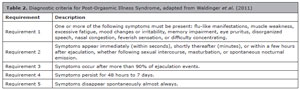
Table 2. Diagnostic criteria for Post-Orgasmic Illness Syndrome, adapted from Waldinger et al. (2011)
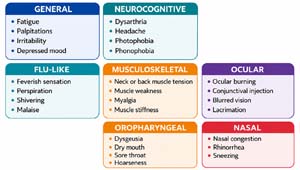
Figure 1. This figure illustrates the main symptom clusters commonly described in POIS, including general complaints (fatigue, palpitations, irritability, depressed mood), flu-like manifestations (feverish sensation, perspiration, shivering, malaise), neurocognitive symptoms (headache, Dysarthria, photophobia, phonophobia), oropharyngeal symptoms (Dysgeusia, Dry mouth, Sore Throat, hoarseness), ocular symptoms (Ocular burning, conjunctival injection, blurred vision, lacrimation), musculoskeletal symptoms (myalgia, neck or back muscle tension, muscle weakness, muscle stiffness), and nasal symptoms (congestion, rhinorrhea, sneezing).
Several pathophysiological mechanisms have been proposed for POIS, although none have been definitively established. Immunological hypersensitivity to seminal components is one of the most frequently discussed hypotheses. Waldinger et al. reported positive skin-prick test reactions to autologous semen in a substantial proportion of patients, suggesting a possible type I or type IV hypersensitivity response (Waldinger et al., 2011). However, semen-specific IgE has not been consistently demonstrated, indicating that the underlying mechanism may be heterogeneous and not exclusively IgE-mediated (Jiang et al., 2015).
Other proposed mechanisms include autonomic dysregulation, cytokine imbalance, and neuroendocrine factors (Abdessater et al., 2019; Nguyen et al., 2018). Sympathetic activation during ejaculation has been hypothesized to contribute to transient inflammatory signaling, but this remains theoretical and has not been directly demonstrated in POIS (Nguyen et al., 2018).
In the present case, the temporal association between repeated epididymal sperm aspiration procedures and subsequent symptom onset raises the possibility of immune sensitization to spermatozoa or epididymal antigens. Nevertheless, a causal relationship cannot be established based on a single case, and this interpretation should be considered speculative.
As no standardized therapy for POIS currently exists, treatment strategies remain empirical. Alpha-adrenergic antagonists, such as tamsulosin, may reduce epididymal and vas deferens contractions, potentially limiting antigen exposure during ejaculation (Tambaro et al., 2005). Ebastine, a selective histamine H1 receptor antagonist, inhibits histamine-mediated responses, whereas montelukast blocks leukotriene-driven inflammatory pathways (Dave et al., 2011; Sastre, 2020). Although the mechanistic relevance of these agents in POIS has not been formally established, their use in this case was associated with clinical improvement.
Regarding treatment, no standardized therapy exists and management remains empirical. Desensitization with diluted autologous semen has been reported as a therapeutic approach associated with symptom improvement in some patients (Waldinger et al., 2011). Intralymphatic immunotherapy has also been associated with sustained remission in isolated case reports (Kim et al., 2018). Given the psychosocial burden of POIS, psychological support and cognitive-behavioral therapy have been suggested as adjunctive interventions (Nguyen et al., 2018).
The potential immunomodulatory effects of SSRIs, including influences on stress-response pathways and immune signaling, have been described in broader immunology literature (Dave et al., 2011); however, their direct role in POIS remains uncertain. Similarly, while antihistamines and leukotriene receptor antagonists may theoretically attenuate inflammatory pathways, their mechanistic relevance in POIS has not been formally established.
The mechanistic interpretation proposed here should be viewed strictly as a hypothetical and illustrative framework. Although some of the observed effects are biologically plausible, this single case does not allow causal inference, confirmation of pathway-level effects, or attribution of symptom improvement to any specific mechanism.
The mechanistic interpretation of the therapeutic response in this case should be considered hypothetical. Although some of the medications used have biologically plausible effects on pathways potentially relevant to POIS, the current evidence remains limited, and no causal inference can be drawn from a single case report. Therefore, any proposed relationship between the treatment regimen and symptom improvement should be viewed as speculative and intended only as a conceptual framework. The clinical course observed here suggests a temporal association between treatment and symptom control, but it does not establish which component of therapy was responsible, whether the effects were synergistic, or which biological pathways may have been involved.
This case illustrates remission following a combined pharmacologic approach, as summarized in Figure 2. The proposed mechanistic links to immune-related pathways, autonomic dysregulation, and psychological factors remain hypothetical and should be interpreted cautiously. Given the single-case design, causal relationships cannot be definitively established; however, the clinical course supports the potential value of a multimodal therapeutic strategy. POIS remains a multifactorial syndrome with a substantial impact on quality of life. Greater awareness among clinicians, the development of patient registries, and multicenter collaborative studies are needed to improve understanding and to support the establishment of evidence-based diagnostic and therapeutic recommendations.
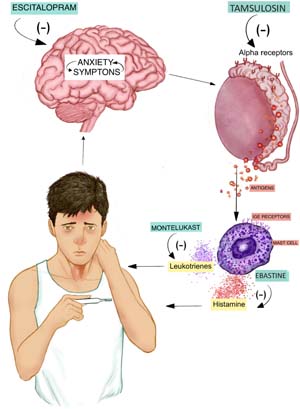
Figure 2. This figure illustrates proposed mechanisms contributing to POIS symptoms and the sites of action of each medication: tamsulosin reducing epididymal contraction, ebastine blocking histamine effects, montelukast inhibiting leukotriene pathways, and escitalopram modulating anxiety-related symptom amplification.
Ethics Statement:
This case report was conducted in accordance with the principles of the Declaration of Helsinki. Written informed consent for publication of clinical information was obtained from the patient. According to institutional policy, ethical committee approval is not required for single-patient case reports that do not involve experimental interventions or identifiable patient data.
Acknowledgments:
The authors received no external funding for the development of this manuscript. We thank the staff of the Department of Urology at Instituto de Medicina Integral Prof. Fernando Figueira (IMIP) for their support during patient evaluation and follow-up. No medical writing assistance was used in the preparation of this article.
REFERENCES
Abdessater M, Elias S, Mikhael E, Alhammadi A, Beley S. Post orgasmic illness syndrome: what do we know till now? Basic Clin Androl. 2019;29:13. PMID: 31508233 DOI: 10.1186/s12610-019-0093-7
Medline
Alanazi FK, Sawma AI, Harisi M, Albabtain M, Almuzaini A. Post-orgasmic illness syndrome: A case report. Cureus. 2024;16:e61494. PMID: 38952608 DOI: 10.7759/cureus.61494
Medline
Dave ND, Xiang L, Rehm KE, Marshall GD Jr. Stress and allergic diseases. Immunol Allergy Clin North Am. 2011;31:55-68. PMID: 21094923 DOI: 10.1016/j. iac.2010.09.009
Medline
Jiang N, Xi G, Li H, Yin J. Postorgasmic illness syndrome (POIS) in a Chinese man: no proof for IgE-mediated allergy to semen. J Sex Med. 2015;12:840-5. PMID: 25630453 DOI: 10.1111/jsm.12813
Medline
Kim TB, Shim YS, Lee SM, Son ES, Shim JW, Lee SP. Intralymphatic immunotherapy with autologous semen in a Korean man with post-orgasmic illness syndrome. Sex Med. 2018;6:174-9. PMID: 29550252 DOI: 10.1016/j. esxm.2017.12.004
Medline
Nguyen HMT, Bala A, Gabrielson AT, Hellstrom WJG. Post-orgasmic illness syndrome: A review. Sex Med Rev. 2018;6:11-5. PMID: 29128269 DOI: 10.1016/j. sxmr.2017.08.006
Medline
Sastre J. Ebastine in the treatment of allergic rhinitis and urticaria: 30 years of clinical studies and real-world experience. J Investig Allergol Clin Immunol. 2020;30:156-68. PMID: 30977465 DOI: 10.18176/jiaci.0401
Medline
Tambaro S, Ruiu S, Dessi C, Mongeau R, Marchese G, Pani L. Evaluation of tamsulosin and alfuzosin activity in the rat vas deferens: relevance to ejaculation delays. J Pharmacol Exp Ther. 2005;312:710-7. PMID: 15470085 DOI: 10.1124/jpet.104.074740
Medline
Waldinger MD, Meinardi MMHM, Zwinderman AH, Schweitzer DH. Postorgasmic illness syndrome (POIS) in 45 Dutch Caucasian males: clinical characteristics and evidence for an immunogenic pathogenesis (Part 1). J Sex Med. 2011;8:1164-70. PMID: 21241453 DOI: 10.1111/j.1743-6109.2010.02166.x
Medline
Waldinger MD, Schweitzer DH. Postorgasmic illness syndrome: two cases. J Sex Marital Ther. 2002;28:251-5. PMID: 11995603 DOI: 10.1080/009262302760328280
Medline