JBRA Assisted Reproduction 2025;29(Suppl.2 SBRA 2025):221
29th Annual Congress of the SBRA. São Paulo/SP - Brazil, 2025
doi: 10.5935/1518-0557.20263861
P-209. Social Fertility Preservation. Ten Years of Elective Oocyte Cryopreservation In a Single Brazilian Reproductive Medicine Center
JBRA Assisted Reproduction 2025;29(Suppl.2 SBRA 2025):221
Poster Presentation
29th Annual Congress of the SBRA. São Paulo/SP - Brazil, 2025
doi: 10.5935/1518-0557.20263861
P-209. Social Fertility Preservation. Ten Years of Elective Oocyte Cryopreservation In a Single Brazilian Reproductive Medicine Center
1 Centro de Reprodução Humana Monteleone - São Paulo – SP -Brasil
2 Centro de Reprodução Humana do Hospital das Clínicas da Faculdade de Medicina da USP - São Paulo – SP -Brasil
3 Escola Paulista de Medicina da Universidade Federal de São Paulo - São Paulo – SP - Brasil
Objective: Since 2013, when oocyte cryopreservation (OC) for social fertility preservation ceased to be considered experimental, the practice has increased steadily. With advancements in laboratory techniques, the procedure has become markedly safer. Nevertheless, there are many questions about its use, benefits and final outcomes. The primary objective of this study is to determine the return rate of women utilizing cryopreserved oocytes for non-medical reasons and to ascertain the live birth rate. Secondary outcomes include oocyte survival following thawing, fertilization rates, blastocyst development and clinical outcomes such as clinical pregnancy and miscarriage rates following embryo transfer.
Methods: We conducted a retrospective cohort study using anonymized data on fertilitypreservation for non-medical reasons collected between 2013 and 2023. The cohort comprised all women without infertility diagnoses who underwent ovarian stimulation for oocyte cryopreservation to delay childbearing by at least one year. After excluding 13 cycles due to missing data, the analysis incorporated 737 cycles from 585 women.
Results: The 737 OC cycles were stratified by women age group:<35 years (n=321), 36–38 years (n=299), and 39–40 years (n=110). As anticipated, both the number of oocytes retrieved and the count of metaphase II (MII) oocytes declined with advancing age, an expected reflection of reduced ovarian reserve. The mean number of vitrified oocytes was 12.4±9.8 for women under 35, 9.2±6.3 for those aged 36–38, and 7.6±5.7 for women aged 39–40. Out of the 585 patients, 24 returned to utilize their cryopreserved oocytes in in vitro fertilization cycles, corresponding to a return rate of 4.1%. Among these, three women underwent two separate thaw cycles, yielding a total of 27 vitrified-warmed oocyte cycles. The mean interval between vitrification and subsequent use was 42.33±17.10 months. Detailed outcomes of the vitrified-warmed cycles are presented in Table 1. Of the 27 warming cycles, four yielded no embryos available for transfer: one cycle exhibited no blastocyst development, one resulted in an aneuploid embryo, and in two cases the patients elected not to proceed with transfer despite blastocyst formation. Among the remaining 23 cycles that underwent transfer, 19 were fresh embryo transfers and 8 involved cryopreservation of all embryos for subsequent hormone-prepared cycles. On average, there were 1.30±0.70 transfers per patient and 1.65±0.78 blastocysts per transfer. Eight women achieved pregnancy culminating in live births, corresponding to a pregnancy rate of 32% per transfer. There were no miscarriages or multiple gestations.
Conclusion: A better understanding of the potential success of OC is essential for effective patient counseling. As this technique becomes an increasingly viable option for women seeking to delay motherhood for various reasons, return-to-use rates continue to vary widely across published studies. In our study, the return rate for oocyte utilization was 4.1%, which is somewhat lower than the 7–38% range reported in the literature. The live birth rate observed in our cohort (32%) closely aligns with findings from other studies, which report rates of up to 39%.
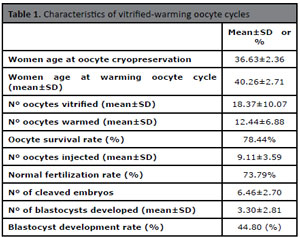
Table 1. Characteristics of vitrified-warming oocyte cycles
SD: standard deviation.