JBRA Assist. Reprod. 2025;29(Suppl 1):2-2
ORAL PRESENTATION
doi: 10.5935/1518-0557.20250060
O-02. The use of dydrogesterone to prevent premature ovulation in shared egg donation cycles is more cost-effective than the use of a flexible GnRH antagonist
1Center for Human Reproduction Prof. Franco Jr, Ribeirao Preto, Brazil
2Paulista Center for Diagnosis- Research and Training, Riberao Preto, Brazil
Objective: Dydrogesterone is a stereoisomer of progesterone and appears to be a highly selective progestin that, owing to its molecular structure, binds almost exclusively to the progesterone receptor. The mechanism of action of progesterone involves a decrease in the LH pulse frequency without affecting the pulse amplitude. Compared with the use of GnRH analogues, progestinprimed ovarian stimulation seems similarly effective and safe in all types of patients undergoing assisted reproductive technology cycles. Specifically, in a shared donation program, the economic factor is preponderant because patients donate half of their eggs in exchange for free IVF but pay for the medications used in the treatment. This study aimed to analyze if a fixed progestogen protocol can be as effective as a flexible GnRH antagonist protocol in shared egg donation cycles?
Methods: This was a prospective study of 44 patients from a shared egg donation program who underwent their first shared egg donation cycle. None of the patients had a history of genetic diseases in their family. Karyotypes were normal, and the antral follicle count was ≥15. For various strategic reasons (distance, ideal scheduling for the transfer of thawed embryos, etc.), both recipient and donor patients cryopreserved all their embryos. The patients were divided into two groups. In Group I (n=22), dydrogesterone was administered at a dosage of 20mg/day starting on the 1st day of the menstrual cycle until the day before egg collection. In Group II (n=22), a GnRH antagonist was administered at a dosage of 0.25mg/day from the time the leading follicle reached 14mm until the day of the ovulatory trigger. Triptorelin acetate (0.2 mg) was administered when the follicles reached ≥17mm in diameter.
Results: The mean age of patients in Group I (31.6±2.4y) was not significantly different from that in Group II (30.7±2.9y). The number of antral follicles (ACs) in Group I (26.6±10.6) did not differ from that in Group II (22.1±7.28). In Group I, the mean dose of urinary FSH (2032±580IU) did not differ significantly from that in Group II (2094±630IU). In Group I, the total number of oocytes collected (15.4±8.2) and the number of oocytes in metaphase II (12.8±7.6) were not significantly different from those obtained in Group II (total number of oocytes collected:14.6±5.8; number of oocytes in metaphase II:10.7±5.4). Table 1 shows the data. In these 44 patients, there was no premature follicular rupture. On the other hand, the mean number of vials of the GnRH antagonist was 5.3±1.2, i.e., a total mean cost of US$400 per cycle. The average number of days using the dydrogesterone blockade was 11.4±1.5, with a box of 28 tablets (10mg) costing US$11. The real savings were approximately US$389 dollars per cycle.
Conclusion: The results using the fixed dydrogesterone protocol were not significantly different from those obtained with the flexible GnRH antagonist protocol, except for being more economical. Since current data suggest that the efficacy of dydrogesterone blockade is not significantly different from that of GnRH antagonists, the low price of the blockade will lead to its increased use in the coming years.
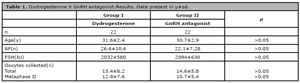
Table 1. Dydrogesterone X GnRH antagonist: Results. Data present in μ±sd.