JBRA Assist. Reprod. 2011;15(3):41-43
ARTIGO ORIGINAL
doi: 10.5935/1518-0557.2011.15.3.11
Choosing to freeze oocytes decrease the chances of pregnancy from fresh oocytes?
Congelando oócitos diminui a chance de engravidar com oócitos à fresco?
1Clinica Fertilitat, Porto Alegre, RS, Brasil
Local do estudo: Fertilitat - Centro de Medicina Reprodutiva, Porto Alegre, RS
RESUMO
Objetivo: A idéia de congelar oócitos e consequentemente evitar problemas éticos, religiosos e administrativos que o congelamento de embriões pode gerar, trás outra preocupação: Poderia congelando oócitos e consequentemente inseminando menos oócitos diminuir a chance de gravidez para os casais usando Técnicas de Reprodução Assistida? Nossa clínica vem congelando oócitos desde 2000; desta forma estes dados foram avaliados para responder esta questão. Este estudo foi observacional retrospectivo, com o objetivo de comparar resultados de pacientes que decidiram congelar oócitos versus aqueles pacientes que decidiram inseminar todos os oócitos nestes últimos 11 anos.
Material e métodos: Nossos dados, de 2000 a 2010, incluem congelamento de oócitos pelo método lento e por vitrificação. Todos os pacientes com mais de 10 oócitos era oferecido à possibilidade de criopreservar os seus oócitos. Um total de 2106 ciclos foi comparado, destes, em 372 ciclos os pacientes decidiram criopreservar oócitos. Quando os pacientes decidiram congelar oócitos, o número de oócitos inseminados (de 5-8) dependendo da idade da mulher, enquanto que os outros oócitos eram congelados. Todos os pacientes seguiram o protocolo de inseminação, cultivo e transferência da clínica. No dia da aspiração folicular, os pacientes iniciavam a utilizar 90mg de progesterona vaginal gel diariamente. Progesterona era administrado até o teste de hCG, e aqueles pacientes que apresentavam resultados acima de 25UI/mL, progesterona era mantida até 12 semanas de gestação. A transferência de embriões foi realizada com cateter, sob controle de ultra-som.
Resultados: Diferença estatística foi observada no número de oócitos inseminados, taxa de fertilização, e média de embriões transferidos (p<0.05), enquanto que taxa de implantação e gestação clinica não houve diferença (p>0.05).
Conclusões: Desta forma estes resultados mostram que inseminando seis oócitos não diminui a chance de gravidez dos casais.
Palavras chave: taxa de gravidez, taxa de fertilização, oócito, criopreservação
ABSTRACT
Objective: The idea of freezing oocytes and consequently avoiding all ethical, religious, and administrative problems that frozen embryos might generate, brings another concern: Could freezing oocytes and consequently inseminating less fresh oocytes decrease the chance of pregnancy to the couples using ART? Our clinic has been freezing oocytes since 2000; therefore these data were evaluated to answer this question. This study was an observational retrospective cohort, with the objective to compare results from patients that decided to freeze oocytes versus those patients that have decided to inseminate all oocytes for the last 11 years.
Material and methods: Our data, from 2000 to 2010, includes frozen oocytes from slow freezing and vitrification techniques. All patients with more than 10 oocytes were offered the possibility to cryopreserve their oocytes. A total of 2106 cycles were compared, from those, in 372 cycles, the patients decided to cryopreserve oocytes. When the patients decided to freeze oocytes, the number of oocytes inseminated (from 5-8) depended on the women’s age, while the extra oocytes were frozen. All patients followed clinical protocol for insemination, culturing and transferring embryos. On the day of follicular aspiration, the patients started using 90mg progesterone vaginal gel daily. Progesterone was maintained until the hCG blood test, and for those patients with results above 25UI/mL, progesterone was kept until 12 weeks of pregnancy. The embryo transfers were performed with a catheter, under ultrasound control.
Results: Statistical difference was observed in the number of oocytes inseminated, rate of fertilization and average of embryo transfer (p<0.05), but not in implantation and clinical pregnancy rates (p>0.05).
Conclusions: Therefore these results have shown that inseminating 6 oocytes did not decrease any chance of pregnancy to the couples.
Key words: pregnancy rate, fertilization rate, oocyte, cryopreservation,
INTRODUCTION
Embryo cryopreservation techniques have improved, allowing storage of viable surplus embryos for an indefinite period of time. However, the disposition of surplus frozen embryos has sparked significant debate regarding the disposition of these embryos when they are no longer required of their parents or the parents die. A possible solution to this problem is to cryopreserve supernumerary oocytes rather than embryos (Azambuja et al., 2011). The first birth of a baby after oocyte cryopreservation occurred in 1986 (Chen, 1986). Since then, improvements in technology have made this a feasible possibility for young women at risk of premature ovarian failure, and for those women who require radiotherapy or chemotherapy for cancer. Among other indications there is the possibility of freezing oocytes in order to avoid all ethical, religious, and administrative problems that frozen embryos might generate. Therefore it means that less oocytes would be inseminated. This may bring another concern: Could frozen oocytes and consequently inseminating less fresh oocytes decrease the chance of pregnancy to the couples using ART? This is a concern that the literature has not tried to address yet. Our clinic has been freezing oocytes since 2000; therefore these data were evaluated to try to answer this question. This study had the objective to compare the fertilization, cleavage, pregnancy, and implantation rate between patients that decided to freeze oocytes versus those patients that have decided to inseminate all oocytes for the last 11 years.
MATERIALS AND METHODS
Study design and patient characteristics
This was an observational retrospective cohort study. The study population consisted of patients who sought medical assistance for treating conjugal infertility. The data were collected from the medical records at the clinic between 2000 and 2010, with administrative authorization. All the patients were informed and gave signed informed consent before the fertilization treatment, granting their data for scientific purposes. The patients that did not wish to freeze supernumerary embryos and had frozen oocytes were included in this data. The oocytes were frozen either by using slow freezing or vitrification techniques. All patients with at least 10 oocytes were offered the possibility to cryopreserve their oocytes, regardless of their age. A total of 2106 cycles were compared, from those, in 372 cycles, the patients decided to cryopreserve oocytes. When the patients decided to freeze oocytes, part of oocytes were inseminated (from 5-8) depending on the women’s age, while the other part of the oocytes were frozen (Group 1). The mean maternal age for this group was 32.7. Group 2 had a mean maternal age of 34.8 years and consisted of patients inseminating a minimum of 08 oocytes. Even inseminating a maximum of 5 eggs (group 1), there were some viable embryos that needed to be frozen after fresh transfer (this possibility was also included in the informed consent).
Freezing oocytes
The cryopreservation protocol consisted of a slow freezing-rapid thawing method, using a choline based medium. After 2-4 h of incubation in HTF® (human tubal fluid, Irvine Scientific, Santa Ana, California, USA) supplemented with 7.5% SSS (Serum Substitute Supplement, Irvine Scientific, Santa Ana, California, USA) the oocytes were transferred to a 4-well dish (Nunclon, Roskilde, Denmark) where removal of the cumulus cells were performed. Aproximatelly 6-7 good quality MII oocytes were fertilized by ICSI (Intracytoplasmic Sperm Injection), and a minimum of 6 oocytes were cryopreserved. The oocytes, to be frozen, were then placed in a Choline based medium with 1.5M PrOH for 15 min, and then held for an additional 15 min in a Choline based medium with 1.5M PrOH plus 0.2M sucrose (Stachecki et al., 1998). The oocytes were loaded in plastic straws (IMV International, Minneapolis,Mn, USA) and transferred into a programmable freezer: Freeze Control (Cryologic CL 8000, Victoria, Australia).The initial chamber temperature was 20°C. The temperature was slowly reduced to -7°C at a rate of -2°C/ min. Ice nucleation was induced manually at -7°C. After holding for 10 min at -7°C, the straws were cooled slowly to -33°C at a rate of 0.3°C/min, rapidly cooled to -120°C and held for approximately 10-15 minutes to allow stabilization of the final temperature, and then transferred into liquid nitrogen tanks for storage until thawing.
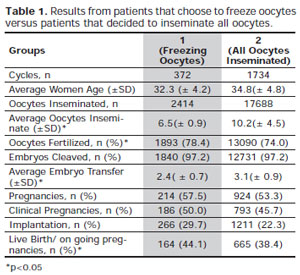
Table 1. Results from patients that choose to freeze oocytes versus patients that decided to inseminate all oocytes.
The cryotop method for oocyte vitrification was used as previously described (Kuwayama et al., 2005). Oocytes were equilibrated in 7.5% (v/v) ethylene glycol (EG) + 7.5% dimethylsulfoxide (DMSO) in TCM 199 medium + 20% synthetic serum substitute (SSS) referred to as equilibium solution-ES at room temperature for 15 minutes. The oocytes were then placed into “ vitrification solution-VS” that was the same as “ES” except that the concentrations were 15% ethylene glycol + 15% DMSO + 0.5M sucrose. After 1 minute in this solution, oocytes were placed on the cryotop strip (Kuwayama et al., 2005) and immediately submerged into new liquid nitrogen.
Stimulation and endometrial preparation
The use of Gonadotropin Releasing Hormone Analogue (a-GnRH) started on the second phase of the menstrual cycle prior to the IVF cycle (down regulation). It is done by sequential administration of the medication until it reaches a complete pituitary blockage, shown by serum levels of estradiol less than 40pg/ml. After that, the gonadotropins are added to stimulate the follicular development. The gonadotrophins were administered until the follicles reach 18-20mm, when the human chorionic gonadotrophin (hCG) is administered. After 33-36 hours the administration of hCG the oocytes were retrieved. On the day of oocyte retrieval the patients started with progesterone gel 8%. The semen preparation and insemination were performed accordingly to laboratory’s procedure. The fertilization was checked 18-20 hours after the insemination. The criteria for normal fertilization were the presence of 2 pronuclei and 2 polar bodies. The embryos were observed daily and on the day of the transfer were selected based on best morphological aspect (Red Latino Americana, 1998). The embryo transfer to the uterus was done on the second or third day after the follicle aspiration, guided by ultrasound. Clinical pregnancy was confirmed with the presence of a gestational sac and fetal heart beat on ultrasound exam. Progesterone supplement were kept until 12 weeks of pregnancy.
Statistical Analysis
The average oocytes inseminated, and average of embryos transferred were compared through Mann-Whitney test (p<0.05), while the fertilization, cleavage, implantation, and pregnancy rates were compared through the chi-square test (p<0.05).
RESULTS/DISCUSSION
As shown in table 1, in 372 cycles the patients decided to freeze part of their oocytes, and in 1734 cycles, the patients decided to inseminate all oocytes. Statistical difference was found in the number of oocytes inseminated, fertilization rate, number of embryos transferred, and the delivery rate between the 2 groups (p<0.05).
The difference in the number of oocytes inseminated (6.5 versus 10.2) in each group was related to the desire of the patients to not freeze supernumerary embryos. All patients were informed that sometimes even inseminating a maximum of 5 oocytes, it decreases but does not eliminate the chance to freeze embryos. The fertilization rates were significantly different between groups (P<0.05), as this value for group 1 was 78.4%, whereas for group 2 was 74%. A possible explanation for this difference, since all oocytes were fresh and all submitted to the same laboratory procedure, might be related to the fact that the oocytes inseminated in group 1, where submitted to a preselection, where the best oocytes with a uniform cytoplasm and no vacuoles where chosen to be inseminated, while in group 2 all Metaphase II oocytes were inseminated. Our overall fertilization rate in the clinic is about 78%, which is similar to obtained in group 1. In both groups the fertilization rate, were higher than the 67% observed when fresh oocytes from donor cycles were used (Nagy et al., 2009), and lower than the 82.2% found in another group (Cobo et al., 2008) also using donor cycles, were the mean age was 26.7 years old. Also, the average embryo transfer was statistically different between the 2 groups (p<0.05): an average of 2.4 embryos transferred for group 1 where part of the oocytes where inseminated versus 3.1 embryos/transfer in group 2 where all oocytes were inseminated. This might be related to the patient’s age, since the mean age was different between both groups, and until recently, patients above 35 years old, had 3 embryos transferred. However, even transferring more embryos in group 2, this did not result in higher clinical pregnancy, or implantation rates (p>0.05) when compared to group 1. The literature reporting double embryo transfers has obtained similar clinical pregnancies rates from 35.8 to 44% (Martikainen et al., 2001; Thurin et al., 2004; Lukassen et al., 2005, Van Moonfort et al., 2006), lower than our 50%, and 45.7 pregnancy rates observed in groups 1 and 2 respectively, although the average of 3 embryo/transfer in group 2. The implantation rate observed in our paper (29.7 and 22.3%) was lower than the 34.3% reported in the double embryo transfer study (Moustafa et al., 2008). However it was higher than the 17.2% implantation rate observed, when a mean of 2.2 embryos per transfer were performed (Aflatoonian et al., 2010). Considering that this paper reports data from the past 10 years, it may explain why the mean of 3 embryos were transferred in group 2. Also the main point of this report was the number of mature oocytes that each patient had available for insemination or freezing regardless their age for each cycle. This factor may reflect the average of embryos transferred in both groups, but specifically in group 2. The 44.1% delivery rate in group 1 was higher than the 38.4% found in group 2. This difference may change since many pregnancies are still ongoing, however these results are similar to the 42% observed in a metaanalysis report where included 8 reports (McLernon et al., 2010).
CONCLUSIONS
These results have shown that inseminating from 5-8 fresh oocytes did not decrease any chance of pregnancy to the couples submitted to an ART. Therefore the possibility to freeze oocytes does not decrease any chance to get the couples pregnant, and should be used worldwide in those cases where the patients do not wish to freeze embryos.
Chen, C., 1986. Pregnancy after human oocyte cryopreservation. Lancet 1, 884-886.