JBRA Assist. Reprod. 2011;15(4):35-37
ARTIGO ORIGINAL
doi: 10.5935/1518-0557.2011.15.4.07
Polymorphism A1298C in 5,10-Methylenetetrahydrofolate Reductase (MTHFR) Gene: A New Marker for Ovarian Reserve?
Polimorfismo A1298C no Gene 5,10-Metilenotetrahidrofolato Redutase (MTHFR): Um Novo Marcador da Reserva Ovariana?
1Cell Therapy Center, Unit of Clinical Research, University Hospital Antonio Pedro, Fluminense Federal University, Niteroi, RJ, Brazil
2RDO -Medical Diagnosis, São Paulo, SP, Brazil
Trabalho apresentado no X Congresso Geral da RED Latinoamericana de Reprodução Assistida - Rio de Janeiro - Maio /2011
ABSTRACT
Purpose: To verify if the A1298C polymorphism in the MTHFR gene is or not associated with a decrease of the ovarian reserve.
Methods: Samples of peripheral blood were obtained from 164 female patients and MTHFR genotypes were compared to the anti-mullerian hormone as well as FSH, LH and inhibin B.
Results: Samples were divided as follows; 84 samples of non-carriers for the A1298C polymorphism in the MTHFR gene, e.g. 1298AA; 62 heterozygous 1298AC for the mutation; and 18 presented variation in homozygous form, e.g. 1298CC. The AMH mean value measured for 1298AA genotype was of 1,14 ng/mL: for the 1298AC genotype was of 0,91 ng/mL; and for the 1298CC genotype was of 1,49 ng/mL. A negative correlation between AMH and FSH, LH and the FSH/LH relationship was observed as expected. Inhibin B, on the other, presented a positive association with AMH, also as expected.
Key words: anti-mullerian hormone, FSH and LH, ovarian reserve, polymorphism MTHFR.
RESUMO
Objetivo: Verificar se o polimorfismo A1298C do gene MTHFR está ou não associado com a diminuição da reserva ovariana.
Métodos: Foram obtidas amostras de sangue periférico de 164 pacientes do sexo feminino e os genótipos do MTHFR foram comparados ao hormônio anti-mulleriano assim como o FSH, LH e inibina B.
Resultados: As amostras foram divididas da seguinte forma: 84 amostras de não-portadores para o polimorfismo A1298C no gene MTHFR, com genótipo 1298AA; 62 heterozigotos 1298AC para a mutação, e 18 apresentaram variação na forma homozigótica, o genótipo 1298CC. O valor médio mensurado para o AMH do genótipo 1298AA foi de 1,14 ng / mL: para o genótipo 1298AC foi de 0,91 ng / mL e para o genótipo 1298CC foi de 1,49 ng / mL. A correlação negativa entre o AMH e o FSH, LH e relaçao FSH/LH foi, como esperado. Inibina B, por outro lado, apresentou uma associação positiva com AMH, também conforme o esperado.
Conclusão: Este estudo mostrou que, por si só o polimorfismo A1298C não parece afetar os níveis de AMH.
Palavras-chave: hormônio anti-mülleriano, FSH e LH, reserva ovariana, polimorfismo, MTHFR.
INTRODUCTION
Ovarian reserve is a term used to describe overall functional potential of the ovaries and reflects directly the quantity and quality of the oocytes contained within; the number of oocytes is known to declines with age, resulting in decreased female reproductive function (Maheshwari et al.,2006).
In subfertile populations, the ease and accuracy of tests for ovarian reserve could therefore provide valuable means to predict pregnancy chances for successful birth rates, either prior or post treatment,. Alternatively, it could ideally be used as a guide in choosing the most suitable gonadotrophins doses for ovarian cycle stimulation individually for each patient, according to her own specific reserve values (Coccia & Rizzello, 2008).
In this scenario, the anti-mullerian hormone (AMH) would be a putative candidate marker to evaluate ovarian reserve, since during menstruation this hormone is preserved from other influences such as the initial follicular development and also because it is not altered or modified by gonadotrophins, thus reflecting only the follicular cohort (Feyereisen et al.,2006).
A small number of genetic factors have been previously associated with response to ovarian stimulation (Perez Mayorga et al., 2000; Simoni et al., 2002). The MTHFR gene (OMIM, 607093) codifies the enzyme 5,10-ethylene tetrahydrofolate reductase, and is located in the short arm of the chromosome 1 (1p36.3). This enzyme catalyses the conversion of 5,10-methylenetetrahydrofolate (5,10-MTHF) to 5 methyltetrahydrofolate (5-MTHF), the most important form of circulant folate. Folate itself is implicated in many biochemical pathways, including the remethylation of homocysteine to methionine, an important step in metabolic pathways that regulates nucleoside biosynthesis. Also present in the methylation of proteins, lipids and DNA (Hecht et al., 2009; Altmäe et al., 2010). Folate is one of the B complex vitamins believed to be essential in reproduction not surprisingly due to folate metabolism involvement in several physiological and pathophysiological processes (Altmäe et al., 2010).
Altmäe et al. (2010) reported that variations in the MTHFR gene may be somewhat related to female infertility. They have assumed that polymorphisms in this gene affects embryonic implantation due to alterations in homeostasis balance between hemorrhage and thrombosis. Women with 1298CC genotype variant attain spontaneous pregnancy less frequently and, when submitted to assisted reproduction techniques also present less chances of carrying a pregnancy to completion after treatment (Rosen et al., 2007). Comcomitantly, women with higher chances of getting pregnant by FIV have elevated folate status (Haggarty et al., 2006).
The literature highlights that the MTHFR A1298C polymorphism, when connected to expression in cumulus cells, may also directly affect the production of the anti-mullerian hormone (Rosen et al., 2007; Altmäe et al., 2010), but there has been no consistent association or a structured study design for MTHFR indirect influence on ovarian function through AMH. In addition to the general lack of consensus for the election of any highly reliable markers in diagnosis, it becomes fundamental and simultaneously difficult to pinpoint confidently such markers for clinical practice. Hence, a putative genetic marker like the A1298C polymorphism in the MTHFR gene would be desirable. Should there be an association between AMH levels and MTHFR genotypes It could in theory be used to predict ovarian reserve status with greater accuracy once it is not known to be influenced by inter and intracycles variabilities.
This study intends to verify the hypothesis that the A1298C polymorphism in the MTHFR gene may be associated to alterations in AMH´s levels and also if this should be true, if it may or may not be associated to a decrease on ovarian reserve as well.
MATERIALS AND METHODS
164 Samples of peripheral blood from woman, taken from patients aged between 22 to 51 who have been actively pursuing IFV or other treatments for fertility, have been analyzed in the third day of the cycle. All these female subjects, even those aged between 45 to 51 years-of-age, were assumed as non-menopausal in relation to their FSH and AMH levels. Subsequently, DNA was extracted with the use of a commercial kit, following manufacturer’s instructions . The DNA of these patients was amplified by the PCR technique in real time using primers and probes for the AA, AC or CC 1298 genotypes. The hormonal dosage of AMH and inhibin B was performed by ELISA, while
The hormonal levels between the study group (carrier of mutations in both heterozygous and homozygous form) and controls (non-carriers of mutations in the gene) was compared by Kolmogorov-Smirnov analysis.
The statistical significance between AMH levels and MTHFR A1298C polymorphism was evaluated by Kruskal-Wallis test to assess the ovarian reserve (Excel, 2003; SPSS 15.0).
The hypothesis of normal distribution of the variables was accepted. Age comparison between genotypes was done using ANOVA parameters.
In order to verify or discard a relationship between AMH levels and other variables we performed: a Spearman test to calculated correlations (see results): a dispersion section to calculate AMH variability in relation to other variables by dispersion diagrams. All the statistical tests were performed within the 95% confidence level.
RESULTS
Of 164 total samples obtained, 84 carried no mutation and had the 1298AA genotype; 62 were heterozygous to the mutation with a 1298AC genotype; and 18 presented the variation in the homozygous form with a 1298CC genotype. There was no observed statistical age difference among the different genotypes, so it was not necessary to divide them according to age.
The genotypes from MTHFR gene were then compared with anti-mullerian hormone as well as FSH, LH and inhibin B. The variables analyzed in this study are described in Table 1 according to their MTHFR genotype and in comparison between the three possible genotypes. We found was no significant difference within variables among women according to their MTHFR genotype (p > 0,05).
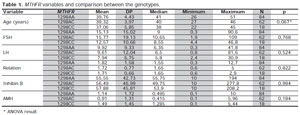
Table 1. MTHFR variables and comparison between the genotypes.
Table 2 shows that AMH levels are inversely correlated with age (r = -0,218 e p = 0,005), for FSH (r = -0,510 e p < 0,001), LH (r = -0,371 e p < 0,001) and the FSH/LH relation (r = -0,300 e p < 0,001). However, both inhibin B and AMH appear to be directly correlated (r = 0,512 e p < 0,001).
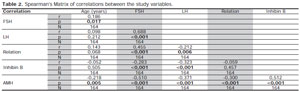
Table 2. Spearman’s Matrix of correlations between the study variables.
DISCUSSION
It was observed in this study that there seems to be no statistical significance between the MTHFR genotypes and anti-mullerian hormone levels alone, However, the relationship between MTHFR genotype and AMH showed to be the closest related among all the analyzed variables (p=0,184), which could be an indication of other parameters involved or even a multifactorial scenario.
Unlike what was observed in our data, a study conducted by Rosen et al. (2007) has demonstrated the association between the 1298AC variant of MTHFR with the FSH value in day 3 of the menstrual cycle. Using linear regression, the above named study noticed that women with the heterozygous genotype of the polymorphism had FSH levels three times higher than those who presented the wild type form. However and perhaps most interestingly, no relation was found with carriers of the homozygous genotype.
We have nonetheless successfully corroborated other results from other groups. The negative correlation between AMH and both FSH and LH levels has been confirmed in this study, thus corroborating Fanchin et al. (2003, 2005) and Eldar-Geva et al. (2005). The inverse relation between FSH and AMH could be caused by the direct effect of FSH in hormone secretion in cumulus cells (La Marca et al., 2006).
We have also noticed that the higher the values of the inhibin B the higher the AMH levels. This data also corroborates previous studies that observed a positive relation between AMH and inhibin B levels. However, the observed correlation may not correspond to a direct relationship between these two hormones (Fanchin et al. 2003;2005), probably because inhibin B is dependent on gonadotrophins status, while AMH is not directly influenced. Wunder et al.(2008) and Muttukrishna et al. (2005) demonstrated independently a positive relationship between measured AMH and inhibin B levels, and the number of fertilized oocytes and successful pregnancy results.
Another study conducted by Andersen et al. (2008) with 43 patients has verified nonetheless, a negative correlation with AMH levels by measuring follicular fluid and inhibin B, whereas La Marca et al. (2006) didn’t find the relation between the two hormones to be of statistical significance. This rather intriguing and somewhat contradictory literature track may also be an indication of other, underappreciated factor influencing AMH levels.
Through our study we have demonstrated that AMH levels decrease with age. This result corroborates previous investigations that associate age increase with reduction of AMH levels (De Vet et al., 2002; Fanchin et al., 2003; Eldar-Geva et al.,2005), potentially due to a decline in ovarian function as a result from a reduction in the small antral follicles pool (Ruess et al., 1996).
CONCLUSION
The present work had the objective of evaluating the relationship between anti-mullerian hormone and A1298C polymorphism in the MTHFR gene. For all effects we have not found statistical significance in the correlation between AMH and MTHFR 1298 polymorphism. However, we would like to highlight that such a possibility should not be completely discarded yet because further experiments comparing both 677 and 1298 polymorphism to AMH levels might be more indicative of association or no association as the combination of these two MTHFR polymorphisms seems to be more directly linked to infertility than each one alone.
The search for genetic markers to evaluate the women’s reproductive potential is of great interest in reproductive medicine field, such markers appear to be very promising in predicting ovarian reserve with more accuracy. For all this reason, further studies continue to be necessary to better evaluate that relation.
Coccia ME, Rizzello F. Ovarian reserve. Annals of the New York Academy of Sciences 2008; 1127:27-30.