JBRA Assist. Reprod. 2011;15(6):15-16
ARTIGO ORIGINAL
doi: 10.5935/1518-0557.2011.15.6.02
Addition of ascorbic acid to cryopreservation medium reduces oxidative damages in semen of infertile men
1Instituto de Biotecnologia, Universidade de Caxias do Sul, Caxias do Sul, RS, Brazil
2Faculdade da Serra Gaúcha, Caxias do Sul, RS, Brazil
ABSTRACT
The aim of this study was to analyze potential beneficial effects of adding ascorbic acid to cryopreservation media of semen of infertile men. Semen from 20 infertile and 10 fertile (control group) men was cryopreserved with and without 10 mM ascorbic acid. Addition of ascorbic acid to the cryopreservation media was able to reduce the lipid oxidative damage induced by the cryopreservation process and increase the antioxidant enzyme superoxide dismutase activity in infertile men. However, this antioxidant was not able to avoid the loss of motility observed in post-thaw spermatozoa of both infertile and fertile men.
Palavras-Chave: ácido ascórbico, criopreservação, sêmen, danos oxidativos.
RESUMO
O objetivo do presente estudo foi analisar os potenciais efeitos benéficos da adição do ácido ascórbico ao meio de criopreservação de sêmen de homens férteis e inférteis. O sêmen de 20 pacientes inférteis e 10 indivíduos férteis (grupo controle) foi criopreservado com e sem ácido ascórbico 10 mM. A adição de ácido ascórbico ao meio de criopreservação foi capaz de reduzir os danos oxidativos a lipídios, induzidos pelo processo de congelamento, além de aumentar a atividade da enzima antioxidante superóxido dismutase em homens inférteis. Por outro lado, este antioxidante não foi capaz de evitar a perda de motilidade observada nos espermatozóides pós-descongelamento de homens inférteis e férteis.
Keywords: ascorbic acid, cryopreservation, semen, oxidative damages.
INTRODUCTION
Although the cryopreservation of human semen is an important technique routinely employed in the clinical management of male infertility (Medeiros et al., 2002), an excessive generation of reactive oxygen species (ROS) has been reported in cryopreservation procedures, which causes a dramatic reduction in sperm quality (Aitken & Baker, 2006).
Ascorbic acid (AA) is the main antioxidant in seminal plasma of fertile men, contributing up to 65% of its total chain-breaking antioxidant capacity (Agarwal, 2004). It has already been shown that, in fertile men, AA can significantly reduce ROS levels (Li et al., 2010) and DNA damages in post-thaw human spermatozoa (Li et al., 2007; Branco et al., 2010). However, infertile men presents a significant decrease in AA levels in seminal plasma (Patel et al., 2009), which could be a risk factor for idiopathic male infertility (Colagar & Marzony, 2009).
Besides, human spermatozoa are rich in polyunsaturated fatty acids, which are very susceptible to ROS attack (Murawski et al., 2007). Therefore, the aim of the present study was to evaluate lipid oxidative levels and the main antioxidant enzymes (superoxide dismutase and catalase) activities, as well as the seminal standard markers in infertile men after the cryopreservation process using ascorbic acid as antioxidant.
The study was conducted with 20 infertile men (30.25 ± 0.37 years), who were diagnosed with infertility after at least two successive semen analyses fulfilled according to the World Health Organization’s infertility criteria (WHO, 1999). The control group consisted of 10 healthy sperm donors (35.00 ± 0.70 years) with proven fertility (initiated a successful pregnancy). The women of both groups were required to be between the ages of 20 and 40 years. Individuals with azoospermia, leukocytospermia or under antioxidant supplementation were excluded. The protocol study was approved by the Ethics Committee of the University of Caxias do Sul, and all subjects provided their informed consent to participate in the study. Semen samples were collected as defined by WHO standards (1999). The samples were placed in CO2 incubation at 37°C for 30 min, so that seminal liquefaction could be performed. Semen parameters (concentration, motility and morphology) were evaluated according to World Health Organization standards (WHO, 1999). Lipid damages in sperm were assessed by thiobarbituric acid reactive species (TBARS), according to Wang et al. (1997). Results were expressed as nM malondialdehyde/108 sperm/hour. Activity of the antioxidant enzymes superoxide dismutase (SOD) and catalase (CAT) was determined in seminal plasma. SOD was done according to Bannister & Calabrese (1987). The result was expressed as USOD/g of protein. One SOD unit was defined as the amount of enzyme that inhibited the rate of adrenochrome formation by 50% per gram of protein. Catalase assay was carried out according to Aebi (1984). The result was expressed as UCAT/mg of protein. One unit of CAT decomposed one µmol of hydrogen peroxide/mg of protein/minute at pH 7.4. Total protein levels were evaluated using the Total Proteins kit from Labtest® (Protein Kit, Labtest Diagnostica S.A., Brazil).
After evaluating the seminal and oxidative stress parameters in fresh semen, the remaining volume of each sample was separated into two aliquots: without ascorbic acid and with 10.0 mM of ascorbic acid (Sigma-Aldrich Corp., St Louis, MO, USA) and incubated for one hour at 37ºC. The semen was then diluted with a cryoprotective agent (Test-Yolk buffer, Irvine Scientific, Santa Ana, CA, USA) in a proportion of 1:1. The cooling rate process was done as described by Garcez et al. (2010). The post-thaw analysis was conducted after 72 hours. Statistical analysis was performed using the Statistical Package for the Social Sciences (SPSS) version 14.0 for Windows© software.
The cryopreservation process did not induce any change in post-thaw sperm concentration or morphology, but a significant decrease in sperm motility was observed, both in infertile (44%) and fertile men (45%), as already reported (Branco et al., 2010; Garcez et al., 2010; Li et al., 2010). Increased TBARS levels were observed in the post-thaw semen in both infertile and fertile men. Superoxide dismutase activity significantly decreased with the cryopreservation process, however only in infertile men. Catalase activity was increased in both infertile (around 2.3 times) and fertile (around 10 times) men (Table 1).
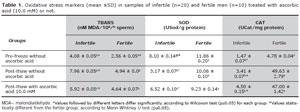
Table 1. Oxidative stress markers (mean ±SD) in samples of infertile (n=20) and fertile men (n=10) treated with ascorbic acid (10.0 mM) or not.
This work shows, for the first time, that the addition of AA to the cryopreservation media was able to reduce lipid oxidative damages and increase SOD activity in infertile men (Table 1). Fluidity and integrity of the spermatozoa membranes is necessary to the fusion events associated with fertilization (Jones et al., 1979). On the other hand, AA was not able to avoid the loss of motility induced by cryopreservation process, both in infertile and fertile men. Similar results were already reported, but just for fertile men (Askari et al., 1994; Li et al., 2010). Although a study with a larger number of samples is needed, the present work showed that ascorbic acid might be used to minimize lipid oxidative damages induced by the cryopreservation procedure in infertile men and could help to design effective cryopreservation strategies in male infertility. It is important to mention that AA is not useful in the preparation of sperm samples where motility is essential. However, this antioxidant can be considered in human cryopreservation procedures such as intracytoplasmic sperm injection, as it does not need motile sperm for achieving a pregnancy.
ACKNOWLEDGMENTS
Central Outpatient Clinic at University of Caxias do Sul, CNPq, CAPES and FAPERGS.
REFERENCES
Aebi H. Catalase in vitro. Meth Enzymol. 1984; 105: 121-6.
Bannister JV, Calabrese L. Assays for sod. Meth Bichem Anal. 1987; 32: 279-312.