JBRA Assist. Reprod. 1999;03(02):11-13
ARTIGO ORIGINAL
doi: 10.5935/1518-0557.1999.3.2.03
Um estudo comparativo para determinar se a inseminação intra-uterina combinada com a hiperestimulação ovariana controlada poderia ser melhor que apenas a hiperestimulação ovariana controlada
A comparative study to determine whether intrauterine insemination combined with controlled ovarian hyperstimulation would be significantly better therapy than controlled ovarian hyperstimulation alone
Abstract
Introduction: A study was done comparing controlled ovarian hyperstimulation only with controlled ovarian hyperstimulation with intrauterine insemination.
Materials and Methods: Patients were recruited to the study after completing their basic investigations. They were assigned to Group A (COH only) or Group B (COH with IUI). The treatment groups consisted of unexplained infertility and male factor. Couples were given 3 cycles of treatment, each one being interspersed alternately with a scanned rest cycle. In Group A couples were instructed to have intercourse for two consecutive days, beginning 24 hours after the hCG injection (treatment). In Group B, 36 hours after hCG, the male partner produced a sample which was subjected to a routine swim-up preparation which was then used for insemination.
Results: The results of the study showed no difference between the two treatment groups.
Conclusion: The additional resources needed to carry out intrauterine insemination may not be worthwhile unless patients are carefully selected, in a setting seeking to offer active management for couples on IVF waiting lists.
Keywords: intrauterine, insemination, ovarian, hyperstimulation
Introduction
In a previous study (Mascarenhas et al., 1994) we showed empirical controlled ovarian hyperstimulation (COH) prior to IVF was a worthwhile alterative to expectant management. We wondered whether COH combined with intrauterine insemination (IUI) might be superior therapy for those awaiting IVF treatment, since it is thought that semen preparation right help particularly when the cause of infertility has been diagnosed as male factor. Previous studies have also suggested IUI as being valuable in cases of unexplained infertility (Zeyneloglu et al., 1998). Accordingly, the objective of this prospective randomized controlled study was to determine whether the addition of IUI to COH therapy confered further advantage in the treatment of male or unexplained infertility, as compared with COH alone.
Materials And Methods
We offered COH and COH with IUI prospectively to 64 consecutive couples (achieving the matching criteria, see below) over a one year period. All couples were diagnosed and subjected to routine investigations as per the Royal College of Obstetricians and Gynaecologists guidelines (1993). Patients with blocked tubes, severe pelvic inflammatory disease, abnormal blood test results, poor cervical mucus (as determined by md cyc1e post coital test) or with more than one obvious cause were excluded from the study. Patients were recruited to the study after completing a standard course of three cycles of COH only (see Mascarenhas et al. 1994). They were assigned on an altemate basis to Group A (COH only) or Group B (COH with IUI). Once a couple had been assigned to Group A, the next couple were assigned to Group B, so long as they matched the first couple with respect to age, duration and category of infertility (for age and duration an allowance of +/- 1 year was made). Couples failing to match were discarded from the study. Patients parameters for the two groups was as follows: Group A: ages ranged from 23 to 39 years (median 31) and the duration of infertility ranged from 3 to 8 years (median 4.5). Group B: ages ranged from 23 to 37 years (median 31) and the duration of infertility ranged from 3 to 9 years (median 4). Group A did not differ significantly from Group B. The main treatment groups consisted of unexplained infertility (n=34; a mid luteal progesterone >30 nmol/l confirmed ovulatory status) and male factor (n=30, < 20 million per ml, oligozoospermia only). About 78% of all cases involved primary infertility. Couples were given 3 cycles of treatment, each one being interspersed altemately with a scanned rest cycle. Monitoring of all cycles was performed by transvaginal ultrasonography (Diasonics DRF 200/7.5 MHz probe, Bedford, UK). Metrodin (FSH 75 IU, Serono Labs, Welwyn Garden City, United Kingdom) at a dose of 3 ampoules daily from day 3 of the cycle, was used for COH (Mascarenhas et al., 1994). Ovulation was induced by injection of 10 000 IU of hCG, when up to 4 follicles had an average diameter of 18 to 25 mm, in conjunction with an average endometrial thickness of 10 mm with an hyperechoic appearance (Mascarenhas et al., 1994).
In Group A couples were instructed to have intercourse for two consecutive days, beginning 24 hours after the hCG injection (treatment). In Group B, 36 hours after hCG, the male partner produced a sample which was subjected to a routine swim up preparation procedure (Davies et al., 1988) using GPM medium (Serono, Welwyn Garden City, UK). After 30 minutes at 37 °C, the medium layer was taken and used for insemination (using a Rocket IUI catheter-Northampton type; Watford, UK). Statistical analysis was performed using computer software (InStat, GraphPad, California, USA) using a 2x2 contingy table and a Fisher's exact test.
Results
Results are detailed in Table 1. When analyzing the data we can see that there was no difference between Group A and Group B. When broken down into male factor and unexplained infertility categories, there was still no clearly defined differences between either groups.
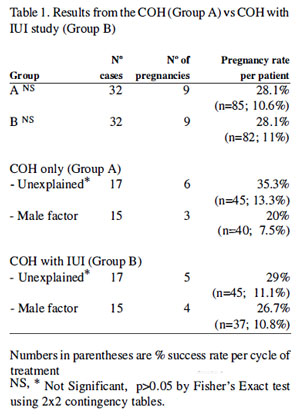
Table 1. Results from the COH (Group A) vs COH with IUI study (Group B)
Discussion
Our aim was to determine whether IUI combined with COH might be superior to COH alone, since in our previous study, we were heartened to find that COH was a useful therapy for patients awaiting IVF (Mascarenhas et al., 1994). Bearing in mind the limited power of this study and the small numbers involved, it is regrettable that in contradiction to Zeyneloglu et al., (1998) or Ford et al., (1997), we find little proof for the idea that the additional use of IUI in conjunction with COH offers advantage. We are rather at a loss when trying to understand why our data seems to be at odds with others (even compared with other studies based on small numbers). Perhaps part of the key lies in the nature of our selection of patients. Very tight criteria were used, resulting in two highly selected groups, which it might be argued were unlikely to benefit much from IUI since, none of the patients in our study had a cervical mucus disorder (CMD; see Materials and Methods) and they were longstanding infertility patients who had already previously bee r treated with three cycles of COH only without success. Nevertheless, one interpretation of the data from this study, is that COH alone is of significant value for patients with unexplained and/or male factor infertility. These results do not exclude the likelihood that COH with IUI offers an advantage over COH alone in cases involving CMD, poor sperm survival in the female reproductive tract and with respect to patient compliance when they have been instructed to have sexo With the IUI we are certain that the costly use of gonadotrophins and ovarian scanning have not been wasted!