JBRA Assist. Reprod. 2003; 07(1):23-25
ARTIGO ORIGINAL
doi: 10.5935/1518-0557.2003.7.1.06
Blastocyst Stage Transfer May Be Beneficial In Patients With Previus Unsuccessful Art Cycle
Transferência em Estado de Blastocisto Pode Ser de Beneficio para os Pacientes com Fracasso Prévio da Fertilização Assistida
Abstract
Embryo transfer in the blastocyst stage has been proposed as an alternative to increase the efficiency of AR T The aim of this study is to compare the results of day 3 embryo vs blastocyst stage transfer in patients with one or more previous unsuccessful attempts. Fifty-one blastocysts stage transfer cycles were prospectively tabulated and 89 day 3 transfer cycles were used as a concurrent and historical control group. Patients with no previus IVF or ICSI attempt, and over 39 years old or with less than 5 mature oocytes were excluded. Patients were stimulated under ovarian suppression with Gn-RH agonists, with recombinant FSH.Ovulation was induced by a single dose of 10.000 IU of HCG 34-36h before oocyte retrieval. Five to eigth mature oocytes were inseminated. Zygotes were cultured in human tubal fluid medium. Blastocyst stage was achieved using co-culture with Vero cells. Statistically significant differences were found when comparing implantation rate (12.9% vs. 27.9%)anddeiiveryraie (21.3% vs. 43.1%) between Day 3 and Blastocyst groups. Our results suggest that transfer of blastocyst stage embryos in patients with at least one previous unsuccessful attempt of IVF or ICSI may be beneficial.
Keywords:Pregnacy, implantation, multiple pregnancy, delivery.
Resumo
A transferência de embriões em estágio de blastocisto tem sido proposta como alternativa para incrementar a eficiência da fertilização assistida. O propósito deste estudo é a comparação dos resultados da transferência no dia 3 versus aquela em estágio de blastocisto para as pacientes com uma ou mais falhas prévias. Cinqüenta e um ciclos de transferência em estágio de blastocisto foram classificados prospectivamente e oitenta e nove ciclos de transferência no dia 3 foram utilizados como grupo controle, contemporâneos e históricos. Idade superior a 39 anos, menos que 5 oócitos maduros e primeiro ciclo de FIV/ICSI foram critérios de exclusão. A supressão ovariana foi feita com agonista do GnRH e a estimulação com FSH recombinante, ou em combinação com o hMG. A ovulação foi induzida com uma única dose de 10.000 UI de hCG, 3436 horas antes da captação dos oócitos. Cinco a oito oócitos maduros foram inseminados.Os zigotos foram cultivados em meio de fluído tubário humano. O estágio de blastocisto foi obtido utilizando co-cultivo com células Vero. Encontraram-se diferenças significativas ao comparar as taxas de implantação (12,9% vs. 27,9%) e nascimentos (21,3% vs. 43,1%) nos grupos dia 3 e blastocistos. Nossos resultados sugerem que a transferência em estágio de blastocisto, em caso de pacientes com um ou mais ciclos de FIV ou ICSI sem gestação, pode ser um benefício.
Unitermos:Gravidez, implantação, gestação múltipla, nascimento.
Introduction
Embryo transfer at blastocyst stage has been proposed as an alternative to increase the efficiency of the ART procedures (Edwards & Holland, 1998). The rationale is that embryos that reach blastocysts stage in vitro would be the healthier ones and have a better implantation potential.
Advantages of blastocyst transfer would be: A better synchronicity between embryo development and the endometrial implantation window, diminished uterine contractility compared with day 3 transfer, natural selection of the embryos with better implantation potential, less spare embryos and less surplus embryos for cryopreservation. It also allows for a better control of multiple pregnancy, because of similar or better implantation rates transferring a smaller number of embryos (Edwards & Holland, 1998; Gardner ei al., 1998; Harper, 1992; Meldrum, 1999; Olivennes eial., 1994; Schoolcraft eial., 1999).
These advantages should be counterbalanced with the risck of no transfer when no embryos reach blastocyst stage and considerable increase in laboratory work. It also requires additional education and counseling both for patients and personnel, as well as need for more space in the incubators. The aim of this study to assess the results of day 3 vs. blastocyst stage transfer in patients with previous unsuccessful attempts.
Materials and Methods
Experimental design: Fifty-one blastocyst stgae transfers from 51 patients with previous unsuccessful day 3 transfer cycles were prospectively tabulated. Eigth-nine day 3 transfers from patients with previous unsuccessful day 3 attempts were used as a concurrent and historical control group. Both groups were comparable regarding age, number of previous attempts and number of oocytes collected. Patients over 39 years old or with less than 5 mature oocytes were excluded.
All patients were stimulated under ovarian suppression with Gn-BH agonists (Lupron, Abbot Laboratories, Chicago, IL, USA; or Reliser, Ares-Serono Laboratories, Geneve, Switzerland), with rFSH alone (Gonal-F Ares-Serono Laboratories, Switzerland; or Peregon, Organon NV, Oss, The Netherlands) or combined with HMG ( Pergonal, Ares-Serono Laboratories, Switzerland; or Humegon, Organon NV, The Netherlands). Na initial gonadotropin dose of 300 IU was maintained for 5 days and adjusted according to ovarian response. A single HCG dose of 10.000 IU (Profasi, Ares-Serono Laboratories, Switzerland; or Pregnyl, Organon NV, The Netherlands) was administered 34-36 h before oocyte retrieval. Intravaginal micronized progesterone suppositories, 800 mg daily was given for luteal phase support.
Five to eigth mature oocytes were inseminated (FIV, n = 66; or ICSI, n = 74). Fertilization was observed 16-18 h after insemination. Zygotes were cultured in human tubal fluid (HTF) medium (Irvine Scientific, Santa Ana, CA, USA) suplemented with 5% human seric albumin (HSA) (Irvine Scientific, USA). Embryos were transferred on day 3 or 5-6. Blastpcyst stage was achieved transferring the embryos to freshly HTF plu 5 % HSA medium in co-culture with Yero cells.
In all cases embryo transfer was done with Frydman catheter (CCD Laboratories, Paris, France). Clinical pregnancy was confirmed at 28-30 days after transfer by transvaginal ultrasound. Statistical comparations were done using Unpaired t test and Fisher’s Exact test as appropriated, both from Instat (GraphPad Software, san Diego, CA, USA). P<0.05 was considered significant.
Results
Statistical differences were found implantation and delivery rates betwen Day 3 and Blastocyst groups (Table I).
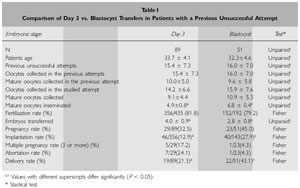
Table I. Comparison of Day 3 vs. Blastocyst Transfers in Patients with a Previous Unsuccessful Attempt
Discussion
Contradictory results have been published when comparing day 3 vs. blastocyst transfer ( Edwards & Berad, 1999; Gardner et al., 1998; Letterie, 2000; Milki et al., 2000; Racowsky et al., 1999). Our results suggest that transfer of blastocyst stage embryos in patients with at least one previous unsuccessful attempt of IVF or ICSI may be beneficial. This agrees with a previous report comparing blastocyst with early embryo transfer in patients with at least two failed IVF cycles (Van der Auwera eta. 1999).
The best sucess markers when analyzing ABT results are implantation and delivery rates. In the present study both were significantly higher in the blastocyst group. Milki et al. (2000) described similar results (high implantation and delivery rates in blastocyst group) possibly due to a better embryo selection, improved embryo - uterine synchronicity and diminished cervical mucus.
Biochemical or cytogenetic events may induce early embryonic arrest (Vlad y col. 1996), both in vivo and in vitro (Benkhalifa y col. 1996). This developmental blockade usually occur around day 3 in coincidence with the initial expression of the newly formed embryonic genome, at the 8-16 cells stage (Braude 1988).
Our results concerning multiple pregnancy were consistent with those from others studies ( Frattarelli et al., 2000; Freeman et al., 2000; Gardner et al., 1998; McCaffreyy et al., 2000; Olivenes y col., 1994). A decrease of the number of multiple pregnancy was observed , although it lacks statistical significance, probably due to the small size of the studied population.
In spite of all the advantages mentioned above, care should be taken before introducing blastocyst tranfer as a routine procedure within an assisted reproduction program that has been sucessful with day 3 embryo transfer.
A prospective multicenter randomized study addressing the present issue should be performed to confirm our results.
8. Harper MJ. The implantation window. Baillieres Clin. Obstet. Gynaecol., 6: 351-371 , 1992.
9. Letterie GS. Clinical studies without patients. Fertil. Steril., 74: 186-187, 2000.
11. Meldrum DR. Blastocyst transfer - A natural evolution. Fertil. Steril., 72: 216-217, 1999.