JBRA Assist. Reprod. 2026;30(2):382-395
REVIEW
doi: 10.5935/1518-0557.20260012
Hyaluronic Acid Enriched Medium for Embryo Transfer: A Systematic Review and Meta-analysis
1SEMEAR Fertilidade - Human Assisted Reproduction. Ribeirão Preto, São Paulo, Brazil
2Uberlandia Medical Center - Endometriosis, Advanced Gynecological Ultrasound and Minimally Invasive Surgery Division, Uberlândia, Minas Gerais, Brazil
3Uberlandia Medical Center - Human Assisted Reproduction Division, Uberlândia, Minas Gerais, Brazil
4Federal University of Uberlândia, Uberlândia, Minas Gerais, Brazil
COMPETING INTERESTS
ABSTRACT
This systematic review and meta-analysis of randomized controlled trials (RCTs) evaluated whether the use of hyaluronic acid (HA)-enriched medium for embryo transfer (ET) improves live birth rates in in-vitro fertilization (IVF) cycles. A comprehensive search of PubMed, Scopus, Web of Science, and ClinicalTrials.gov was conducted up to December 2024, without language restrictions, and only RCTs comparing HA-enriched to standard ET media were included. Risk of bias was assessed using the Cochrane tool, meta-analyses were performed using a random-effects model with the Mantel-Haenszel method, sensitivity analyses excluded studies at high risk of bias, and evidence quality was evaluated with GRADE. Of 450 records identified, 24 studies were eligible, of which 20 were included in the meta-analysis, and most studies had a high risk of bias. Eleven studies reported live birth outcomes, with 2,026 versus 2,037 participants and 803 versus 697 live births in the HA-enriched and standard medium groups, respectively. The relative risk (RR) for live birth was 1.14 (95% CI: 0.99-1.31; p=0.07), with moderate heterogeneity (I2=54%), and sensitivity analysis showed an RR of 1.06 (95% CI: 0.85-1.31; p=0.62). Clinical pregnancy rates were initially higher with HA-enriched medium (RR=1.17; 95% CI: 1.05-1.29; p=0.004), but this effect disappeared in sensitivity analysis (RR=1.05; p=0.53), and pregnancy loss showed no significant difference between groups. Previous studies had suggested a potential benefit of HA-enriched ET medium on live birth outcomes; however, in the present analysis no significant difference in live birth rates was observed between HA-enriched and standard ET media. Overall evidence quality was rated as very low due to high risk of bias, inconsistency, and imprecision, and current evidence does not support a clear benefit of HA-enriched ET medium, although ongoing trials may further clarify its role.
Keywords:hyaluronic acid, hyaluronan, embryoglue, embryo transfer, assisted reproduction
INTRODUCTION
Uterine embryo implantation after transfer is a key step in assisted reproduction treatments. For instance, in Europe in 2019, the mean pregnancy rate per embryo transfer was 34.6% after IVF, 32.1% after ICSI, 35.9% after frozen embryo transfer and 50.5% after egg donation (European IVF Monitoring Consortium (EIM) for the European Society of Human Reproduction and Embryology (ESHRE) et al., 2023). The mechanisms that explain successes and failures are still poorly understood. However, many alternatives were proposed to potentially increase the number of successful implantations, and Hyaluronic acid (HA) is frequently used to possibly improve the reproductive results (Holt-Kentwell et al., 2022). HA is a high molecular weight glycosaminoglycan of the extracellular matrix without antigenic properties, and it is essential for creating and filling extracellular spaces, being naturally present in almost all body tissues, including the genital tract (Rodriguez-Martinez et al., 2016). The early in vitro studies using a mouse model proposed that HA promotes cell to cell and cell to matrix adhesions via its receptor CD44, which is expressed on the preimplantation embryo and also on the endometrial stroma in mammals (Cowman et al., 2015; Adeniyi et al., 2021). HA is used in embryo transfer medium because it increases its viscosity without imposing any harm to the embryo (Cowman et al., 2015). Additionally, it is thought that HA can facilitate implantation by promoting cellular interactions (Adeniyi et al., 2021), and the HA-enriched medium for embryo transfer is a commercially available add-on for assisted reproductive technology (ART) (Lensen et al., 2021).
In the last two decades, several studies have evaluated the effectiveness of HA-enriched medium for embryo transfer (Valojerdi et al., 2006; Urman et al., 2008; Fancsovits et al., 2015), and there are also some recent systematic reviews on this topic (Heymann et al., 2020; 2022; Tyler et al., 2022). All these three systematic reviews concluded that HA-enriched medium might improve reproductive outcomes, and the quality of the evidence was judged to be moderate (Heymann et al., 2022). However, since the publication of these reviews, new RCTs with considerable sample sizes have been published, showing no beneficial effect of this intervention (Yung et al., 2021), and there is also evidence that infusion of the uterine cavity with HA might actually worsen the endometrial receptivity (Marei et al., 2017).
The objective of this systematic review is to identify, assess, and summarize evidence on the effectiveness and safety of HA-enriched medium compared with the standard medium for embryo transfer.
METHODS
Registration
The protocol of this review was registered at PROSPERO under CRD42024579125, available at https://www.crd.york.ac.uk/prospero/display_record.php?ID=CRD42024579125
Information sources
Published and unpublished studies were searched, without language restriction, in PubMed, Scopus, Web of Science and Clinicaltrials.gov, until December 2024. Additionally, we hand-searched the reference list of the previously published systematic reviews on this topic.
Search strategy
The following terms were used for the searches: (Hyaluronic OR hyaluronan OR Embryoglue OR Glue) AND (embryo OR IVF) AND (Random* OR Trial).
Eligibility criteria
Regarding the study design, only randomized controlled trials were considered eligible. Crossover trials were considered eligible, but only data from the first phase were included in the quantitative analysis, as the crossover is not a valid design in this context. Quasi-randomized trials (allocation based on date of birth, day of the week, alternated) were not considered eligible. The participants were all women undergoing embryo transfer. The intervention in question used an enriched medium in comparison to a standard medium (that might contain lower concentrations of HA) for embryo transfer.
Outcomes
The primary outcome is live birth per allocated woman. Ongoing pregnancy would be used as a surrogate for live birth when only the latter was available (Braakhekke et al., 2014).The secondary outcomes were clinical pregnancy per allocated woman and pregnancy loss per clinical pregnancy. Multiple pregnancies and the birth of twins were counted as single events.Pregnancy loss was evaluated using clinical pregnancy as the denominator to avoid confusion when interpreting the results. For example, assume these theoretical results: Group 1=100 women, 60 clinical pregnancies, 12 pregnancy losses, 48 live births; Group 2=100 women, 30 clinical pregnancies, six pregnancy losses, 24 live births. By using the number of randomized women as the denominator, one should conclude that the risk of pregnancy loss is higher in group 1 (12% vs. 6%, groups 1 and 2, respectively). However, by using clinical pregnancy as the denominator, one would conclude that the pregnancy loss by clinical pregnancy is similar between groups (20% vs. 20%). We believe the latter makes more sense, avoiding the conclusion that the risk of pregnancy loss is greater in group 1 while the pregnancy loss by clinical pregnancy was precisely the same, and the observed difference only occurred because there were more clinical pregnancies in group 1.
Selection process
Two reviewers (RMR and MCRA) read the title/abstracts of all records after excluding duplicates. All records that were considered potentially eligible by at least one of the reviewers were selected for evaluating the full text. The next step was performed by the same reviewers, reading the entire manuscript of the records that were selected in the first phase to evaluate whether the study was eligible or not. Disagreements were solved by consulting another reviewer (WPM).
Data collection process
Two reviewers (RMR and MCRA) independently extracted data from the eligible studies. Additionally, other reviewer (WPM) compared the extract data with those reported in previously published systematic reviews. Disagreements were solved by discussion.The following outcomes and data items were assessed: Live birth, ongoing pregnancy, clinical pregnancy and pregnancy loss.We also evaluate the mean age (differences greater than 1.0 years were considered to be relevant), ovarian antral follicle count (differences greater than 2.0 follicles were considered to be relevant), anti-mullerian hormone AMH (differences greater than 0.5 ng/mL were supposed to be appropriate), and the number of transferred embryos (differences greater than 0.2 embryos were considered to be relevant). If age or the number of embryos transferred were not reported, the study was considered to be at high risk of bias.Additionally, we assessed whether the embryo transfer medium in the control group had HA on its composition, and we performed a subgroup analysis separating the studies by this criterion.
Study risk of bias assessment
Two reviewers (RMR and MCRA) independently evaluated the risk of bias of the included studies by using the Cochrane risk-of-bias tool for randomized trials version 2 (RoB 2) (Higgins et al., 2024). Disagreements were solved by discussion with a third author (WPM).
Effect measures
We assessed the risk ratios and their respective 95% confidence interval (CI).
Synthesis methods
Data were combined for meta-analysis using Review Manager 5.4 using the Mantel-Haenszel method and a random-effects model. Heterogeneity was assessed by I2 statistics. Forest-plots were produced to summarize the analyses, and a sensitivity analysis was performed excluding the studies deemed at high-risk of bias.
Reporting bias
When the one of the evaluated outcomes could not be extracted from the full texts, we evaluated whether the outcomes were reported in the published protocol clinicaltrials.gov. When the results were not available, we tried to contact the study authors to provide additional information. Additionally, we assessed the funnel-plot to evaluate the risk of reporting bias.
Certainty assessment
We evaluate the quality/certainty of the evidence as suggested GRADE working group (https://www.gradeworkinggroup.org/), evaluating the limitations of the included studies, inconsistency, indirectness, imprecision, and publication bias. An evidence table was created reporting the judgements about evidence quality (high, moderate, low or very-low) with the justifications (Schünemann et al., 2023).
Artificial Intelligence Use Declaration
Large Language Models tools were used to English scientific language correction and readability improvement.
RESULTS
Search Results
The search results are reported in Figure 1. The last electronic search was performed in 2024.12.01 and retrieved a total of 431 records: PubMed=128; Scopus=125; Web of Science=160; and Clinicaltrials.gov=18. Nineteen additional records were added by manual search, and 107 duplicates were removed. A total of 343 records were screened based on title/abstracts, and 301 were excluded. A total of 45 records were completely assessed for eligibility: 13 records were excluded for some reason (Table 1), and we identified three ongoing trials (Cai et al., 2025; Nogueira, 2025; Warhade et al., 2025). A total of 24 studies (from 30 records) were considered eligible (Table 2). Two records (Ten et al., 2019; Sellers et al., 2022) reported the same cohort with separated randomization and different control groups; two studies had three records each, and the other two studies had two records each (Table 3).
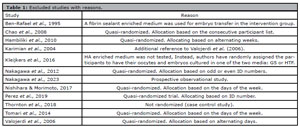
Table 1. Excluded studies with reasons.
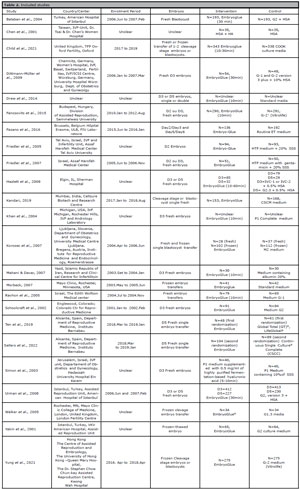
Table 2. Included studies
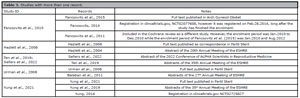
Table 3. Studies with more than one record.
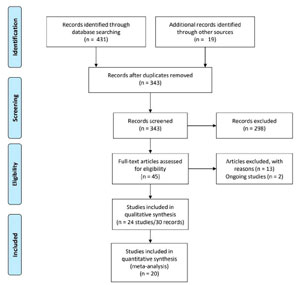
Figure 1. Search results.
We extracted data from a previously published systematic review (Heymann et al., 2022) for three studies: all data for 2 studies (Korosec et al., 2007) and only data for live birth for the other study . We were not able to extract data from the outcomes of interest from 4 studies (Chen et al., 2001; Khan et al., 2004; Drew et al., 2014; Fasano et al., 2016) therefore, we included 20 studies in the quantitative analysis.
Risk of bias results
The risk of bias assessment of the 24 included studies is reported on Table 4. One study (Yung et al., 2021) was considered to have low risk of bias and we have some concerns regarding the risk of bias for another study (Hazlett et al., 2008). The remaining 22 studies were deemed to be at high risk of bias.
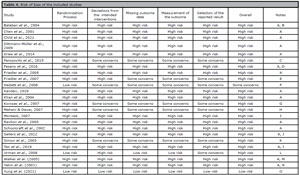
Table 4. Risk of bias of the included studies.
Quantitative analysis
The results for live births are presented in Figure 2a. A total of 11 studies were included in this analysis; the total number of participants allocated to the HA-enriched medium was 2,026 compared to 2,037 who were allocated to the standard transfer medium, encompassing 803 and 697 live births, respectively. The relative risk (RR) was 1.14 (95% CI=0.99-1.31), p=0.07. We observed a substantial heterogeneity, with I2=54%. Sensitivity analysis, including only the two studies not considered to be at high risk of bias (Figure 2b), resulted in a RR=1.06 (95% CI=0.85-1.31), p=0.62, with low heterogeneity (I2=0%). We did not use ongoing pregnancy as a surrogate outcome.
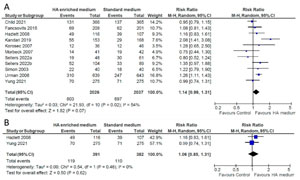
Figure 2. Results for live birth considering all the included studies (A) and only those not considered to be at high risk of bias (B).
The results for clinical pregnancy are presented in Figure 3a. Only one study included in the quantitative analysis did not report clinical pregnancy but reported live birth (Child et al., 2021). A total of 19 studies were included in this analysis; the total number of participants allocated to the HA-enriched medium was 2,452, compared to 2,450 who were allocated to the standard transfer medium, encompassing 1,149 and 985 clinical pregnancies, respectively. The RR was 1.17 (95% CI=1.05-1.29, p=0.004. We observed a substantial heterogeneity, with I2=50%. Sensitivity analysis, including only the two studies not considered to be at high risk of bias (Figure 3b), resulted in a RR=1.05 (95% CI=0.87-1.26), p=0.53, with low heterogeneity (I2=0%).
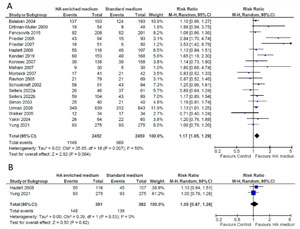
Figure 3. Results for clinical pregnancy considering all the included studies (A) and only those not considered to be at high risk of bias (B).
The results for pregnancy loss are presented in Figure 4a. A total of 9 studies were included in this analysis; the total number of clinical pregnancies in participants allocated to the HA-enriched medium was 736, compared to 647 in the standard transfer medium, encompassing 103 and 122 pregnancy losses, respectively. The RR was 0.75 (95% CI=0.55-1.02, p=0.06. We observed a low heterogeneity, with I2=26%. Sensitivity analysis, including only one study not considered to be at high risk of bias (Figure 4b), resulted in a RR=1.05 (95% CI=0.61-1.80), p=0.86.
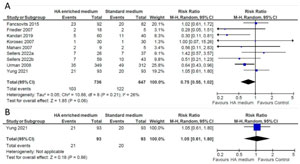
Figure 4. Results for pregnancy loss considering all the included studies (A) and only those not considered to be at high risk of bias (B).
Results from studies not included in the quantitative analysis
Four studies published solely as abstracts were not included in the quantitative analysis: (Chen et al., 2001), (Drew et al., 2014), Fasano et al. (2016), and Khan et al. (2004).(Chen et al., 2001): this study randomized 70 women. The observed results showed no significant difference for positive pregnancy test performed 14 days after the embryo transfer (8/35=23% vs. 5/35=14%, HA enriched medium vs. standard medium, respectively). The authors concluded that there is a trend towards a better pregnancy rate in an HA-enriched medium. Since this study reported only positive pregnancy tests, we could not extract data for the outcomes of interest.(Drew et al., 2014): this study randomized 493 embryo transfers. The observed results showed no significant difference for clinical pregnancy following either single embryo transfer (D3=30.2% vs. 23.3%, D5=44.1% vs. 42.4%, HA enriched medium vs. standard medium, respectively) or double embryo transfer (D3=30.4% vs. 39.7% and D5=44.4% vs. 42.4%). The authors concluded that using an HA-enriched medium resulted in no benefit to reproductive outcomes. We were not able to extract data for quantitative analysis because the total number of participants in each group was not reported.Fasano et al. (2016): this study randomized 372 warming cycles from 253 women. Pregnancy rates per transfer were comparable between groups (29.4% vs. 23.9% p=0.32). Authors concluded that HA enriched medium is as effective as the standard medium. We were not able to extract data for quantitative analysis because authors reported the results for embryo transfer cycles, allowing the same participant to be included repeated times.Khan et al. (2004): this study randomized 169 women aged below 39 years. The ongoing pregnancy rates were comparable between groups (53% vs. 50%). Authors concluded that HA enriched medium does not show any significant improvement when compared to standard medium. We were not able to extract data for quantitative analysis because the total number of participants in each group was not reported.
Ongoing studies
Three ongoing studies were identified. One is being conducted in Abu Dhabi, United Arab Emirates (Nogueira, 2025). The study started on Jan. 2024; the authors estimated that the study will enroll 783 participants and will be completed by Dec. 2025.The other ongoing study is being conducted in Xian, Shaanxi, China (Cai et al., 2025), and it started on Oct. 2024. The authors estimated to enroll 858 participants and plan to complete the study by Sep. 2026.Finally, there is a study been held in Wardha, India (Warhade et al., 2025). There is an estimation to enroll 52 subjects, in the context of recurrent implantation failure. The predicted study completion is by Dec. 2026.
Certainty assessment
The certainty of the evidence is reported in Table 5. The quality of the evidence for live birth, clinical pregnancy and pregnancy loss was judged to be of very low quality. Most of the studies were judged to be at high risk of bias, there was inconsistency among studies, and the estimates were not very precise. Moreover, although some of the published studies have found some benefit of the intervention, the only two studies that were not considered to be at high risk of bias did not show any effect, as well as the four studies that were not included in the quantitative analysis.
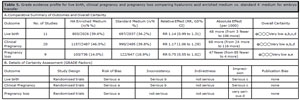
Table 5. Grade evidence profile for live birth, clinical pregnancy and pregnancy loss comparing hyaluronic acid enriched medium vs. standard 4 medium for embryo transfer.
DISCUSSION
This systematic review aimed to evaluate the effectiveness of using an HA-enriched medium for embryo transfer based on the currently available evidence. Due to the limitations of the included studies, inconsistency and imprecision, our level of certainty in the observed estimates is still very low for live births, clinical pregnancies, and pregnancy loss. The quantitative analysis considering all the included studies did not show a significant difference for live birth (RR=1.14, 95% CI=0.99-1.31) and pregnancy loss (RR=0.75, 95%CI=0.55-1.02), although there was a small increase in clinical pregnancies (RR=1.17, 95%CI=1.05-1.29). When analyzing only the two studies not considered to be at high risk of bias, none of the results were very similar for the live birth (RR=1.06, 95%CI=0.85-1.31), clinical pregnancy (RR=1.05, 95%CI=0.87-1.26), and pregnancy loss (RR=1.05, 95%CI=0.61-1.80). The four studies that were not included in the quantitative analysis also reported no benefit of the intervention.
Although the lists of included studies were very similar, there were some differences between this review and the previously published Cochrane review (Heymann et al., 2022). Firstly, two studies (Ten et al., 2019; Sellers et al., 2022) were included that were not previously available. Additionally, data of clinical pregnancy were analyzed from Walker et al. (2005), that was included in the previous review, but authors reported that they failed to extract data because the study had reported the outcomes as percentage alone. However, authors have reported that there were 34 participants in each group, allowing to ultimately extract the data.
Moreover, the study of Fancsovits et al. (2011) was not included in our review because it comprises only a preliminary report of the complete study (Fancsovits et al., 2015): the enrolment period reported by Fancsovits et al. (2011) was Jan. 2010 to Dec. 2010 while the enrolment period of Fancsovits et al. (2015) was Jan. 2010 to Aug. 2012. By including Fancsovits et al. (2011), the previous review counted the results for the same participant more than once, which is not appropriate.
In addition, we did not include one study where the comparison was not HA-enriched medium vs. standard medium for embryo transfer (Kleijkers et al., 2016). In this study, participants were randomly assigned to have their oocytes and embryos cultured in one of the two media: G5 (Vitrolife, Goteborg, Sweden) and HTF (Lonza Verviers, Belgium). Although the G5 medium has HA in its composition and the HTF medium does not have HA, we do not believe the comparison is similar to using the HA-enriched medium only for embryo transfer. In this study, the authors compare two different standard media for the whole process, including embryo culture. Additionally, the concentration of HA in G5 (0.125 mg/mL) is very different from the HA-enriched medium for embryo transfer (0.5 mg/mL).
Finally, there is only one registered trial that will include only euploid blastocysts (19). It will be essential to follow up if the use of HA-enriched medium will influence treatment results within the group of euploid embryos.
Although the differences in the included studies were small, there is a crucial difference in the conclusions between the two reviews. In the previously published Cochrane review (Heymann et al., 2022), authors have concluded that moderate-quality evidence shows improved clinical pregnancy and live birth rates with the addition of HA as an adherence compound in embryo transfer media. In the present review, we observed a very low level of certainty for the three outcomes, which were live birth, clinical pregnancy, and pregnancy loss. Moreover, based on the results of the only study judged to be at low risk of bias, we believe that there is no clinically relevant difference between using an HA-enriched medium or a standard medium for embryo transfer. Therefore, it is also suggested that we should wait for the results of the three extensive ongoing studies before making further recommendations for clinical practice and future research.
ACKNOWLEDGEMENTS
This research received no specific grant from any funding agency in the public, commercial, or not-for-profit sectors.
REFERENCES
Adeniyi T, Horne G, Ruane PT, Brison DR, Roberts SA. Clinical efficacy of hyaluronate-containing embryo transfer medium in IVF/ICSI treatment cycles: a cohort study. Hum Reprod Open. 2021;2021:hoab004. PMID: 33718621 DOI: 10.1093/hropen/hoab004 Medline
Ben-Rafael Z, Ashkenazi J, Shelef M, Farhi J, Voliovitch I, Feldberg D, Orvieto R. The use of fibrin sealant in in vitro fertilization and embryo transfer. Int J Fertil Menopausal Stud. 1995;40:303-6. PMID: 8748919. Medline
Braakhekke M, Kamphuis EI, Dancet EA, Mol F, Veen F van der, Mol BW. Ongoing pregnancy qualifies best as the primary outcome measure of choice in trials in reproductive medicine: an opinion paper. Fertil Steril. 2014;101:1203-4. PMID: 24786739 DOI: 10.1016/j.fertnstert.2014.03.047 Medline
Cai H, Xu D, Wang Z, Huang B, Xue X, Bai H, Man Y, Lei D, Wu Q, Ni Y, Lei J, Shi J. Efficacy and safety of hyaluronic acid-enriched transfer medium in women undergoing single blastocyst transfer: a study protocol for a multicentre randomised controlled trial. BMJ Open. 2025;15:e104571. PMID: 41263844 DOI: 10.1136/bmjopen-2025-104571 Medline
Cowman MK, Schmidt TA, Raghavan P, Stecco A. Viscoelastic Properties of Hyaluronan in Physiological Conditions. F1000Res. 2015;4:622. PMID: 26594344 DOI: 10.12688/f1000research.6885.1 Medline
European IVF Monitoring Consortium (EIM) for the European Society of Human Reproduction and Embryology (ESHRE); Smeenk J, Wyns C, De Geyter C, Kupka M, Bergh C, Cuevas Saiz I, De Neubourg D, Rezabek K, Tandler-Schneider A, Rugescu I, Goossens V. ART in Europe, 2019: results generated from European registries by ESHRE†. Hum Reprod. 2023;38:2321-38. PMID: 37847771 DOI: 10.1093/humrep/dead197 Medline
Fancsovits P, Lehner A, Murber A, Kaszas Z, Rigo J, Urbancsek J. Effect of hyaluronan-enriched embryo transfer medium on IVF outcome: a prospective randomized clinical trial. Arch Gynecol Obstet. 2015;291:1173-9. PMID: 25398398 DOI: 10.1007/s00404-014-3541-9 Medline
Friedler S, Schachter M, Strassburger D, Esther K, Ron El R, Raziel A. A randomized clinical trial comparing recombinant hyaluronan/recombinant albumin versus human tubal fluid for cleavage stage embryo transfer in patients with multiple IVF-embryo transfer failure. Hum Reprod. 2007;22:2444-8. PMID: 17644629 DOI: 10.1093/humrep/dem220 Medline
Hambiliki F, Ljunger E, Karlström PO, Stavreus-Evers A. Hyaluronan-enriched transfer medium in cleavage-stage frozen-thawed embryo transfers increases implantation rate without improvement of delivery rate. Fertil Steril. 2010;94:1669-73. PMID: 19939373 DOI: https://doi.org/10.1016/j.fertnstert.2009.10.019 Medline
Hazlett WD, Meyer LR, Nasta TE, Mangan PA, Karande VC. Impact of EmbryoGlue as the embryo transfer medium. Fertil Steril. 2008;90:214-6. PMID: 17765233 DOI: 10.1016/j.fertnstert.2007.05.063 Medline
Heymann D, Vidal L, Or Y, Shoham Z. Hyaluronic acid in embryo transfer media for assisted reproductive technologies. Cochrane Database Syst Rev. 2020;9:CD007421. PMID: 32876946 DOI: https://doi.org/10.1002/14651858.CD007421.pub4 Medline
Heymann D, Vidal L, Shoham Z, Kostova E, Showell M, Or Y. The effect of hyaluronic acid in embryo transfer media in donor oocyte cycles and autologous oocyte cycles: a systematic review and meta-analysis. Hum Reprod. 2022;37(7):1451-69. PMID: 32876946 DOI: 10.1002/14651858.CD007421.pub4 Medline
Holt-Kentwell A, Ghosh J, Devall A, Coomarasamy A, Dhillon-Smith RK. Evaluating interventions and adjuncts to optimize pregnancy outcomes in subfertile women: an overview review. Hum Reprod Update. 2022;28:583-600. PMID: 35137098 DOI: 10.1093/humupd/dmac001 Medline
Kleijkers SH, Mantikou E, Slappendel E, Consten D, van Echten-Arends J, Wetzels AM, van Wely M, Smits LJ, van Montfoort AP, Repping S, Dumoulin JC, Mastenbroek S. Influence of embryo culture medium (G5 and HTF) on pregnancy and perinatal outcome after IVF: a multicenter RCT. Hum Reprod. 2016;31:2219-30. PMID: 27554441. DOI: 10.1093/humrep/dew156 Medline
Korosec S, Virant-Klun I, Tomazevic T, Zech NH, Meden-Vrtovec H. Single fresh and frozen-thawed blastocyst transfer using hyaluronan-rich transfer medium. Reprod Biomed Online. 2007;15:701-7. PMID: 18062869 DOI: 10.1016/s1472-6483(10)60538-x Medline
Lensen S, Hammarberg K, Polyakov A, Wilkinson J, Whyte S, Peate M, Hickey M. How common is add-on use and how do patients decide whether to use them? A national survey of IVF patients. Hum Reprod. 2021;36:1854-61. PMID: 33942073 DOI: 10.1093/humrep/deab098. Medline
Mahani IM, Davar R. Hyaluronic acid versus albumin in human embryo transfer medium. East Mediterr Health J. 2007;13:876-80. PMID: 17955771. Medline
Marei WFA, Wathes DC, Raheem KA, Mohey-Elsaeed O, Ghafari F, Fouladi-Nashta AA. Influence of hyaluronan on endometrial receptivity and embryo attachment in sheep. Reprod Fertil Dev. 2017;29:1763-73. PMID: 27725075 DOI: https://doi.org/10.1071/RD16232 Medline
Nakagawa K, Horikawa T, Orita Y, Yamashiro E, Watanabe H, Shirai A, Ogata S, Kataoka H, Kuroda K, Takamizawa S, Sugiyama R. Hyaluronan-enriched transfer medium (HETM) can improve the implantation rate in morphologically poor euploid blastocyst transfer. Arch Gynecol Obstet. 2023;308:611-9. PMID: 37256356 DOI: 10.1007/s00404-023-07083-9 Medline
Nakagawa K, Takahashi C, Nishi Y, Jyuen H, Sugiyama R, Kuribayashi Y, Sugiyama R. Hyaluronan-enriched transfer medium improves outcome in patients with multiple embryo transfer failures. J Assist Reprod Genet. 2012;29:679-85. PMID: 22527894 DOI: 10.1007/s10815-012-9758-2 Medline
Nishihara T, Morimoto Y. Evaluation of transfer media containing different concentrations of hyaluronan for human in vitro fertilization. Reprod Med Biol. 2017;16:349-53. PMID: 29259488 DOI: 10.1002/rmb2.12051 Medline
Rodriguez-Martinez H, Tienthai P, Atikuzzaman M, Vicente-Carrillo A, Rubér M, Alvarez-Rodriguez M. The ubiquitous hyaluronan: Functionally implicated in the oviduct? Theriogenology. 2016;86:182-6. PMID: 26768539 DOI: 10.1016/j.theriogenology.2015.11.025 Medline
Schünemann HJ, Brennan S, Akl EA, Hultcrantz M, Alonso-Coello P, Xia J, Davoli M, Rojas MX, Meerpohl JJ, Flottorp S, Guyatt G, Mustafa RA, Langendam M, Dahm P. The development methods of official GRADE articles and requirements for claiming the use of GRADE - A statement by the GRADE guidance group. J Clin Epidemiol 2023;159:79-84. PMID: 37211327. DOI: 10.1016/j.jclinepi.2023.05.010 Medline
Simon A, Safran A, Revel A, Aizenman E, Reubinoff B, Porat-Katz A, Lewin A, Laufer N. Hyaluronic acid can successfully replace albumin as the sole macromolecule in a human embryo transfer medium. Fertil Steril. 2003;79:1434-8. PMID: 12798894 DOI: 10.1016/s0015-0282(03)00349-2 Medline
Tyler B, Walford H, Tamblyn J, Keay SD, Mavrelos D, Yasmin E, Al Wattar BH. Interventions to optimize embryo transfer in women undergoing assisted conception: a comprehensive systematic review and meta-analyses. Hum Reprod Update. 2022;28:480-500. PMID: 35325124 DOI: 10.1093/humupd/dmac009 Medline
Urman B, Yakin K, Ata B, Isiklar A, Balaban B. Effect of hyaluronan-enriched transfer medium on implantation and pregnancy rates after day 3 and day 5 embryo transfers: a prospective randomized study. Fertil Steril. 2008;90:604-12. PMID: 17936283 DOI: 10.1016/j.fertnstert.2007.07.1294 Medline
Valojerdi MR, Karimian L, Yazdi PE, Gilani MAS, Madani T, Baghestani AR. Efficacy of a human embryo transfer medium: a prospective, randomized clinical trial study. J Assist Reprod Genet 2006;23:207-12. PMID: 16786421 DOI: 10.1007/s10815-006-9031-7 Medline
Warhade A, More A, Choudhary N, Kalaskar G, Warhade P. Association of Hyaluronic Acid-Enriched Transfer Medium (HETM) with Clinical Pregnancy Outcome in Women Undergoing Frozen-Thawed Embryo Transfer (FET). J Pharm Bioallied Sci. 2025;17:S948-S951. PMID: 40510953 DOI: 10.4103/jpbs.jpbs_456_25 Medline
Yung SSF, Lai SF, Lam MT, Lui EMW, Ko JKY, Li HWR, Wong JYY, Lau EYL, Yeung WSB, Ng EHY. Hyaluronic acid-enriched transfer medium for frozen embryo transfer: a randomized, double-blind, controlled trial. Fertil Steril 2021;116:1001-9. PMID: 33845988 DOI: 10.1016/j.fertnstert.2021.02.015 Medline