JBRA Assist. Reprod. 2011;15(3):22-25
ARTIGO ORIGINAL
10.5935/1518-0557.2011.15.3.05
Locus at chromosome 19 positively influences the number of retrieved oocytes in stimulated cycles
Locus no cromossomo 19 influencia positivamente o número de oócitos recuperados em ciclos estimulados
aSapientiae Institute - Educational and Research Centre in Assisted Reproduction Rua Vieira Maciel, 62. São Paulo, SP - Brazil, Zip: 04203-040, Telephone: 55 11 3018-3488
bFertility - Assisted Fertilization Centre, Av. Brigadeiro Luis, 4545. São Paulo, SP - Brazil, Zip: 01401-002, Telephone: 55 11 3018-8181
cRDO - Medical Diagnosis, Av. Brasil, 1150. São Paulo, SP - Brazil. Zip: 01430-001
dDepartment of Gynaecology and Obstetrics - Botucatu Medical, School/UNESP - Distrito de Rubião Junior. Botucatu, SPBrazil. Zip: 18618-970
RESUMO
Objetivo: Avaliar se os loci associados com a variação da idade normal da menopausa e menopausa precoce podem explicar a má resposta ao estimulo ovariano controlado (EOC).
Métodos: Setenta e uma pacientes, com idade ≤ 35 anos, submetidas à injeção intracitoplasmática de espermatozóides foram testadas para três recém identificadas variantes genéticas associadas com a variação normal na idade da menopausa e a menopausa precoce. As pacientes foram divididas em dois grupos: pobre respondedoras (grupo PR, n = 21) e normo-respondedoras (grupo NR, n = 50). A influência da freqüência do alelo de risco sobre a resposta ao EOC foi avaliada. Modelos de regressão logística foram usados.
Resultados: Não houve diferença significativa na incidência das variantes genéticas entre os grupos NR e PR. O alelo de risco para a variante de cromossomo 19 (rs4806660) demonstrou um efeito protetor. A presença de um alelo de risco, seja em homozigose ou heterozigose, foi associado com um aumento da resposta ao EOC, resultando em um maior número de folículos (Coef: 2.54, P = 0,041) e oócitos recuperados (Coef: 1,41, P = 0,041 ).
Conclusões: as variantes genéticas rs244715, rs9379896 e rs4806660 não são fatores de risco para a má resposta ovariana. Em vez disso, a rs4806660 está associada com maior número de folículos e oócitos recuperados. Pode-se supor que a rs4806660 está associada a um aumento da resposta ao estímulo com gonadotrofinas.
Palavras-chave: ténicas de reprodução assistida, marcadores biológicos, estímulo ovariano controlado, injeção intracitoplasmática de espermatozóide, polimorfismos de nucleotídeo único.
ABSTRACT
Objective: To evaluate if identified loci associated with normal age of menopause variation and early menopause can account for the poor response to controlled ovarian stimulation.
Methods: A total of 71 patients, with age ≤ 35 years old, undergoing intracytoplasmic sperm injection were tested for three of the four newly identified genetic variants associated with normal variation in menopausal age and early menopause. Patients were divided into two groups: poor responder group (PR group, n=21) and normoresponder group (NR group, n=50). The influence of risk allele frequency on the response to controlled ovarian stimulation (COS) was evaluated. Logistic regression models were used.
Results: There was no significant difference in the incidence of the genetic variants between NR and PR group. The risk allele for chromosome 19 variant (rs4806660) demonstrated a protective effect. The presence of a risk allele, either in homozygosis or in heterozygosis, was associated with an increased response to COS, resulting in an elevated number of follicles (Coef: 2.54, P= 0.041) and retrieved oocytes (Coef: 1.41, P= 0.041).
Conclusions: Genetic variants rs244715, rs9379896 and rs4806660 are not risk factors for poor ovarian response. Instead, rs4806660 is associated with higher number of follicles and retrieved oocytes. It could be hypothesized that rs4806660 is associated with an increased response to gonadotrophin stimulus.
Key words: assisted reproduction techniques, biological markers, controlled ovarian stimulation, intracytoplasmic sperm injection, single nucleotide polymorphisms.
INTRODUCTION
Women have been postponing childbirth in recent years. This tendency has consequently led to an increase in age-related infertility, subsequently increasing the utilization of assisted reproductive technologies (ART) (Broekmans et al., 2009)B.
Premature reduction of ovarian follicle number has been demonstrated to significantly affect the success of in vitro fertilization (IVF), despite the chronological women age (Templeton et al., 1996), and it is one of the most difficult challenges to those carrying out ART (Setti et al., DOI 10.1007/s10815-010-9516-2).
Despite advances in assisted conception, it has been estimated that among patients undergoing IVF treatment the prevalence of poor ovarian response is 9-24% (Keay et al., 1997). Therefore, poor ovarian response to gonadotrophin stimulation remains a significant problem in modern fertility treatment, especially, in vitro fertilization (IVF) where a large number of oocytes is desirable.
Poor response phenomenon was first described by Garcia et al. (Garcia et al., 1983), who defined this patients as having a peak E2 level of <300pg/mL after standard stimulation with human menopausal gonadotrophin. Poor responders have been defined on the basis of mature oocytes (Lashen et al., 1999), elevated early follicular phase of FSH peak (Esposito et al., 2002), number of basal antral follicle (Loverro et al., 2003), number of follicle at the end of ovarian stimulation (Ulug et al., 2003), plasma oestradiol concentration (Surrey and Schoolcraft, 2000) or number of oocytes retrieved (Kumbak et al., 2009).
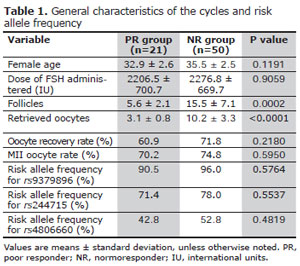
Table 1. General characteristics of the cycles and risk allele frequency
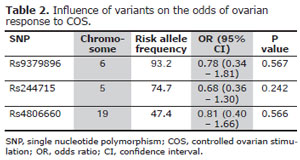
Table 2. Influence of variants on the odds of ovarian response to COS.
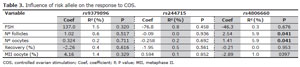
Table 3. Influence of risk allele on the response to COS.
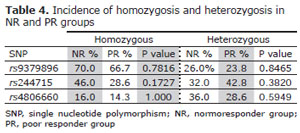
Table 4. Incidence of homozygosis and heterozygosis in NR and PR groups Homozygous Heterozygous
The current methods for predicting age at menopause are reliant on detecting the peri-menopausal changes in oocyte number and are therefore poor long-range predictors (Lambalk et al., 2009). Hormonal serum levels alter prior to menopause, including follicle-stimulating hormone (FSH), antimullerian hormone (AMH) and inhibin B. Of these, AMH is the best long-term predictor, with levels decreasing approximately 10 years before menopause (van Rooij et al., 2004; Onland-Moret et al., 2005). In addition to endocrine markers, other markers of ovarian reserve are antral follicle count and ovarian volume(Lambalk et al., 2009).
Genetic predictors of menopausal age have the obvious advantage of being present from birth and thus have the potential to offer women advice about their reproductive lifespan from an early age, enabling them to make informed reproductive choices. Estimations of heritability in menopausal age range from 31 to 87% (Torgerson et al., 1997; Snieder et al., 1998; de Bruin et al., 2001; Murabito et al., 2005; van Asselt et al., 2006).
The most common type of genetic variation is single nucleotide polymorphisms (SNPs), which are small genetic changes, or variations, that occur every 100 to 300 bases along the 3-billion-base human genome. The genetic code is specified by the four nucleotide “letters” A (adenine), C (cytosine), T (thymine), and G (guanine). The SNP variation occurs when a single nucleotide replaces one of the other three nucleotide letters. On average, SNPs occur in the human population more than 1 percent of the time. Many SNPs have no effect on cell function, but others could predispose people to disease or influence their response to a drug (He et al., 2010; Murray et al., 2010). Recent genome-wide association studies (GWAS) have been successful in identifying genetic loci for many complex traits. Two independent studies identified loci associated with normal age of menopause variation, on chromosomes 5, 6, 19 and 20 (Stolk et al., 2009; He et al., 2010). Moreover, Murray et al. (2010) demonstrated that the four variants increased the odds of having early menopause. However, whether these variants can account for the poor response to controlled ovarian stimulation in IVF patients is still to be elucidated, and therefore was the aim of this study.
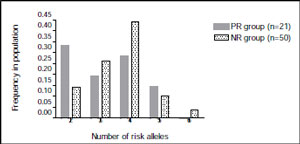
Figure 1. Number of risk alleles for all three SNPs in PR and NR group SNP, single nucleotide polymorphism; PR, poor responder; NR, normoresponder
METHODS
A total of 71 patients undergoing intracytoplasmic sperm injection (ICSI) were included in this study. All patients were 35 years old or younger. We tested three of the four newly identified genetic variants associated with normal variation in menopausal age and early menopause (rs244715, rs9379896 and rs4806660 in chromosomes 5, 6 and 19, respectively) in our patients.
All the patients had a blood sample collected prior to the beginning of infertility treatment. Blood samples were centrifuged and the white cell buttons were removed, followed by cryopreservation under liquid nitrogen. Upon thawing cell lysis were performed to release DNA.
In the first analysis patients were divided into two groups according to the response to COS: poor responder group (PR group, patients with number of retrieved oocytes ≤ 4, n=21) and normoresponder group (NR group, patients with number of retrieved oocytes from 5 to 15, n=50). The incidence of risk alleles were compared between the groups. In a further analysis, the influence of individual risk allele frequency on the response to COS (total dose of FSH administered, number of follicles, number of retrieved oocytes, oocyte recovery rate and metaphase II (MII) oocyte rate) was evaluated.
The results were expressed as mean ± standard deviation for numeric variables, while proportions (%) were used for categorical variables. Mean values were compared using a Student’s t parametric test. Linear regression models were used to determine the effects of the risk allele for each SNP on the variables associated with COS response. Results are expressed as regression coefficients (Coef), R2 and P values.
The influence of risk allele frequency on the odds of being a case was assessed through binary logistic regression and results are expressed as odds ratios (OR), 95% confidence interval (CI) and P value. Results were considered to be significant at the 5% critical level (p < 0.05). Data analysis was carried out using the Minitab (version 14) Statistical Program.
A written informed consent was obtained, in which patients agreed to share the outcomes of their own cycles for research purposes, and the study was approved by the local Institute review board.
RESULTS
All individuals were successfully genotyped for all three SNPs. The general characteristics of the cycles and risk allele frequency for all SNPs are shown in Table 1.
None of the three variants was a determinant of the odds of being a case (Table 2).
The influence of risk allele on the response to COS (total dose of FSH administered, number of follicles, number of retrieved oocytes, oocyte recovery rate and metaphase II (MII) oocyte rate) is shown in Table 3.
Out of 71 patients, 4 (5.6%) did not possess risk allele for rs9379896 (2 in NR group and 2 in PR group); 17 patients (23.9%) did not possess any risk allele for rs244715 (11 in NR group and 6 in PR group); and 36 patients (15.5%) did not possess any risk allele for rs4806660 (24 in NR group and 12 in PR group).
The incidence of homozygosis and heterozygosis for all variants in both groups is shown in Table 4.
The distribution of combined risk alleles between the groups is shown in Figure 1. When risk alleles for all three SNPs were combined there was no influence of the number of risk alleles on the odds of being in the case group (OR: 0.69, CI: 0.43 - 1.12, P= 0.124).
DISCUSSION
Even though ART relies on a COS for the production of a high number of oocytes, a reasonable percentage of women undergoing IVF do not respond adequately to the stimulus (Keay et al., 1997). The poor response to COS has been associated with premature ovarian failure (Nikolaou et al., 2002). Recently, four loci associated with normal age of menopause variation and early menopause, on chromosomes 5, 6 and 19 and 20, were identified (Stolk et al., 2009; He et al., 2010; Murray et al., 2010). Therefore, we aimed at verifying if three of these four loci were also associated with poor ovarian response in patients undergoing IVF.
Our data suggest that variants associated with normal menopausal age and early menopause are not significant risk factors for poor response to COS in IVF cycles. For all three tested SNPs there was no evidence that the odds of being a PR case, per risk allele, were different from the odds of being a NR case.
Our results demonstrated that the risk allele for chromosome 19 variant (rs4806660) demonstrated a protective effect for poor ovarian response. The presence of a risk allele, either in homozygosis or in heterozygosis, was associated with an increased response to COS, resulting in an elevated number of follicles and retrieved oocytes. Although more than 99% of human DNA sequences are the same, variations in DNA sequence can have a major impact on how humans respond to drugs (Shastry, 2002). Therefore, it could be hypothesized that the genetic variant rs4806660 is associated with an increased response to gonadotrophin stimulus, in Brazilian patients undergoing ART.
Indeed, the results of the different genetic studies on menopausal age show the difficulties in finding genetic loci for this complex trait. When comparing the different types of studies, there is almost no overlap in the genes that are associated with menopausal age (Voorhuis et al., 2010). One major reason for inconsistency in these findings may be differences in ethnicity. Race-specific variation in the distribution of polymorphism has already been dem¬onstrated (Allocco et al., 2007; Barbosa et al., 2010). Indeed, the difficulty, in our country, of correlating any findings with ethnicity has been previously discussed (Pena, 2005). In Brazil, it gets even more complicated by the fact that our population is miscegenated (Ribeiro Junior et al., 2009).
CONCLUSIONS
Genetic variants rs244715, rs9379896 and rs4806660 are not risk factors for poor ovarian response in women undergoing ART. Instead, rs4806660 is associated with higher number of follicles and retrieved oocytes. It could be hypothesized that the genetic variant rs4806660 is associated with an increased response to gonadotrophin stimulus, in Brazilian patients undergoing ART.
Shastry BS. SNP alleles in human disease and evolution. J Hum Genet. 2002;47:561-6.