JBRA Assist. Reprod. 2026 2026;00(0):00-00
ORIGINAL ARTICLE
doi: 10.5935/1518-0557.20260117
The Synergistic Role of Curcumin and L-Carnitine in Mitigating Cryo-preservation-Induced Damage in Human Sperm
1Student Research Committee, Qazvin University of Medical Sciences, Qazvin, Iran
2Cellular and Molecular Research Center, Research Institute for Non-Communicable Diseases, Qazvin University of Medical Sciences, Qazvin, Iran
CONFLICT OF INTERESTS
ABSTRACT
Objective: Sperm cryopreservation serves as a vital technique in assisted reproductive technologies and the preservation of male fertility; however, this process often leads to a marked decline in sperm quality. Using exter-nal antioxidants to counteract the buildup of free radicals during cryopreservation has proven to be an effective ap-proach for improving sperm quality after thawing. This study aimed to evaluate the combined effect of Curcumin and L-carnitine on human sperm motility, viability, mor-phology, DNA integrity, and lipid peroxidation following cryopreservation.
Methods: Forty semen samples from normozoosper-mic men were divided into four groups: control, Curcum-in (20μm), L-carnitine (100μm), and a combination group (Curcumin + L-carnitine). Samples were cryopreserved for one week and subsequently thawed at 37∘C for 5 minutes. Post-thaw analysis included assessment of sperm motility (using CASA), viability (eosin-nigrosin staining), morphol-ogy, DNA fragmentation (TUNEL assay), and malondialde-hyde (MDA) levels (TBARS assay).
Results: Both Curcumin and L-carnitine treatments significantly improved sperm motility and viability com-pared to the control group (p<0.01). The combination group exhibited the highest levels of motility and the low-est levels of MDA and DNA fragmentation, indicating supe-rior protection against oxidative stress and DNA damage. No significant differences were observed in sperm mor-phology across the groups.
Conclusion: Supplementation with Curcumin and L-carnitine during sperm cryopreservation enhances post-thaw sperm quality, particularly improving motility and preserving DNA integrity. Further studies evaluating func-tional outcomes are necessary before clinical application.
Keywords: sperm cryopreservation, antioxidants, Cur-cumin, L-carnitine, DNA integrity
INTRODUCTION
Cryopreservation is a commonly used method to store semen for long periods of time. However, various issues regarding sperm freezing such as reduced viability and motility of sperm, ice crystal formation acrosome damage, short lifespan, cold shock, and membrane damage have been observed (Ozimic et al., 2023). Sperm cells have a unique cellular structure that includes a plasma membrane, many mitochondria, low cytoplasmic content, and low levels of antioxidants in the cytoplasm (Dutta et al., 2019). Antioxidants are crucial for protecting against oxidative stress caused by free radicals, and sperm’s protective antioxidant systems come from the cytoplasm and its components (Bansal & Bilaspuri, 2011). However, during the final stages of differentiation, sperm lose much of their cytoplasm and cytoplasmic components containing antioxidant molecules (Bucak et al., 2007). Additionally, during cryopreservasion sperm membrane, which is made of unsaturated fatty acids, is highly susceptible to oxidative stress (Martínez-Soto et al., 2013; Hezavehei et al., 2021; Aitken & Drevet, 2020). Thus, damage to the plasma membrane of sperm cells reduces both fertilization capacity and overall sperm quality (Du Plessis et al., 2015; Pintus & Ros-Santaella, 2021). Therefore, adding antioxidants to cryosolution is necessary to balance reactive oxygen species (ROS) and improve the fertilizing ability of cryopreserved human semen.
L-carnitine is a type of antioxidant that hinders the process of lipid peroxidation and has an impact on the production of sperm by encouraging the absorption of glucose by Sertoli cells (Mateus et al., 2023). It also provides the main source of energy for motility of the sperm, enhances the lifespan of sperm by stabilizing the plasma membrane and decrease the likelihood of spontaneous acrosome reaction (Gülçin, 2006). Curcumin, another antioxidant, possesses potent free radical scavenging properties that effectively prevent lipid peroxidation. Curcumin, another antioxidant, possesses potent free radical scavenging properties that effectively prevent lipid peroxidation. It has also been shown to protect thermal shock and oxidative damage during the process of cryopreservation. One of the key mechanisms by which Curcumin exerts its antioxidant effects is through the provision of hydrogen atoms to lipid peroxyl radicals via the β-diketone moiety present in its chemical structure (Chandra et al., 2007).
The primary objective of this study was to assess the effects of Curcumin and nitine supplementation on sperm motility, viability, and DNA integrity in human sperm cryopreservation.
MATERIALS AND METHODS
Sample collection
Semen samples were collected from forty healthy men aged 20-40 years at the Infertility Treatment Center of Qazvin University of Medical Sciences, Iran. Sample collection was performed by masturbation into sterile containers following a sexual abstinence period of 3-4 days. All samples were evaluated in accordance with the World Health Organization (WHO) guidelines for the assessment of normozoospermic parameters. Individuals with a history of cryptorchidism, varicocele, systemic disorders, accessory gland infections, smoking, alcohol consumption, or recent hormonal therapy were excluded from the study. The research protocol was reviewed and approved by the Ethics Committee of Qazvin University of Medical Sciences (IR.QOM.REC.1400.005), and written informed consent was obtained from all participants in compliance with the principles of the Declaration of Helsinki.
Sample preparation
The 40 semen samples were each divided into four parts and assigned to one of four groups: control, Curcumin (CUR, 20μm), L-carnitine (LC, 100μm), and a combination of CUR + LC. Concentrations were based on preliminary viability and motility tests.
The process of freezing and thawing sperm
After semen samples were prepared and supplemented according to their assigned groups (control, Curcumin, L-carnitine, or combination), each sample was gradually diluted in a commercial cryoprotectant medium (Sperm Freeze™, Origio, Denmark). This medium contains 15% glycerol, HEPES buffer, and human serum albumin (HSA), and was mixed with semen at a 1:1 ratio. The mixture was allowed to equilibrate at room temperature (22-25°C) for 30 minutes to enable adequate permeation of cryoprotectants. Following equilibration, the samples were loaded into 0.5 mL cryovials, sealed, and then placed 10-15 cm above the surface of liquid nitrogen to expose them to nitrogen vapour phase for 15 minutes, achieving a controlled slow cooling rate. After this initial cooling, cryovials were plunged into liquid nitrogen (-196°C) and stored for one week
Sperm Morphology Assessment
Sperm morphology was evaluated to determine the percentage of structurally normal spermatozoa. Thin smears were prepared from each semen sample, air-dried, and fixed with methanol. Slides were stained using eosin-nigrosin staining, consistent with the fifth edition of the World Health Organization laboratory manual (World Health Organization, 2010). The stained slides were then examined under a light microscope at 400× magnification. Each sperm cell was assessed for morphological abnormalities, including defects in the head (tapered, amorphous, double-headed), midpiece (irregular, thickened), and tail (coiled, short, duplicated). A total of at least 200 spermatozoa were evaluated per sample, and the percentage of morphologically normal sperm was calculated and recorded.
Sperm motility assesment
Sperm motility was evaluated using a computer-assisted sperm analysis (CASA) system to ensure standardized and objective measurements. A 10µL aliquot of each semen sample was placed into a pre-warmed Makler chamber maintained at 37°C. The motility analysis was performed using the IVOS II CASA system (Hamilton Thorne, USA) attached to a phase-contrast microscope at 400× magnification. Motility was classified into three categories based on WHO guidelines: Progressive motility, Non-progressive motility, Immotility. At least ten different microscopic fields were assessed per sample, and a minimum of 200 spermatozoa were analyzed. The percentage of progressively motile sperm was recorded as the primary outcome for motility evaluation.
Sperm Viability Assessment
Sperm viability was assessed using the eosin-nigrosin staining method, which distinguishes live from dead spermatozoa based on membrane integrity. A 50µL aliquot of sperm suspension was mixed with 25µL of 0.5% eosin Y solution and allowed to stand for 30 seconds. Subsequently, 25µL of nigrosin solution was added to the mixture. A thin smear was then prepared on a clean glass microscope slide, air-dried, and examined under a light microscope at 1000× magnification using oil immersion. Live spermatozoa with intact plasma membranes, excluded the eosin stain and appeared colorless or faintly stained, whereas dead spermatozoa, with compromised membranes, took up the stain and appeared pink or red. A minimum of 200 sperm cells per sample were counted across randomly selected microscopic fields, and the percentage of viable (unstained) sperm was recorded.
Assessment of Lipid Peroxidation (MDA Quanti-fication)
Lipid peroxidation was determined by quantifying malondialdehyde (MDA) levels through the thiobarbituric acid reactive substances (TBARS) method. In this assay, 1 mL of semen was combined with 1 mL of butylated hydroxytoluene (BHT), 1 mL of ethylenediaminetetraacetic acid (EDTA), and 2 mL of trichloroacetic acid (TCA). The resulting mixture was centrifuged at 1200 rpm for 15 minutes. After centrifugation, 1 mL of the clear supernatant was transferred into a clean microtube and mixed with 1 mL of TBA reagent. The tubes were tightly closed and incubated in a water bath at 95°C for 15 minutes to facilitate the reaction. After heating, samples were cooled at room temperature for 5 to 10 minutes. Finally, 1 mL of the reaction mixture was placed into a cuvette, and absorbance was recorded at 532 nm using a spectrophotometer.
Sperm DNA fragmentation
DNA fragmentation in spermatozoa was evaluated using the TUNEL (Terminal deoxynucleotidyl transferase dUTP Nick-End Labeling) assay, following the protocol provided with the In Situ Cell Death Detection Kit (Roche Diagnostics, Germany). For each sample, 20µL of sperm suspension was placed on a clean microscope slide and fixed with 4% paraformaldehyde for 1 hour at room temperature. After fixation, slides were washed with phosphate-buffered saline (PBS) and air-dried. The cells were then permeabilized using a solution containing 0.1% Triton X-100 and 0.1% sodium citrate for 2 minutes at 4°C. The TUNEL reaction mixture-consisting of 5µL of terminal deoxynucleotidyl transferase (TdT) enzyme solution and 45µL of fluorescein-labeled nucleotide mix-was added to each slide. Slides were incubated for 1 hour at 37°C in a humidified chamber and protected from light. After incubation, slides were stained with DAPI (4′,6-diamidino-2-phenylindole) for 5 minutes to visualize total sperm nuclei. Fluorescent signals were then observed using a Nikon Eclipse E600 fluorescence microscope equipped with a 330-380 nm bandpass filter and a 420 nm long-pass emission filter. Sperm nuclei emitting green fluorescence were considered to have fragmented DNA (TUNEL-positive). At least 200 spermatozoa per sample were evaluated, and the DNA Fragmentation Index (DFI) was calculated as the percentage of TUNEL-positive sperm.
Statistical Analysis
Statistical analyses were performed using IBM SPSS Statistics for Windows, Version 29.0 (IBM Corp., Armonk, NY, USA). Data are presented as mean±standard deviation (SD). The Shapiro-Wilk test was used to assess the normality of data distribution. Differences among the four experimental groups (Control, Curcumin, L-carnitine, and Combination) were analyzed using one-way analysis of variance (ANOVA). Where significant differences were found, Tukey’s post hoc test was applied for multiple comparisons between groups. A p-value < 0.01 was considered statistically significant.
RESULTS
The effects of Curcumin, L-Carnitine, and their combination on post-thaw sperm quality parameters are summarized in Table 1. There were no significant alterations in sperm morphology among the different experimental groups. The average sperm head dimensions remained consistent across the Control (7.15±0.03μm), Curcumin (7.16±0.03μm), L-carnitine (7.15±0.03μm), and Combination (7.16±0.02μm) groups (p=0.64). All treatments belonged to the same statistical subset (a), indicating that neither the individual nor combined administration of Curcumin and L-carnitine influenced sperm head morphology (Fig. 1a & b).
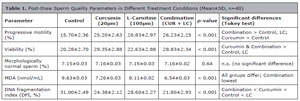
Table 1. Post-thaw Sperm Quality Parameters in Different Treatment Conditions (Mean±SD, n=40)
Footnotes:
*Data are expressed as mean±standard deviation (SD).
†Statistical analysis performed using one-way ANOVA followed by Tukey’s post hoc test.
‡Significance threshold set at p<0.01.§n.s., not significant.
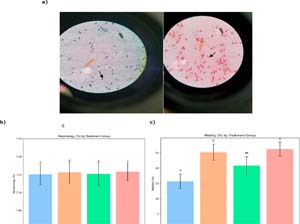
Figure 1. Effects of L-Carnitine and Curcumin on Sperm Morphology and Motility. a) The image illustrates sperm morphology, with a normal spermatozoon identified by the black arrow and an abnormal one by the pink arrow. b) No significant differences were observed in sperm head morphology across groups, with all treatments showing similar head dimensions (p=0.64). c) Sperm motility significantly increased in all treatment groups compared to Control, with the Combination group showing the greatest enhancement (p<0.001). Curcumin and Combination treatments were more effective than L-carnitine, though not significantly different from each other.
Significant improvements in sperm motility were observed following treatment, with the Combination group showing the highest enhancement (26.23±2.25%) compared to Control (15.70±2.36%) (p<0.001). Curcumin also improved motility (25.20±2.63%), and L-carnitine had a moderate effect (20.83±2.97%). Both Combination and Curcumin treatments were significantly more effective than Control and L-carnitine, though no significant difference was found between the two. Notably, the Combination group achieved the greatest overall motility improvement (Fig. 1c).
As shown in Table 1, Significant enhancements in sperm viability were observed in the Curcumin (29.35±2.88%) and Combination (28.83±2.34%) groups compared to Control (20.28±2.70%) (p<0.001). L-carnitine treatment (22.63±2.88%) did not significantly differ from Control. Statistical analysis showed that both Curcumin and the Combination treatments yielded significantly higher viability rates than both Control and L-carnitine groups, while no difference was found between the Curcumin and Combination groups (Fig. 2a).
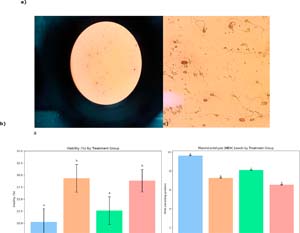
Figure 2. Assessment of sperm viability and oxidative stress following curcumin and L-carnitine treatments. a) Eosin-nigrosin stained human spermatozoa observed under light microscopy (100×). White-headed sperm are viable; red-headed sperm are non-viable. b) Cell viability was significantly enhanced in the combination (CL) group compared to the control and L-carnitine groups (p<0.001), and was comparable to curcumin alone. c) Malondialdehyde (MDA) levels were significantly reduced in the CL group, indicating the greatest protection against lipid peroxidation among all treatments (p<0.001). Different letters indicate statistically significant differences between groups
Levels of MDA, a biomarker of oxidative stress, were significantly reduced in all treated groups relative to the Control (p<0.001). The highest MDA concentration was observed in the Control group (9.63±0.03 nmol/mL), with progressive reductions in L-carnitine (8.11±0.02), Curcumin (7.26±0.03), and Combination (6.54±0.03) groups. Each group differed significantly from the others, with the Combination treatment showing the most pronounced reduction, indicating a potentially synergistic antioxidant effect when Curcumin and L-carnitine were used together (Fig. 2b).
Treatment with Curcumin, L-carnitine, and their combination resulted in a significant decrease in DNA fragmentation compared to the Control group (p<0.001). The Control group had the highest DFI (31.00±2.49%), whereas the Combination group demonstrated the lowest value (21.80±2.93%), followed by Curcumin (24.38±2.12%). L-carnitine produced a moderate yet significant reduction (28.60±2.27%). Pairwise comparisons confirmed that both Curcumin and Combination treatments significantly reduced DFI compared to Control, with the Combination being more effective than L-carnitine alone(Fig. 3A & B).
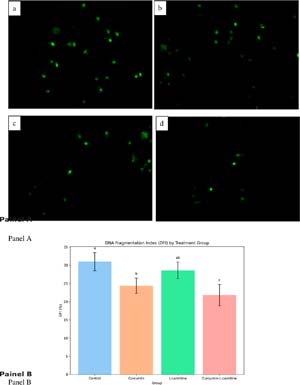
Figure 3. TUNEL assay-based visualization and quantification of sperm DNA fragmentation. (A) Representative fluorescence microscopy images of sperm nuclei from (a) Control, (b) Curcumin-treated, (c) L-carnitine-treated, and (d) Combination (Curcumin + L-carnitine) groups. (B) Comparison of DNA Fragmentation Index (DFI, %) among groups. The Combination treatment resulted in the lowest DFI, significantly reduced compared to Control, L-carnitine, and Curcumin groups (p<0.001), indicating enhanced protection against DNA damage. Curcumin also significantly reduced DFI relative to Control and L-carnitine.
DISCUSSION
Elevated levels of reactive oxygen species (ROS) have been shown to negatively impact sperm quality by affecting sperm structure and function, including motility and DNA fragmentation (Subramanian et al., 2018). In recent years, researchers have investigated the use of oral antioxidants, such as vitamins C and E, zinc, taurine, hypotaurine, and glutathione, to counteract oxidative damage in semen (Asadi et al., 2017). Analysis following cryopreservation has revealed a connection between ROS production, changes in mitochondrial membrane properties, loss of motility, and increased DNA fragmentation in sperm. The freeze-thaw procedure has been found to cause an increase in the production of reactive oxygen species (ROS), leading to oxidative stress (Agarwal et al., 2014). This can be attributed to either an increase in ROS production or a decrease in scavengers. The activation of proteins from the BAX protein family by these ROS molecules results in the release of cytochrome c from mitochondria, triggering caspase activation and ultimately leading to apoptosis. Furthermore, ROS molecules can directly oxidize DNA bases, causing strand breaks and altering the deoxyribose sugar. ROS production may also be associated with a loss of motility (Hussain et al., 2023).
In this study, antioxidant supplementation led to significant improvements in sperm motility in treated group compared to control groups. The highest motility was observed in the sperm groups supplemented with CUR-LC. Moreover, in vitro supplementation of the semen extender with Curcumin and L-carnitine separately increased total and progressive sperm motility compared with the control group.
Preserving sperm DNA integrity is critical for achieving successful fertilization, particularly under conditions of oxidative stress associated with cryopreservation. In our study, the proportion of sperm exhibiting DNA fragmentation doubled in the control group following freezing and thawing. In contrast, a reduction in DNA fragmentation was observed in post-thaw sperm treated with L-carnitine (LC), Curcumin (CUR), and especially the combined LC-CUR formulation. These findings indicate that the inclusion of both antioxidants in the cryopreservation medium can better preserve DNA integrity, with the LC-CUR combination offering the most pronounced protective effect. This has important clinical implications, particularly for individuals with low motility semen, where maintaining chromatin stability is vital. However, it is important to note that while antioxidant supplementation shows promise, caution is warranted. Some studies have reported that certain antioxidants, or their inappropriate combinations, may paradoxically increase DNA damage in spermatozoa (Peña et al., 2019; Szcześniak-Fabiańczyk et al., 2003; Lechowski, 2009).
Inclusion of Curcumin and L-carnitine (LC) at concentrations of 20 and 100 mM, or CUR-LC, in the cryopreservation groups did not yield any significant enhancement in sperm morphology compared with the control group. Despite the benefits observed, sperm morphology did not show significant improvement across treatment groups This is not unexpected, as morphological defects are typically established during spermatogenesis and epididymal maturation and are less susceptible to modulation by post-ejaculatory interventions. Cryopreservation and antioxidant addition may have limited impact on these pre-existing structural anomalies (Milewska et al., 2024; Eberhardt et al., 2023).
Maintaining optimal levels of lipid peroxidation (LPO) and antioxidant enzymes is essential for preserving sperm health. Mammalian spermatozoa are particularly susceptible to oxidative damage due to the high concentration of polyunsaturated fatty acids (PUFAs) in their plasma membranes. Lipid peroxidation is initiated when reactive oxygen species (ROS)-including superoxide anions, hydrogen peroxide, and hydroxyl radicals-oxidize membrane lipids, resulting in structural deterioration and impaired sperm function (Fleming & Thomson, 2025; Dutta et al., 2019; Sengupta et al., 2024).
This oxidative damage can be counteracted by antioxidants, which neutralize ROS and safeguard cellular components. However, the cryopreservation process intensifies oxidative stress, frequently leading to elevated LPO levels. This compromises membrane integrity and adversely affects sperm motility and fertilization capacity. A key biomarker of LPO is malondialdehyde (MDA), a cytotoxic aldehyde formed during PUFA oxidation. Alongside MDA, other lipid peroxidation by-products such as 4-hydroxynonenal (4-HNE), propanol, and hexanol can impair cellular functions by covalently modifying proteins, lipids, and DNA, potentially resulting in cellular dysfunction or apoptosis (Corsaro, 2025). In the present study, we evaluated MDA concentrations as a biomarker of ROS-induced lipid peroxidation in human sperm before and after cryopreservation. Additionally, we examined the effects of Curcumin and L-carnitine-both independently and in combination-on oxidative stress reduction.
Our results demonstrated a significant decrease in MDA levels in antioxidant-treated groups compared to the untreated control. Notably, sperm samples treated with the combined Curcumin and L-carnitine formulation exhibited the lowest MDA concentrations, approximately 68% of those observed in the control group. This finding suggests a synergistic protective effect of the two antioxidants against oxidative damage.
Up until now, there have been many studies validating that application of Curcumin and L-carnitine in cryopreservation for improvement of sperm parameters. The findings of current study are in consistent with those of two previous studies where Curcumin supplementation on frozen semen samples from fertile men showed that adding optimum concentration of Curcumin to the freezing medium improved sperm motility, reduced DNA fragmentation, and decreased intracellular reactive oxygen species (ROS) (Santonastaso et al., 2021). Moreover, Curcumin has shown promising results in protecting dog sperm against damage caused by cryopreservation procedures. It not only improves sperm quality but also protects against reactive oxygen species (ROS) while promoting the expression of the NADPH oxidase 5 (NOX5) gene (Aparnak & Saberivand, 2019). Notably, a recent study by Mansouri-Bahrani et al. (2025) further supports these findings, reporting that Curcumin significantly enhanced post-thaw motility and reduced DNA fragmentation-effects that are in agreement with our results. However, unlike their study, we observed no significant changes in sperm morphology across treatment groups (Mansouri-Bahrani et al., 2025).
One study investigated the effect of an antioxidant supplement containing 1500mg L-carnitine on sperm quality in men with oligoastenoteratozoospermia (OAT). After 3 months, sperm count and morphology significantly improved, suggesting that L-carnitine-rich antioxidants may be beneficial for enhancing semen quality in this group (Nazari et al., 2021). Naderi Noreini et al. (2023) further support these observations by demonstrating that L-carnitine and its derivative, acetylcarnitine, not only improved sperm fertilizing capacity but also reduced ROS production and lipid peroxidation. Notably, acetylcarnitine showed additional benefits in motility and vitality, suggesting that carnitine derivatives may offer superior protection compared with L-carnitine alone. A study of frozen-thawed semen samples from men with asthenozoospermia and normozoospermia demonstrated that incorporating L-carnitine into the cryopreservation medium significantly enhanced post-thaw sperm parameters and reduced cryodamage in both groups when compared with the control group (Zhang et al., 2016). However, unlike studies reporting morphological improvements with antioxidants (Nazari et al., 2021), we observed no significant changes in sperm morphology, likely due to the pre-existing nature of structural defects. Our combination therapy (CUR+LC) outperformed individual treatments in reducing MDA and DNA fragmentation, a synergy also observed by Bucak et al. (2007) with taurine and trehalose in ram sperm.
There are several limitations to the present study. Fresh semen parameters were not recorded for preand post-cryopreservation comparison, which would have strengthened the interpretation of treatment effects. Additionally, only one concentration of Curcumin and L-carnitine was tested, and the freeze-storage period was limited to one week. Long-term effects and dose-response relationships remain to be explored. Future studies should investigate varying antioxidant concentrations, combinations with other cryoprotective agents, and evaluate post-thaw sperm function in fertilization assays. In vivo fertilization outcomes or embryo development data would also provide valuable clinical relevance.
CONCLUSION
In conclusion, the addition of Curcumin and L-carnitine to the freezing medium offers a promising approach to improve the quality of cryopreserved sperm by enhancing motility and viability and reducing oxidative stress and DNA damage. While these results are encouraging, further research is needed to confirm these benefits in clinical settings and to fully understand the functional impact on male fertility.
Acknowledgements:
The authors sincerely thank all the participants who generously contributed their time and samples to this study. Their cooperation and commitment made this research possible. We also extend our appreciation to the staff of the Infertility Treatment Center at Qazvin University of Medical Sciences for their valuable assistance and support throughout the sample collection and analysis process.
REFERENCES
Agarwal A, Virk G, Ong C, du Plessis SS. Effect of oxidative stress on male reproduction. World J Mens Health. 2014;32:1-17. PMID: 24872947 DOI: 10.5534/wjmh.2014.32.1.1
Medline
Aitken RJ, Drevet JR. The Importance of Oxidative Stress in Determining the Functionality of Mammalian Spermatozoa: A Two-Edged Sword. Antioxidants (Basel). 2020;9:111. PMID: 32012712 DOI: 10.3390/antiox9020111
Medline
Aparnak P, Saberivand A. Effects of curcumin on canine semen parameters and expression of NOX5 gene in cryopreserved spermatozoa. Vet Res Forum. 2019;10:221-26. PMID: 31737231 DOI: 10.30466/vrf.2019.76137.2015
Medline
Asadi N, Bahmani M, Kheradmand A, Rafieian-Kopaei M. The Impact of Oxidative Stress on Testicular Function and the Role of Antioxidants in Improving it: A Review. J Clin Diagn Res. 2017;11:IE01-IE05. PMID: 28658802 DOI: 10.7860/JCDR/2017/23927.9886 Erratum in: J Clin Diagn Res. 2025;19:ZZ01. PMID: 28658802 DOI: 10.7860/ JCDR/2025/23927.21426
Medline
Bansal AK, Bilaspuri GS. Impacts of oxidative stress and antioxidants on semen functions. Vet Med Int. 2011;2011:686137. PMID: 20871827 DOI: 10.4061/2011/686137
Medline
Bucak MN, Ateşşahin A, Varışlı O, Yüce A, Tekin N, Akçay A. The influence of trehalose, taurine, cysteamine and hyaluronan on ram semen Microscopic and oxidative stress parameters after freeze-thawing process. Theriogenology. 2007;67:1060-67. PMID: 17280711 DOI: 10.1016/j.theriogenology.2006.12.004
Medline
Chandra AK, Chatterjee A, Ghosh R, Sarkar M. Effect of curcumin on chromium-induced oxidative damage in male reproductive system. Environ Toxicol Pharmacol. 2007;24:160-6. PMID: 21783805 DOI: 10.1016/j. etap.2007.04.009
Medline
Du Plessis SS, Agarwal A, Halabi J, Tvrda E. Contemporary evidence on the physiological role of reactive oxygen species in human sperm function. J Assist Reprod Genet. 2015;32:509-20. PMID: 25646893 DOI: 10.1007/s10815-014-0425-7
Medline
Dutta S, Majzoub A, Agarwal A. Oxidative stress and sperm function: A systematic review on evaluation and management. Arab J Urol. 2019;17:87-97. PMID: 31285919 DOI: 10.1080/2090598X.2019.1599624
Medline
Eberhardt M, Prochowska S, Partyka A, Bielas W, Van Soom A, Olech W, Niżański W. The morphology, morphometry and functionality of fresh and cryopreserved wisent (Bison bonasus) epididymal spermatozoa. Sci Rep. 2023;13:13866. PMID: 37620548 DOI: 10.1038/s41598-023-40798-y
Medline
Fleming SD, Thomson LK. The Oxidative Stress of Human Sperm Cryopreservation. Antioxidants (Basel). 2025;14:402. PMID: 40298642 DOI: 10.3390/antiox14040402
Medline
Gülçin I. Antioxidant and antiradical activities of L-carnitine. Life Sci. 2006;78:803-11. PMID: 16253281. DOI: 10.1016/j. lfs.2005.05.103
Medline
Hezavehei M, Sharafi M, Fathi R, Shahverdi A, Sadighi Gilani MA. Membrane lipid replacement with nano-micelles in human sperm cryopreservation improves post-thaw function and acrosome protein integrity. Reprod Biomed Online. 2021;43:257-68. PMID: 34256996 DOI: 10.1016/j. rbmo.2021.05.005
Medline
Hussain T, Kandeel M, Metwally E, Murtaza G, Kalhoro DH, Yin Y, Tan B, Chughtai MI, Yaseen A, Afzal A, Kalhoro MS. Unraveling the harmful effect of oxidative stress on male fertility: a mechanistic insight. Front Endocrinol (Lausanne). 2023;14:1070692. PMID: 36860366 DOI: 10.3389/ fendo.2023.1070692
Medline
Mansouri-Bahrani B, Kutenaee MA, Heydari Nasrabadi M, Salehi E. Curcumin protects human sperm quality during cryopreservation. Biopreserv Biobank. 2025;23:236-42. PMID: 39929147 DOI: 10.1089/bio.2023.0091
Medline
Martínez-Soto JC, Landeras J, Gadea J. Spermatozoa and seminal plasma fatty acids as predictors of cryopreservation success. Andrology. 2013;1:365-75. PMID: 23596043 DOI: 10.1111/j.2047-2927.2012.00040.x
Medline
Mateus FG, Moreira S, Martins AD, Oliveira PF, Alves MG, Pereira ML. L-carnitine and male fertility: is supplementation beneficial? J Clin Med. 2023;12:5796. PMID: 37762736 DOI: 10.3390/jcm12185796
Medline
Milewska AJ, Kuczyńska A, Pawłowski M, Martynowicz I, Deluga-Białowarczuk S, Sieczyński P, Kuczyński W, Milewski R. The influence of cryopreservation on sperm morphology and its implications in terms of fractions of higher-quality sperm. J Clin Med. 2024;13:7562. PMID: 39768485 DOI: 10.3390/jcm13247562
Medline
Nazari L, Salehpour S, Hosseini S, Allameh F, Jahanmardi F, Azizi E, Ghodssi-Ghassemabadi R, Hashemi T. Effect of antioxidant supplementation containing L-carnitine on semen parameters: a prospective interventional study. JBRA Assist Reprod. 2021;25:76-80. PMID: 32598834 DOI: 10.5935/1518-0557.20200043
Medline
Ozimic S, Ban-Frangez H, Stimpfel M. Sperm cryopreservation today: Approaches, efficiency, and pitfalls. Curr Issues Mol Biol. 2023;45:4716-34. PMID: 37367049 DOI: 10.3390/cimb45060300
Medline
Peña ST Jr, Gummow B, Parker AJ, Paris DBBP. Antioxidant supplementation mitigates DNA damage in boar (Sus scrofa domesticus) spermatozoa induced by tropical summer. PLoS One. 2019;14:e0216143. PMID: 31039205 DOI: 10.1371/journal.pone.0216143
Medline
Pintus E, Ros-Santaella JL. Impact of oxidative stress on male reproduction in domestic and wild animals. Antioxidants. 2021;10:1154. PMID: 34356386 DOI: 10.3390/antiox10071154
Medline
Santonastaso M, Mottola F, Iovine C, Colacurci N, Rocco L. Protective effects of curcumin on the outcome of cryopreservation in human sperm. Reprod Sci. 2021;28:2895-905. PMID: 33861392 DOI: 10.1007/ s43032-021-00572-9
Medline
Sengupta P, Pinggera GM, Calogero AE, Agarwal A. Oxidative stress affects sperm health and fertility-time to apply facts learned at the bench to help the patient: lessons for busy clinicians. Reprod Med Biol. 2024;23:e12598. PMID: 39224210 DOI: 10.1002/rmb2.12598
Medline
Subramanian V, Ravichandran A, Thiagarajan N, Govindarajan M, Dhandayuthapani S, Suresh S. Seminal reactive oxygen species and total antioxidant capacity: correlations with sperm parameters and impact on male infertility. Clin Exp Reprod Med. 2018;45:88-93. PMID: 29984209 DOI: 10.5653/cerm.2018.45.2.88
Medline
Szcześniak-Fabiańczyk B, Bochenek M, Smorag Z, Ryszka F. Effect of antioxidants added to boar semen extender on the semen survival time and sperm chromatin structure. Reprod Biol. 2003;3:81-7. PMID: 14666145
Medline
Zhang W, Li F, Cao H, Li C, Du C, Yao L, Mao H, Lin W. Protective effects of L-carnitine on asthenoand normozoospermic human semen samples during cryopreservation. Zygote. 2016;24:293-300. PMID: 26081351 DOI: 10.1017/S0967199415000180
Medline